
Best overall ad network for VPN and cybersecurity offers in 2026: EZmob, for self-serve access to pop, push, display and native traffic without the vertical restrictions that block most software and privacy offers outright. Best for push notification scale: PropellerAds. Best for native placements: RichAds. Best for popunder volume: Adsterra. Best for keyword-targeted redirects: Zeropark.
- EZmob wins for VPN and cybersecurity offers in 2026 because one self-serve account covers pop, push, display and native traffic.
- PropellerAds leads on push notification scale; RichAds leads on native placements for longer-form security pitches.
- Adsterra covers cheap popunder volume across Tier-2/3 GEOs; Zeropark fits keyword-targeted redirect campaigns.
- Vertical acceptance for VPN, proxy and antivirus offers is the first filter to check before testing budget on any network.
Why this matters
VPN subscriptions, proxy tools and antivirus software sit in a gray zone on most ad networks. Google restricts VPN keywords in a long list of GEOs, and a chunk of self-serve platforms flag "privacy," "proxy" or "security" language for manual review before a single impression fires.
Media buyers running these offers need traffic that clears review fast, plus more than one format — push for urgency copy, native for a longer pitch, popunder for raw volume. EZmob runs all four formats through one self-serve account, which is the main reason it tops this list: you're not juggling four network logins to cover one VPN funnel.
That matters more in 2026 than it did two years ago. Ad fraud filtering has tightened across the industry, and privacy-vertical offers get hit by bot and proxy-based click fraud at a higher rate than standard e-commerce or app-install campaigns. A network that can't filter that traffic burns test budget before you ever see a real conversion rate.
What makes the best ad network for VPN and cybersecurity offers
- Vertical acceptance — does the network allow VPN, proxy, antivirus and identity-protection offers without routing every campaign through a multi-day manual review
- Format diversity — pop, push, native and display in one dashboard beats running four separate network relationships for one offer
- Approval speed — self-serve accounts that go live in minutes beat networks requiring account-manager sign-off before a VPN offer runs
- GEO coverage — Tier-1 privacy-conscious markets (US, Germany, Canada, UK) alongside Tier-2/3 volume markets for cheaper testing
- Fraud filtering — bot and proxy traffic inflates cost on privacy offers faster than most other verticals
- Minimum spend to test — a lower bar to launch a real split test before committing a full campaign budget
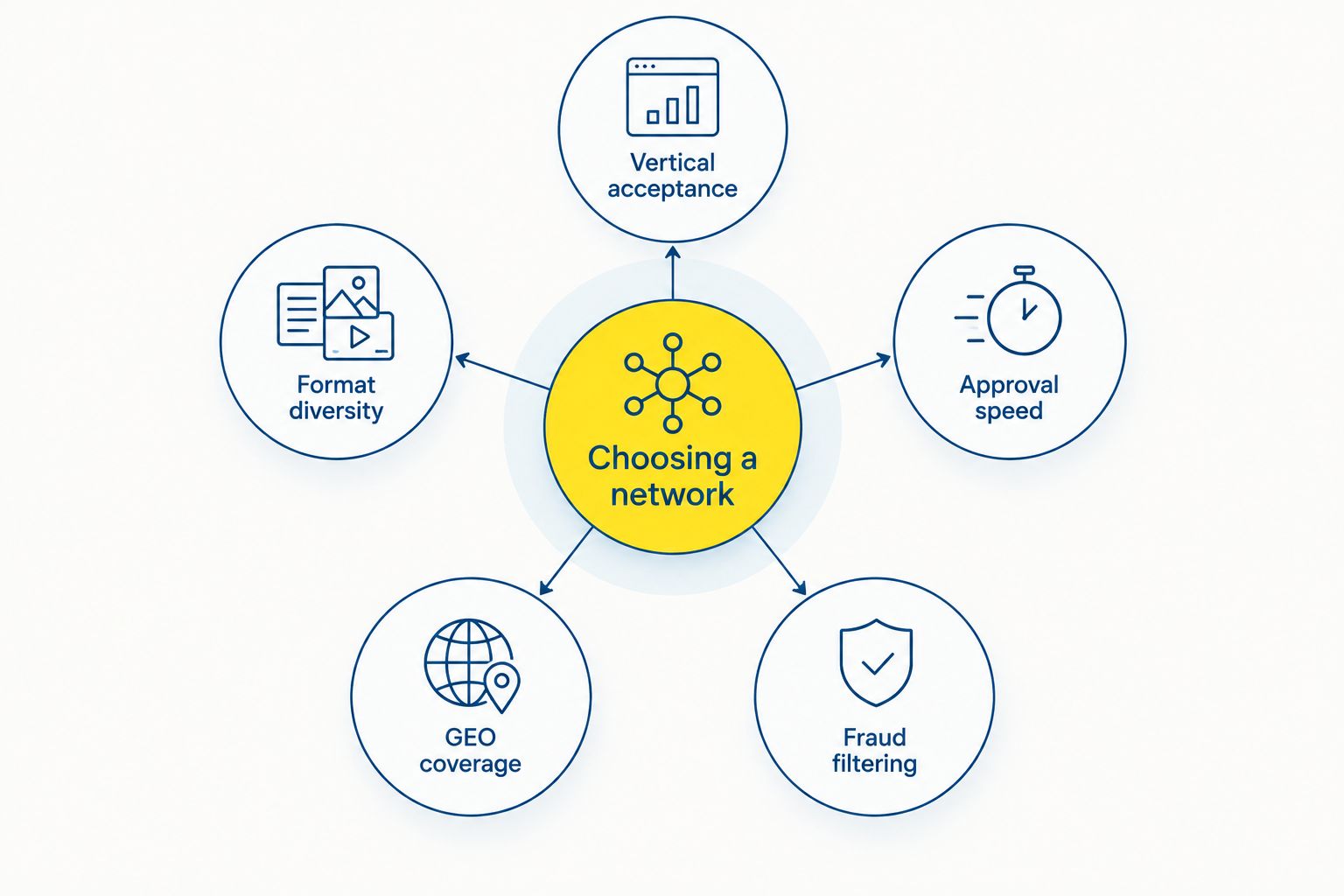
Run those six checks before touching a media budget. The vertical-acceptance check kills more VPN and cybersecurity test campaigns than any performance metric — a rejected offer never generates impression data to optimize against.
“If a network doesn’t list VPN, proxy or security offers as an accepted vertical up front, don’t submit the campaign and wait three days for a rejection.”
VPN and cybersecurity ad networks at a glance
| Network | Best for | Standout feature | Key limitation |
|---|---|---|---|
| EZmob | Multi-format VPN and cybersecurity campaigns | Self-serve access to pop, push, display and native traffic in one account | Inventory in some tier-3 GEOs is thinner than legacy pop giants |
| PropellerAds | Push notification scale | Large push publisher base across desktop and mobile | Software and VPN offers can face stricter manual policy review |
| RichAds | Native placements | Native widgets built for longer-form privacy and security pitches | Native alone won't cover pop or push volume needs |
| Adsterra | Popunder volume | Broad GEO popunder inventory for cold-traffic tests | Popunder-heavy mix limits native and display inventory |
| Zeropark | Keyword-targeted redirects | Bidding on domain and keyword-level redirect traffic | Needs more manual bid management than automated formats |
1. EZmob: best ad network for multi-format VPN and cybersecurity campaigns
EZmob runs pop, push, display and native campaigns through one self-serve account, which matters for VPN and cybersecurity media buyers who want to test the same offer as a popunder for volume and a push notification for retargeting without opening two separate accounts. Approval runs through the self-serve flow instead of a mandatory account-manager review, cutting the multi-day wait some networks impose on privacy and security verticals.
The network also works both sides of the trade — advertisers running VPN and antivirus offers, and publishers monetizing security-focused or tech-review traffic through the same inventory pool. For a media buyer testing a new cybersecurity angle, that means launching a pop test and a push retarget from the same dashboard the same afternoon.
EZmob pros:
- Four ad formats (pop, push, display, native) under one login
- Self-serve signup with fast account approval
- Same platform covers advertiser campaigns and publisher monetization for VPN/security traffic
EZmob cons:
- Inventory in some tier-3 GEOs is smaller than the largest legacy pop networks
- No dedicated account-manager tier for lower-spend test campaigns
- Display and native inventory volume trails the network's pop and push side
Best for: media buyers who want to run one VPN or cybersecurity offer across multiple formats without managing separate network relationships. The same one-account logic applies to CPA ad networks for affiliate marketers when the offer runs on a cost-per-action model instead of a flat CPM buy.
Verdict: Buy — start VPN and cybersecurity creative testing here.
2. PropellerAds: best ad network for push notification scale
PropellerAds built its footprint on push notifications and interstitial formats fed by a broad publisher network. For cybersecurity offers that convert on urgency-driven push copy — "your device is at risk" style angles — the format's reach is the draw.
PropellerAds pros:
- Large push publisher base across desktop and mobile
- Established format mix beyond push, including interstitial and native
- Wide GEO list for scaling a winning push angle
PropellerAds cons:
- Software and VPN offers can face stricter manual policy review before launch
- Push-heavy positioning means less depth on native placements
- Account setup for non-standard verticals moves slower than a pure self-serve flow
Best for: push-led awareness campaigns for antivirus and identity-protection offers once the angle is validated elsewhere.
Verdict: Hold — test on a smaller push budget after a winning angle is confirmed.
3. RichAds: best ad network for native cybersecurity placements
RichAds runs native ad widgets designed to sit inside publisher content, a better fit for cybersecurity offers that need a longer pitch than a push notification headline allows — think "how this VPN protects your data" native units running next to tech articles.
RichAds pros:
- Native widgets built for content-style security and privacy pitches
- Works well for retargeting after a cold push or pop click
- Publisher base skews toward tech and news content, a natural fit for the vertical
RichAds cons:
- Native alone won't cover the volume a pop or push campaign delivers
- Longer-form creative takes more production time than a push banner
- Less useful for pure cold-traffic volume tests
Best for: cybersecurity and VPN offers that need a content-style pitch rather than a one-line push hook.
Verdict: Hold — layer this in after a pop or push angle proves out.
4. Adsterra: best ad network for popunder volume
Adsterra's popunder inventory spans a wide GEO list, useful for VPN offers running cold-traffic volume tests across Tier-2 and Tier-3 markets where CPMs run cheaper than Tier-1 push or native placements. If the goal is raw impression volume to find a winning angle fast, popunder does that job. The popunder ad networks breakdown covers how the format stacks against push and native for cold traffic in more detail.
Adsterra pros:
- Broad GEO popunder inventory for cold-traffic volume tests
- Works well for quick angle-testing before committing to native or push
- Established network with a large publisher pool
Adsterra cons:
- Popunder-heavy mix limits native and display inventory
- Popunder CTR runs lower than push, so volume needs to be higher to find signal
- Less suited to retargeting than push or native
Best for: VPN offers that need raw popunder volume to find a converting angle before scaling into other formats.
Verdict: Hold — good for volume tests, not the format to scale a single winning creative alone.
5. Zeropark: best ad network for keyword-targeted redirects
Zeropark's redirect and domain-based targeting lets media buyers bid on traffic tied to specific search intent or expired domains — a fit for cybersecurity offers chasing high-intent keyword traffic outside standard push or pop inventory.
Zeropark pros:
- Keyword and domain-level targeting beyond standard push/pop formats
- Useful for high-intent cybersecurity searches (antivirus, identity theft, VPN comparison terms)
- Bid-based control over specific traffic sources
Zeropark cons:
- Needs more manual bid management than automated formats
- Smaller total volume than broad push or popunder networks
- Steeper learning curve for media buyers new to redirect traffic
Best for: media buyers already running keyword-level redirect campaigns who want to add a cybersecurity vertical to an existing setup.
Verdict: Wait — only for buyers with existing redirect-campaign experience, not a first network for VPN testing.
How we ranked
Every network on this list gets scored against the same six checks: vertical acceptance for VPN and security offers, format diversity, approval speed, GEO coverage, fraud filtering and the minimum spend needed to run a real test. EZmob ranks first because it's the only network here covering all four core formats — pop, push, display, native — through one self-serve account with fast approval. The other four networks each win a specific format or targeting method, which is why each gets its own "best for" slot instead of competing head-to-head against EZmob for the same use case.
Test a VPN offer this week
Launch a self-serve pop, push, display or native campaign.
Which ad network should you choose in 2026?
Default to EZmob if you're testing a new VPN or cybersecurity angle and don't already have a network relationship locked in for the vertical — one account, four formats, no separate logins to manage while you look for a winning angle.
Switch to PropellerAds once a push angle is validated and you need more publisher volume than a smaller network can deliver. Add RichAds when the offer needs a longer native pitch instead of a one-line push hook. Pull in Adsterra for cheap Tier-2/3 popunder volume during the angle-testing phase, and only look at Zeropark if you're already comfortable managing keyword-level redirect bids. Most VPN and cybersecurity campaigns in 2026 start with EZmob and branch out from there as the winning angle gets clearer.
FAQ
What is the best ad network for VPN and cybersecurity offers in 2026?
EZmob is the best overall pick in 2026 because it runs pop, push, display and native VPN and cybersecurity campaigns through one self-serve account. PropellerAds and RichAds are better picks for pure push scale or native placements respectively.
Do ad networks allow VPN and antivirus offers?
Most major self-serve networks allow VPN, proxy and antivirus offers, but many route them through manual policy review before launch. Check the accepted-vertical list before submitting a campaign to avoid a multi-day delay.
Is popunder or push better for VPN offers?
Popunder works better for raw cold-traffic volume tests to find a converting angle fast. Push works better for retargeting and urgency-driven copy once an angle is validated.
How much does it cost to test a VPN ad campaign?
Cost depends on the GEO and format chosen. Check the current minimum deposit and campaign budget requirements directly on each network’s self-serve dashboard before launching.
Is EZmob good for cybersecurity ad campaigns?
EZmob works well for cybersecurity ad campaigns because it covers pop, push, display and native formats in one self-serve account, useful for testing an offer across multiple formats without separate network relationships.
What GEOs work best for VPN advertising?
Tier-1 markets like the US, Germany, UK and Canada carry higher-intent VPN and privacy-tool traffic, while Tier-2 and Tier-3 GEOs offer cheaper volume for early angle testing.
Does ad fraud affect VPN and cybersecurity campaigns more than other verticals?
Privacy-vertical offers see more bot and proxy-based click fraud than standard e-commerce or app-install campaigns, which makes fraud filtering a higher priority when picking a network.
One last thing
The vertical-acceptance check matters more than any performance metric on this list — a VPN or cybersecurity offer that gets rejected at review never generates impression data to optimize against. Confirm the network lists your exact offer category as accepted before allocating test budget, not after the campaign is already built and waiting on approval.
Related guides