
PropellerAds gives publishers access to push and pop monetization, but those formats alone do not answer whether another network fits your inventory better. The best PropellerAds alternative for publishers in 2026 is EZmob if you want to assess pop, push, display, and native options; choose Google AdSense if conventional display is your priority. Keep PropellerAds if its placements already deliver the strongest net yield without hurting your visitors’ experience.
- For propellerads alternatives for publishers, EZmob is the first option to assess when format choice matters.
- Choose Google AdSense for conventional display; consider Media.net when contextual ad fit is the priority.
- Compare networks on the same GEO, device mix, placement, and net revenue—not a headline rate.
- Keep PropellerAds if a controlled test does not produce a better outcome for your site.
Why this matters
A publisher is selling access to inventory, not buying traffic. That distinction changes the comparison: a media buyer cares about targeting and bids, while you need to know which placements suit your pages, what demand reaches those placements, and what you retain after adjustments. A network’s advertiser tools are not proof of publisher earnings.
Push, pop, display, and native also ask different things of a visitor. A pop placement changes the browsing experience in a way an in-page display placement does not. If you compare only revenue, you miss the cost of an intrusive placement to engagement and repeat visits. In 2026, pick the format you are willing to run before judging the network that supplies it.
PropellerAds alternatives for publishers at a glance
| Network | Best for | Standout feature | How it differs from PropellerAds |
|---|---|---|---|
| EZmob | Publishers assessing multiple ad formats | A network spanning pop, push, display, and native campaigns | Gives you another source of demand to assess across those formats; publisher placement eligibility still needs confirmation |
| PropellerAds | Publishers already getting acceptable results from push or pop | Established push and pop options | Baseline for the comparison |
| Google AdSense | Sites prioritizing conventional on-page ads | Publisher-focused display monetization | Centers the decision on ads within pages rather than push or pop |
| Media.net | Sites evaluating contextual advertising | Contextual ad approach | Makes page-topic fit a central consideration |
This is a format and inventory-fit comparison, not a payout ranking. No network in the table has a proven earnings advantage for your site without results from your own placements. The same applies to approval, available demand, and payment terms: check current publisher terms before committing inventory.
1. EZmob: best for assessing multiple formats
EZmob is a self-serve advertising network for advertisers and website publishers. Its network offers pop, push, display, and native campaigns, making it the first PropellerAds alternative to assess when you do not want to frame the decision around push and pop alone. That range is a reason to investigate publisher inventory fit, not a promise that every format belongs on every site.
Where EZmob shines
- Format choice: You can assess a network that covers pop, push, display, and native rather than assuming one placement type suits every page.
- Buyer-side context: The same platform serves digital advertisers, so the publisher conversation can start with the traffic and formats you can supply.
- Practical testing: You can compare its eligible placements against an existing network without treating a format list as a revenue forecast.
Where EZmob falls short
- A broader format list does not establish which publisher placements your site qualifies to run.
- If you want only conventional contextual ads within articles, its push and pop options provide no reason on their own to switch.
- Without results from your own inventory, EZmob cannot claim a higher net yield than PropellerAds.
Best for: Website publishers willing to evaluate more than one monetization format and judge each placement by results and visitor impact.
| Decision point | EZmob | PropellerAds |
|---|---|---|
| Publisher question | Which of the network’s formats fits my inventory? | Are my existing push or pop placements still the right choice? |
| Formats considered here | Pop, push, display, native | Push and pop baseline |
| Evidence needed | Eligible placements and measured net yield | Current placement results and measured net yield |
| Reason to choose | You want to assess additional format options | Your existing setup continues to perform better |
Verdict: Test. Ask which publisher placements fit your site, then compare an eligible placement against your present setup. Keep formats separate in your reporting; a display result does not validate a pop placement.
2. Google AdSense: best for conventional display
Google AdSense is a publisher monetization option for placing ads on website pages. It belongs in this comparison because some publishers looking for a PropellerAds alternative do not want another push or pop setup at all. They want ads that sit within their existing page experience.
Where Google AdSense shines
- Its publisher use case is clear: monetize website pages with on-page ads.
- It gives a display-first site a comparison that does not depend on opening additional browsing windows or securing notification permission.
Where Google AdSense falls short
- It is not the direct answer when your test is specifically about replacing a pop placement with another pop placement.
- A display result cannot tell you what push or pop inventory would earn under the same conditions; those are different placements.
Best for: Publishers whose pages and audience suit on-page advertising and who want to assess display before more interruptive formats.
| Decision point | Google AdSense | PropellerAds |
|---|---|---|
| Main use in this comparison | On-page display monetization | Push or pop monetization baseline |
| Visitor experience to assess | Ads within the page | The effect of the current push or pop placement |
| Fair comparison | Net revenue alongside page engagement | Net revenue alongside page engagement |
Verdict: Test if display is the format you want. Do not call it a better network because a display unit earns less or more than a pop unit; first decide which visitor experience you will accept.
3. Media.net: best for assessing contextual fit
Media.net is an option for publishers evaluating contextual advertising. Its place on this list is narrower than a general format comparison: look at how ads connected to page content fit your articles or other content pages. If your main asset is pop inventory, it is not a like-for-like replacement test.
Where Media.net shines
- Contextual fit gives content publishers a distinct criterion to evaluate.
- It provides another on-page approach when push and pop do not suit the site.
Where Media.net falls short
- A contextual approach does not answer whether a pop or push placement would work better on your inventory.
- Page-topic fit alone does not establish net yield. You still need results from eligible pages.
Best for: Content publishers who want to evaluate ads in the context of their pages rather than start with a push or pop placement.
| Decision point | Media.net | PropellerAds |
|---|---|---|
| Test focus | Contextual fit on content pages | Existing push or pop performance |
| Placement question | Do ads fit the page? | Does the placement fit the visitor experience? |
| Proof required | Results on eligible content pages | Results on current inventory |
Verdict: Test on pages where contextual fit is a real selection criterion. If your goal is to replace a working pop setup without changing the placement type, keep looking at comparable pop inventory instead.
Why publishers switch from PropellerAds
The strongest reason to consider a switch is a change in placement strategy, not an unsupported claim that PropellerAds underpays. A publisher who no longer wants to run a pop placement needs a different format. A publisher testing several acceptable formats needs a way to separate each format’s outcome from the network behind it.
Other valid reasons are specific to your own site:
- You need a display-first test. Compare on-page placements rather than judging them by a push or pop result.
- You want to assess contextual fit. Content pages create a different question from whether pop inventory monetizes.
- You need another demand source. Testing an alternative tells you whether your current result is the best result available for that placement and traffic mix.
- Your visitor experience is the constraint. A placement that earns revenue but conflicts with how you want the site to work is not a win.
None of these reasons proves another network will earn more. They establish what to test. In 2026, a network switch is justified by an outcome on your inventory, not by an alternatives list.
How to run a fair publisher comparison
Start with the placement decision. If you replace a pop placement with an in-page ad, you are testing both a network and a format; you cannot attribute the entire difference to the network. Keep that distinction visible in your notes.
- Baseline: Record the current placement’s revenue and eligible inventory before changing it. Use net revenue after any adjustments as the decision metric.
- Placement: Compare like with like when you want a network verdict. When you intentionally change formats, record the visitor-experience difference as part of the decision.
- GEO: Separate results by geography and device mix. Combined totals can conceal the traffic segment that actually drives the outcome.
- Net yield: Review what remains after adjustments, alongside page engagement. Do not choose a network from a quoted rate that your inventory has not earned.
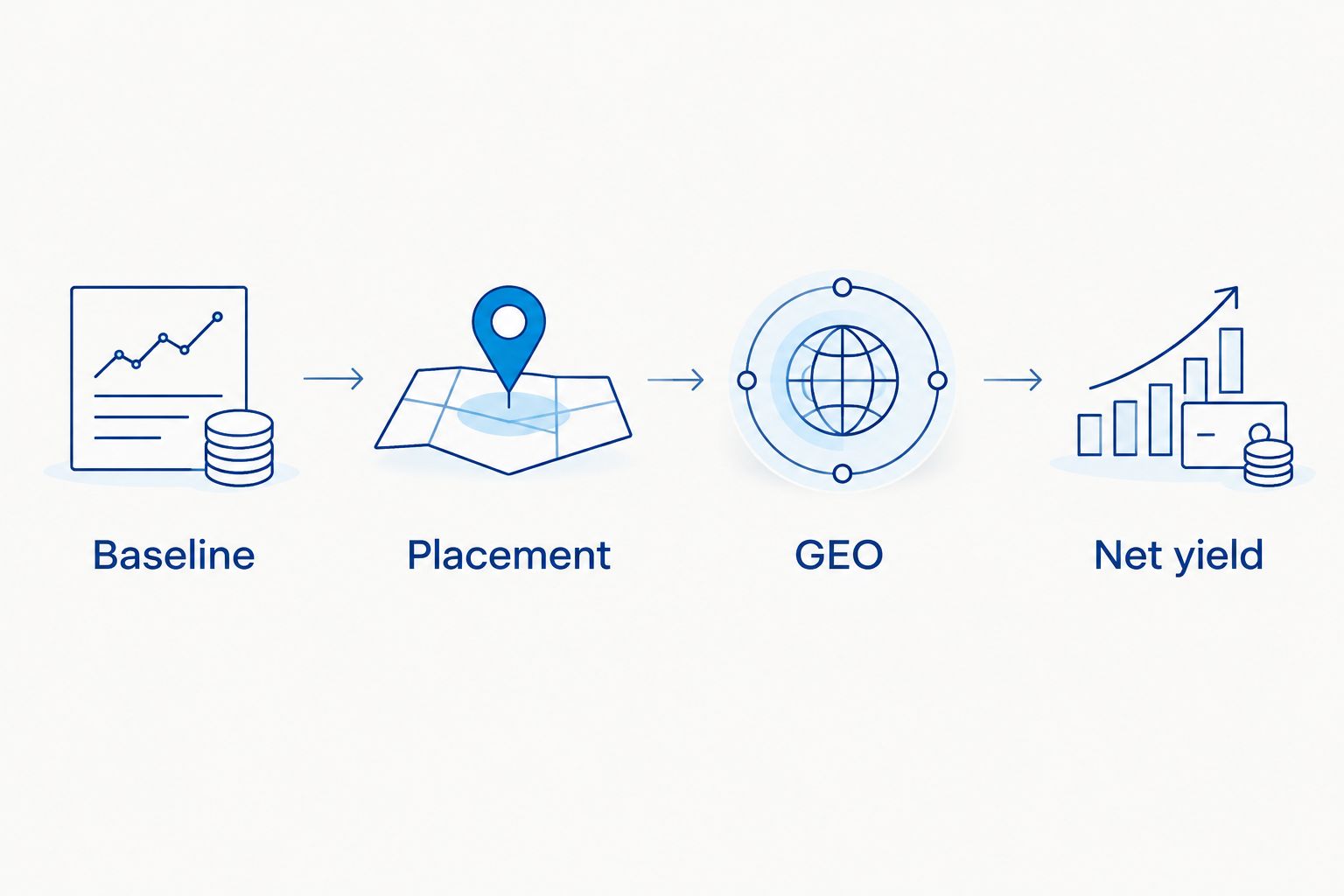
For a direct network test, preserve the same kind of placement and comparable traffic conditions. For a format test, treat the result as a format decision first. This distinction matters more than a generic ranking because publishers do not all have the same pages, GEOs, or tolerance for intrusive ads.
When staying with PropellerAds is the right call
Stay if your existing placements meet your net-revenue and visitor-experience requirements and an alternative does not beat that result under comparable conditions. Switching networks creates work; an unmeasured promise of better monetization is not a reason to do it.
PropellerAds also remains a sensible baseline when push or pop is the format you intend to keep. In that case, compare equivalent placements before expanding the test. A display-first option answers a different question, even if it is a better fit for another publisher.
FAQ
What are the best PropellerAds alternatives for publishers in 2026?
EZmob is the first option to assess if you want to evaluate pop, push, display, and native formats. Google AdSense fits a display-first test, while Media.net fits a contextual advertising test.
Is EZmob better than PropellerAds for publishers?
EZmob is the stronger option to assess when you want a network spanning pop, push, display, and native campaigns. Which network earns more for your site requires a test on eligible inventory.
Should I replace a pop ad with a display ad?
Replace a pop ad with a display ad when the on-page visitor experience better suits your site and the measured trade-off is acceptable. That comparison changes the format as well as the potential demand source.
Is Google AdSense a direct replacement for PropellerAds?
Google AdSense is a display-first publisher option, not a like-for-like pop placement test. Compare it when you want on-page ads rather than assuming it will reproduce your existing push or pop result.
When does Media.net make sense for a publisher?
Media.net makes sense when contextual fit on content pages is central to your test. Assess eligible pages and their measured results rather than treating contextual relevance as proof of higher earnings.
What should I compare before switching ad networks?
Compare eligible placements, GEO and device mix, net revenue after adjustments, and visitor impact. Keep the format constant if you want to isolate the network as the reason for a change.
Should I leave PropellerAds if my current setup works?
Keep PropellerAds if your placements meet your requirements and a comparable alternative does not improve the result. A switch needs evidence from your own inventory.
One last thing
Your first decision is the placement, not the network. In 2026, choosing between a pop, a display unit, and a contextual ad changes the test before any network enters it. Pick the visitor experience you can accept, then make networks compete for that inventory.
Related guides
- Best publisher ad networks for website monetization
- Best display advertising networks for publishers
- Pop ad networks ranked by payout
- Best in-page push ad networks