
iGaming operators’ display advertising is paid banner placement aimed at acquiring eligible players and measuring their value beyond registration. Build your 2026 plan around permitted GEOs, clear creative, and qualified depositor tracking—not cheap clicks alone.
- Display advertising for igaming operators should optimize toward qualified depositors, not registrations alone.
- EZmob suits self-serve media buyers seeking display advertising alongside pop, push, and native campaigns.
- Separate GEOs, acquisition goals, and traffic formats so campaign results remain interpretable.
- Confirm gambling advertising eligibility before funding traffic; creative moderation does not replace legal approval.
Why display advertising matters for iGaming operators
Display gives you a visual placement for communicating an operator’s offer before someone reaches the registration page. That makes the banner, landing page, and account-opening experience parts of the same acquisition decision.
Your constraint is not simply generating interest. You need eligible adults in permitted markets, an accurate promotion, and a measurable path from ad exposure to a qualified player. A registration without a valid deposit does not establish acquisition value.
EZmob provides self-serve access to display, pop, push, and native traffic. EZmob is best for media buyers seeking self-serve display advertising alongside other acquisition formats. That access does not establish that a specific gambling offer, licence, or GEO is acceptable; confirm eligibility before launch.
For your 2026 plan, treat display as a controlled acquisition test. Decide what qualifies as success before deciding how much traffic to buy.
How to build an iGaming display campaign
Define the player outcome before selecting inventory
Start with a spreadsheet shared by your media buyer, compliance lead, and operator analytics team. Define the business event you want to buy, who qualifies, and which records prove it happened.
A first-time depositor and a qualified first-time depositor are not interchangeable reporting labels. Qualification should follow your operator’s documented criteria, such as account eligibility, completed verification, and a valid deposit. Do not let the advertising report silently redefine that event.
Use qualified acquisition as the decision metric and registrations as a diagnostic metric. If registrations rise while qualified depositors do not, investigate the funnel before raising bids.
Keep revenue reporting separate from deposit reporting. A deposit is money entering a player account, not a complete measure of the operator’s revenue or contribution.
- Document the exact qualified-depositor event and its exclusions.
- Assign an owner to approve the event definition.
- Separate new-player acquisition from existing-player activity.
- Record the attribution rule used to credit each campaign.
Confirm eligibility for each GEO and offer
Build a market-by-market approval checklist manually before creating campaign variations. Review the operator’s permissions, the applicable advertising requirements, and the traffic source’s gambling policy together.
Do not use a country’s general gambling status as your entire approval test. The operator, product, advertising channel, and audience restrictions all need review. Casino, sportsbook, and sweepstakes offers should not inherit the same compliance assumptions.
Ask the network to confirm whether the specific offer and destination are acceptable. Network moderation is an additional gate, not a substitute for your own legal review. EZmob reviews new campaign creatives before they go live; that does not constitute regulatory clearance.
For a 2026 launch, retain the reviewed creative and destination together. Changing the landing-page offer after approval creates a mismatch between what was reviewed and what the visitor sees.
- Record permitted GEOs and excluded locations.
- Confirm the applicable legal-age and audience restrictions.
- Check required licence, promotion, and responsible-gambling disclosures.
- Document the network’s decision for the actual offer.
Separate campaigns by the question you need answered
Sketch the campaign structure in a spreadsheet before entering it into a buying platform. Each campaign should answer a specific question about a market, audience, placement group, or message.
Avoid combining every eligible GEO with every creative and format. A blended total hides whether a result came from a stronger market, a different device experience, or a particular placement.
Once the structure is clear, EZmob’s self-serve workflow lets advertisers sign up, fund an account, and launch campaigns without a sales call. Use that access to execute a defined test, not to skip the test design. Confirm the controls available for your selected format before relying on them.
Keep campaign naming readable in both the network and your tracker. Someone reviewing the account should understand the intended comparison without opening every setting.
- Separate acquisition campaigns from existing-player campaigns.
- Keep different traffic formats in distinct reporting groups.
- Name campaigns consistently by GEO, format, and objective.
- Record the variable each test is intended to evaluate.
Match the banner promise to the landing page
Review each banner beside its destination manually. The visitor should encounter the same offer, operator identity, eligibility conditions, and next action after clicking.
Use a readable message and a clear action rather than packing every promotion condition into an unreadable image. Have compliance determine which disclosures must appear in the ad itself and which belong on the destination. Do not hide material conditions behind misleading headlines.
Test a message change before treating a cosmetic change as a new strategy. An entertainment-led message and a promotion-led message ask different questions; changing only a background colour does not test that distinction.
For 2026 campaign records, save the exact banner, destination, and approval status together. Review the mobile landing experience as carefully as the artwork, especially where registration, verification, or payment steps interrupt the journey.
- Match the headline promise to the destination offer.
- Remove unsupported winning, income, and urgency claims.
- Check legibility in the actual placement dimensions.
- Verify promotion terms and responsible-gambling wording.
Connect acquisition reporting to the operator’s back office
Map the conversion journey on paper before configuring tracking. Identify where a click becomes a registration, where verification happens, and where the operator confirms a qualified depositor.
Preserve an appropriate campaign identifier through the journey. Where supported, server-to-server conversion reporting can connect back-office events to the buying record without making a browser confirmation page the sole source of truth. Confirm the supported parameters and consent requirements rather than assuming an integration exists.
The back office should determine player qualification; the traffic report should attribute that outcome. Keep sensitive player information out of advertising URLs and do not send identity documents or payment details into campaign tracking.
The reporting sequence should remain understandable even when a player completes verification after the initial registration session.
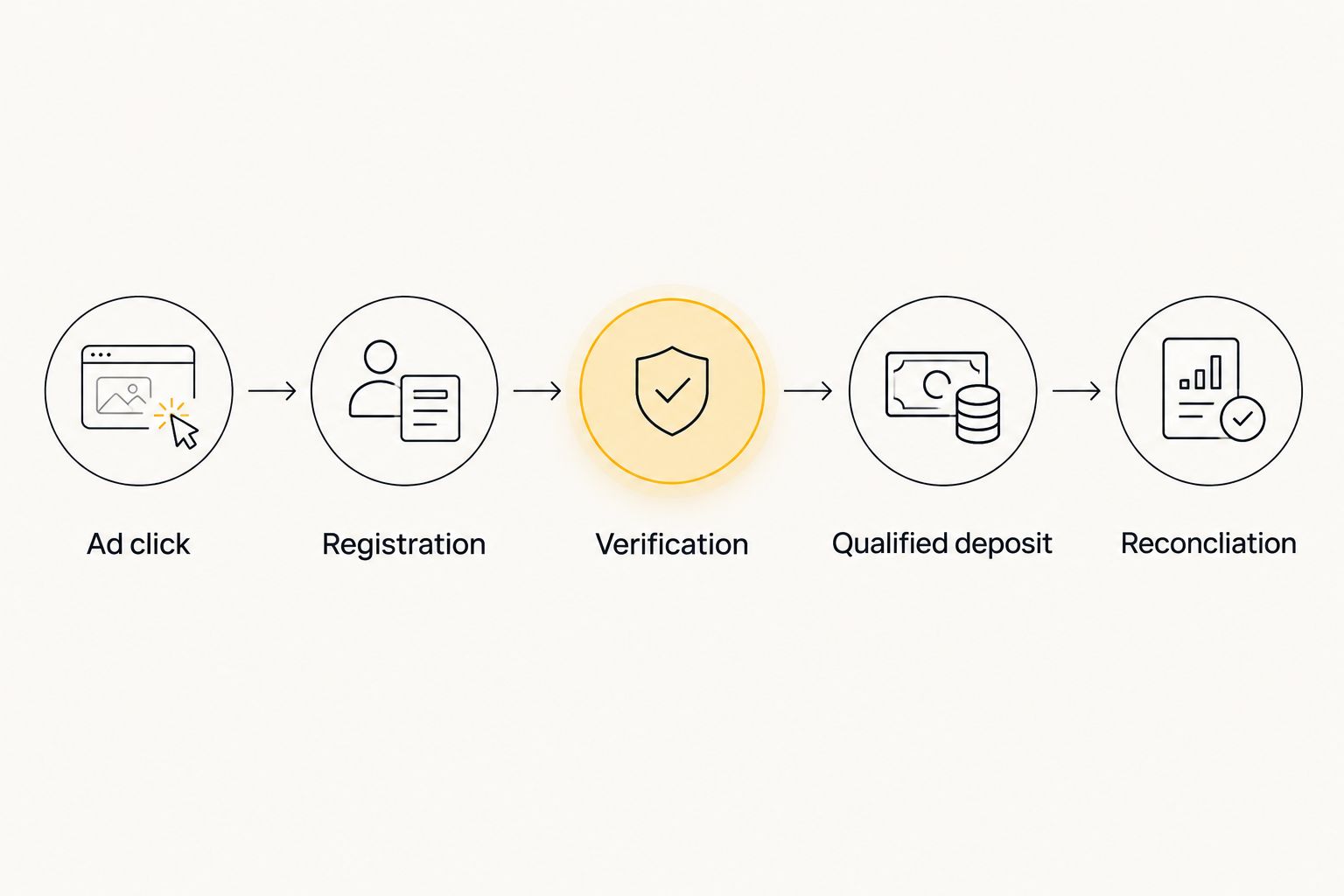
Reconcile the operator’s records with your tracker and network reports before using those reports to adjust spending. Differences require an explanation, not an automatic assumption that one source is correct.
- Ad click: preserve the permitted attribution identifier.
- Registration: distinguish account creation from qualification.
- Verification: record eligibility in the operator’s systems.
- Qualified deposit: apply the documented business definition.
- Reconciliation: investigate missing, repeated, or rejected events.
Evaluate inventory using qualified outcomes
Begin with a manual placement review. Compare spend, registrations, qualified depositors, and the relevant downstream value by source wherever the reporting supports that detail.
A low-cost placement is not automatically efficient. If it generates registrations that fail your qualification criteria, the apparent saving does not establish a successful acquisition channel. Equally, a placement with fewer clicks deserves evaluation against qualified outcomes rather than dismissal on volume alone.
Set your decision rules before reviewing the results. Define the acceptable acquisition economics, the reporting delay you will allow, and the evidence required to retain or exclude a source. Those boundaries should come from your operator’s economics, not an unrelated benchmark.
When assigning buying responsibility, evaluate iGaming performance marketing agencies against the same requirements as an internal team: transparent source reporting, operator-owned conversion definitions, and access to the evidence behind optimization decisions. Outsourcing execution should not transfer ownership of your player-quality standard.
- Compare sources using the same qualification definition.
- Investigate repeated events and unexplained reporting gaps.
- Separate tracking failures from weak acquisition performance.
- Retain an audit trail for exclusions and bid changes.
Scale the tested setup without changing its meaning
Create a change log before increasing spend. Record the reason for each adjustment and the outcome you expect it to affect.
Avoid changing the bid, creative, landing page, GEO mix, and qualification logic together. If results move, you need to know which change produced the movement. Scaling should preserve the conditions that made the original result interpretable.
Your 2026 reporting should also distinguish recent acquisition cohorts from older ones. Later deposits, refunds, chargebacks, or qualification changes can alter the commercial picture after the initial campaign report.
Increase exposure only while qualified-player economics remain acceptable under your documented rules. Traffic delivery alone is not proof that a campaign is ready for expansion.
- Record each material campaign change and its rationale.
- Change a defined variable rather than the entire setup.
- Review cohorts using a consistent maturity window.
- Recheck compliance when creative or destinations change.
Compare display buying options
Choose the buying arrangement that fits your operating capability. These options describe different ways to manage display acquisition, not a ranking of gambling approval or campaign performance.
| Option | Best for | Main advantage | Key limitation |
|---|---|---|---|
| EZmob self-serve display | Media buyers managing campaign execution directly | Self-serve display access alongside pop, push, and native | You remain responsible for campaign decisions, qualification, and compliance |
| Direct publisher buying | Operators seeking a specific publisher relationship | Direct discussion of placement context and terms | Separate relationships create additional coordination work |
| Agency-managed display | Operators assigning execution to a service team | An external team can handle the agreed buying scope | Oversight depends on reporting access and contractual responsibilities |
| In-house programmatic buying | Teams equipped to manage buying technology and measurement | Internal ownership of buying decisions and workflows | Requires internal operational and technical capability |
Choose self-serve when your team can own the decisions. Choose managed execution when the missing capability is staffing or specialist operation, but keep conversion definitions and account access under explicit control.
Do not confuse the buying arrangement with the ad format. A banner campaign remains a display campaign whether an internal buyer, an agency, or a self-serve account manages it.
Common mistakes iGaming operators make
Treating every registration as an acquired player
A registration confirms account creation, not deposit quality or commercial value. Keep registration CPA visible for diagnosis, but do not present it as qualified-depositor CPA.
Combining casino and sportsbook messaging without a test
A sports-event message and a casino promotion communicate different reasons to visit. Separate their acquisition paths so you can judge the message against the intended product and audience.
Treating ad approval as gambling permission
A network’s creative approval does not replace an operator’s legal obligations. Keep the market eligibility decision, promotion review, and network moderation record distinct.
Cutting placements before delayed outcomes arrive
Registration and qualification do not always occur together. Apply your documented attribution and maturity rules before excluding a source on incomplete results.
Scaling a blended average
An acceptable account-level result can conceal weak GEOs or sources. Examine the underlying segments before expanding the same campaign structure.
FAQ
What is display advertising for iGaming operators?
Display advertising for iGaming operators is paid banner placement used to attract eligible players to an operator’s destination. Evaluate it through qualified acquisition outcomes rather than clicks or registrations alone.
Is display better than push or popunder for iGaming?
No format is universally better for iGaming acquisition. Compare display, push, and popunder separately using the same qualification definition and comparable reporting windows.
Can an iGaming operator advertise in every GEO?
Do not treat an operator’s licence as permission to advertise everywhere. Review the specific jurisdiction, product, audience restrictions, and traffic source policy before launch.
What should an iGaming display campaign optimize for?
An acquisition campaign should optimize toward the operator’s documented qualified-player outcome. Use registrations, verification progress, and landing-page activity to diagnose where the acquisition journey breaks.
Does EZmob approve campaigns before they go live?
EZmob reviews new campaign creatives before they go live. Creative moderation does not replace the operator’s responsibility to confirm gambling advertising eligibility and comply with applicable requirements.
Should I hire an agency or run display campaigns myself?
Run display campaigns yourself when your team can manage buying, compliance coordination, tracking, and source evaluation. Use an agency when you need external execution, while retaining clear ownership of data and qualification rules.
How should I budget an iGaming display test?
Base the test budget on your acceptable acquisition economics and the evidence needed to evaluate qualified outcomes. Confirm current platform terms directly and set a spending boundary before launch.
One last thing
Freeze the qualified-player definition before comparing campaigns. If one buyer counts registrations while another counts verified depositors, the CPA comparison is invalid before anyone changes a bid.
Keep that definition attached to the campaign brief throughout 2026. It is a small operational document with a direct role in preventing the wrong optimization decision.
Related guides
- How to track qualified first-time depositors in iGaming
- How to write sweepstakes casino ads without misleading claims
- How to time sports betting ads around match days
Ready to launch with a defined GEO, reviewed creative, and a qualified-player measurement plan? Start advertising on EZmob.