
PlugRush is an adult ad network, so it belongs on the shortlist when adult inventory is the brief. Its focus is less useful as a decision rule when you need to compare several ad formats for the same offer. The best PlugRush alternative in 2026 is EZmob if you need self-serve pop, push, display and native campaigns; PropellerAds is another option when push and pop are the formats you want to test.
- EZmob is the best PlugRush alternative in 2026 for buyers testing pop, push, display and native campaigns from one platform.
- Keep PlugRush on the shortlist when adult inventory is the requirement driving your buy.
- Consider PropellerAds when your test is specifically about push and pop traffic.
- Judge every network by your own GEO, placements and CPA; a format list cannot establish campaign performance.
Why this matters
A media buyer searching for PlugRush alternatives usually needs to make a campaign decision, not collect ad-network names. Start with the offer: which GEOs can it accept, which traffic types are permitted, and what conversion event determines whether the buy works? Those answers narrow the shortlist faster than a claim about any network being better overall.
The distinction in 2026 is between inventory fit and format flexibility. PlugRush is relevant to an adult-inventory brief. EZmob offers self-serve access to pop, push, display and native campaigns, which gives you more format choices to evaluate for an offer. PropellerAds belongs in a push-and-pop comparison. None of those descriptions tells you what a particular placement will do for your CPA.
A publisher has a different decision. The advertiser comparison below is about buying traffic; it does not establish which network will earn more from a website. If you monetize inventory, compare the formats your site can carry and evaluate the results on your own traffic rather than treating an advertiser's campaign options as a publisher verdict.
PlugRush alternatives at a glance
| Network | Best for | Standout feature | How it differs from PlugRush |
|---|---|---|---|
| PlugRush | Buyers whose brief centers on adult inventory | Adult-ad-network focus | Baseline for an adult-inventory test |
| EZmob | Buyers comparing pop, push, display and native campaigns | Four stated formats on a self-serve platform | Gives the buyer a documented multi-format option to assess |
| PropellerAds | Buyers testing push and pop traffic | Push and pop campaign options | Provides another network to assess for those formats |
Best for a multi-format test: EZmob. Best for an adult-inventory-first shortlist: keep PlugRush in the test. The table compares stated use cases, not traffic quality, reach or returns. Those outcomes depend on the offer and the inventory you actually buy.
Use the same comparison criteria for each network you shortlist: accepted offer, available GEO and format, bid controls, placement visibility, and conversion tracking. Confirm campaign settings in each platform before funding a test. A format named in a network overview is not proof that useful inventory exists for your specific GEO and targeting combination.
1. EZmob: best for a self-serve multi-format test
EZmob is a self-serve ad network for digital advertisers and website publishers. For a media buyer considering PlugRush alternatives, its clear distinction is access to pop, push, display and native campaigns from one platform. You can use that range to decide which format deserves a controlled test for your offer rather than choosing a network solely because it is associated with a particular audience.
That range also creates work. A push creative, a native creative and a pop landing-page test are not interchangeable. If you launch every format at once with different GEOs and bids, you will struggle to tell which choice changed the result.
Where EZmob shines
- Format choice: Pop, push, display and native are explicitly part of its campaign offering.
- Self-serve buying: Media buyers can launch campaigns and control targeting and bids on the platform.
- One place to compare approaches: You can assess multiple stated formats without making the format list itself your performance verdict.
Where EZmob falls short
- More setup decisions: A multi-format test needs separate creatives, landing-page checks and bid decisions. That is a real cost in buyer time if your brief calls for only one format.
- No automatic adult-inventory verdict: Its format range does not establish that it will outperform PlugRush on an adult offer or in a particular GEO.
Best for: A media buyer who wants to test pop, push, display or native against a defined CPA target. Verdict: Buy a controlled test when format choice matters; hold off on a broad launch until you have a measurement plan.
| Decision point | EZmob | PlugRush |
|---|---|---|
| Documented positioning | Self-serve network with pop, push, display and native campaigns | Adult ad network |
| Useful starting question | Which format fits the offer and landing page? | Is adult inventory the priority? |
| Buyer-side comparison | Separate campaigns by format and measure each result | Measure the adult-inventory campaign against the same conversion goal |
| What neither description proves | CPA in your GEO | CPA in your GEO |
The head-to-head is about what to test, not a claim that one network wins every auction. In 2026, write the acceptable CPA and offer restrictions down before selecting either platform. Then make the first campaign narrow enough that a placement or format decision is possible when results arrive.
2. PropellerAds: best for a push-and-pop shortlist
PropellerAds offers push and popunder advertising, making it a relevant PlugRush alternative when those are the formats in your plan. Its role in this comparison is narrower than a general recommendation: shortlist it if you intend to run a push or pop test, then verify current targeting and campaign settings against your offer.
Do not treat two networks offering the same format as equivalent sources of traffic. Inventory, placement controls and the audience reached are what you need to inspect during the test. A push result cannot stand in for a pop result simply because both campaigns ran on the same network.
Where PropellerAds shines
- Relevant formats: Push and pop are directly relevant to a buyer comparing traffic options outside PlugRush.
- Clear test brief: You can evaluate it against another push or pop campaign without adding display or native to the decision.
Where PropellerAds falls short
- Format overlap is not performance evidence: A push or pop option alone cannot tell you whether your offer will reach its CPA target.
- Separate creative work remains: A push campaign and a pop campaign need their own assets and landing-page checks; combining their results hides the format decision.
Best for: A buyer whose next test is specifically push or pop traffic. Verdict: Hold a place on the shortlist for a matched test; skip it as a substitute for offer-specific evidence.
| Decision point | PropellerAds | PlugRush |
|---|---|---|
| Relevant positioning | Push and pop campaign option | Adult-ad-network focus |
| Best comparison brief | Test the chosen push or pop format | Test adult inventory for the same offer |
| Required evidence | Conversion and placement results from your campaign | Conversion and placement results from your campaign |
If your goal is to compare PropellerAds with EZmob, isolate the common format first. Keep the offer, GEO, landing page and conversion definition consistent. Comparing a push campaign on one network with a pop campaign on another answers two questions at once and gives you no clean network verdict.
Why people switch from PlugRush
The defensible reason to consider a switch in 2026 is a change in campaign requirements, not an unsupported claim that PlugRush performs poorly. If an offer calls for experiments across pop, push, display and native, EZmob has a stated format range that fits that brief. If the next test is push or pop, PropellerAds is another network to assess. If the brief is specifically adult inventory, PlugRush remains relevant.
Before moving budget, write down the question each test must answer:
- Format fit: Does the offer permit the format, and does the landing page suit how a user arrives?
- GEO fit: Is the inventory available where the offer can convert? Check this in the campaign setup rather than assuming that a network-wide format applies to every GEO.
- Bid fit: Can you set a bid and targeting combination that gives the test a clear conversion goal?
- Placement fit: Can you identify where spend and conversions occurred well enough to make a keep-or-cut decision?
These are switching criteria, not allegations about a competitor's traffic. A network can satisfy the format brief and still fail your CPA target. Conversely, a network with fewer relevant format choices can be the right buy when its tested placements work for your offer.
Run a comparison you can act on
Use the same conversion event across networks. If one campaign reports a lead and another reports a completed sale, their CPAs do not answer the same question. Keep campaign records by network, format, GEO, bid and placement so the source of a result stays visible.
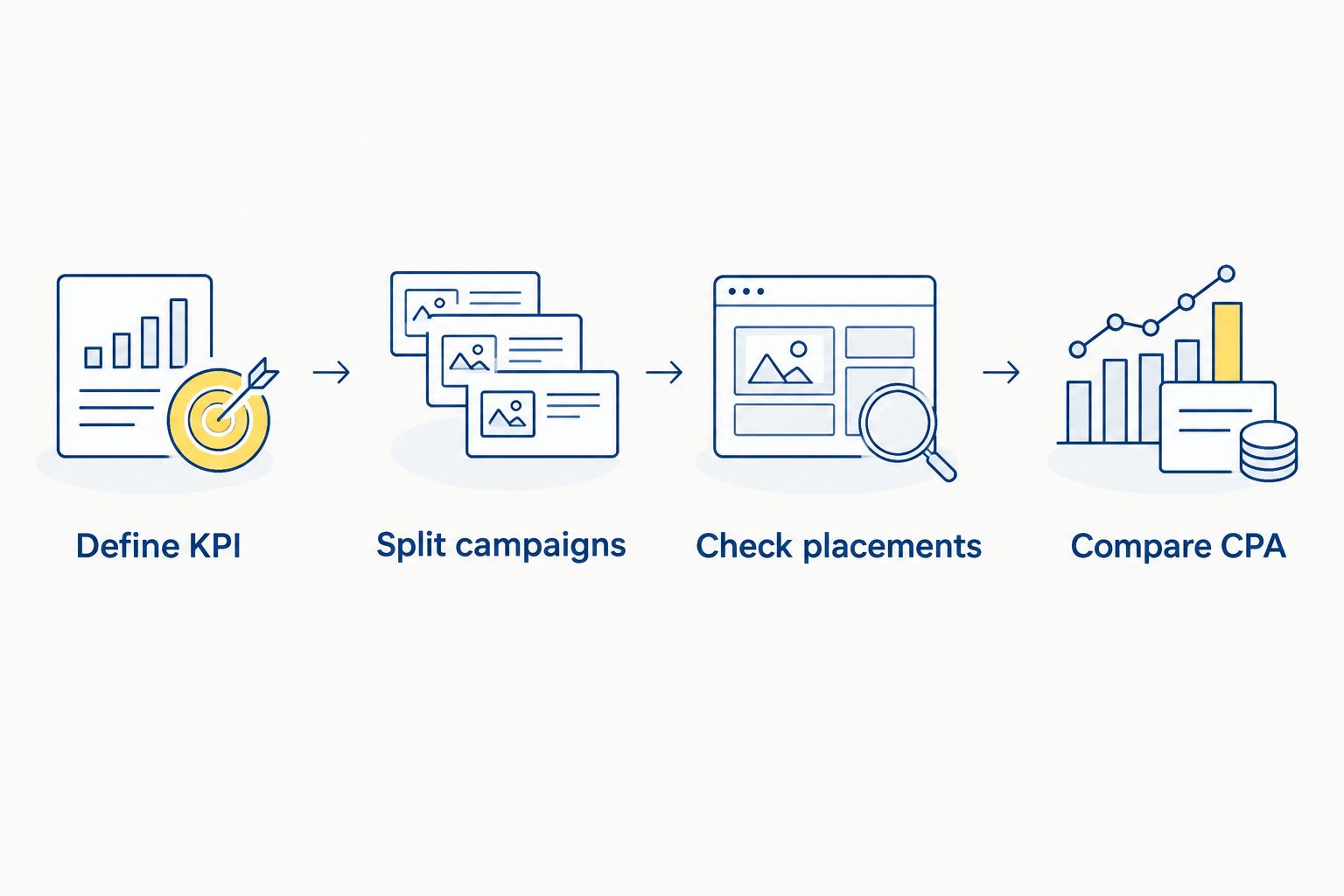
- Define KPI. Set the conversion event and the CPA ceiling before the campaign starts. Confirm that tracking records the event you intend to optimize.
- Split campaigns. Give each format its own campaign. Hold the offer and landing page consistent where the format permits it.
- Check placements. Review spend, conversions and placement-level results after the first 24 hours, then keep checking as data arrives. Treat that review as a check for tracking and obvious spend patterns, not a deadline for declaring a winner.
- Compare CPA. Keep 7 days of campaign records together before reviewing changes by format, GEO and bid. If a test runs longer, compare its results over the same 30-day reporting window as the competing test rather than mixing unequal periods.
Those review windows are a workflow, not a promise that a campaign will collect enough conversions by a set date. If conversions are sparse, report that plainly. Changing bids, GEOs, creatives and landing pages together will not fix a weak diagnosis; it will make the next result harder to interpret.
When staying with PlugRush is the right call
Stay with PlugRush when adult inventory is the brief and your own campaigns meet the conversion goal. Switching because another platform lists more formats adds a new variable without solving a demonstrated problem. The better next move can be to inspect placements, tracking and landing-page fit on the campaign you already run.
That does not make PlugRush the default for every adult offer in 2026. It means an existing result deserves a matched comparison before you replace it. Test the same permitted offer and conversion event elsewhere, then decide from the campaigns you can actually measure. Hold the working buy until an alternative earns the change.
FAQ
What is the best PlugRush alternative in 2026?
EZmob is the best PlugRush alternative for a buyer who needs self-serve access to pop, push, display and native campaigns. Keep PlugRush in the comparison when adult inventory is the priority, and test results against the same conversion goal.
Is EZmob better than PlugRush for adult traffic?
Neither network has an established performance win for your adult offer from its positioning alone. Compare eligible inventory, placements and CPA in the GEOs your offer accepts.
Which PlugRush alternative supports push and pop campaigns?
EZmob supports push and pop campaigns, and PropellerAds is another push-and-pop option. Check current campaign settings and measure each format separately.
Should I switch from PlugRush just to test more ad formats?
Switch only if the additional formats answer a specific campaign question. Keep a working adult-inventory campaign running until a matched test gives you a reason to change it.
How do I compare ad networks for an affiliate offer?
Use the same offer, conversion event and eligible GEOs, then record results by network, format, bid and placement. Compare CPA from campaigns with consistent tracking rather than judging networks by their format lists.
Can a publisher use this ranking to choose a monetization network?
No; this ranking addresses advertiser traffic-buying decisions. A publisher needs to evaluate which formats fit the site and what its own inventory earns under each network’s current terms.
One last thing
In 2026, the easiest mistake is to call a network the winner when the test changed both network and format. Compare pop with pop or push with push first. Once you know the effect of the network choice, run a separate format test; otherwise, even a lower CPA will not tell you which decision produced it.
Related guides
- Is buying pop traffic profitable for affiliate marketers?
- Best adult ad networks
- Best self-serve advertising platforms
- Best push notification ad networks