
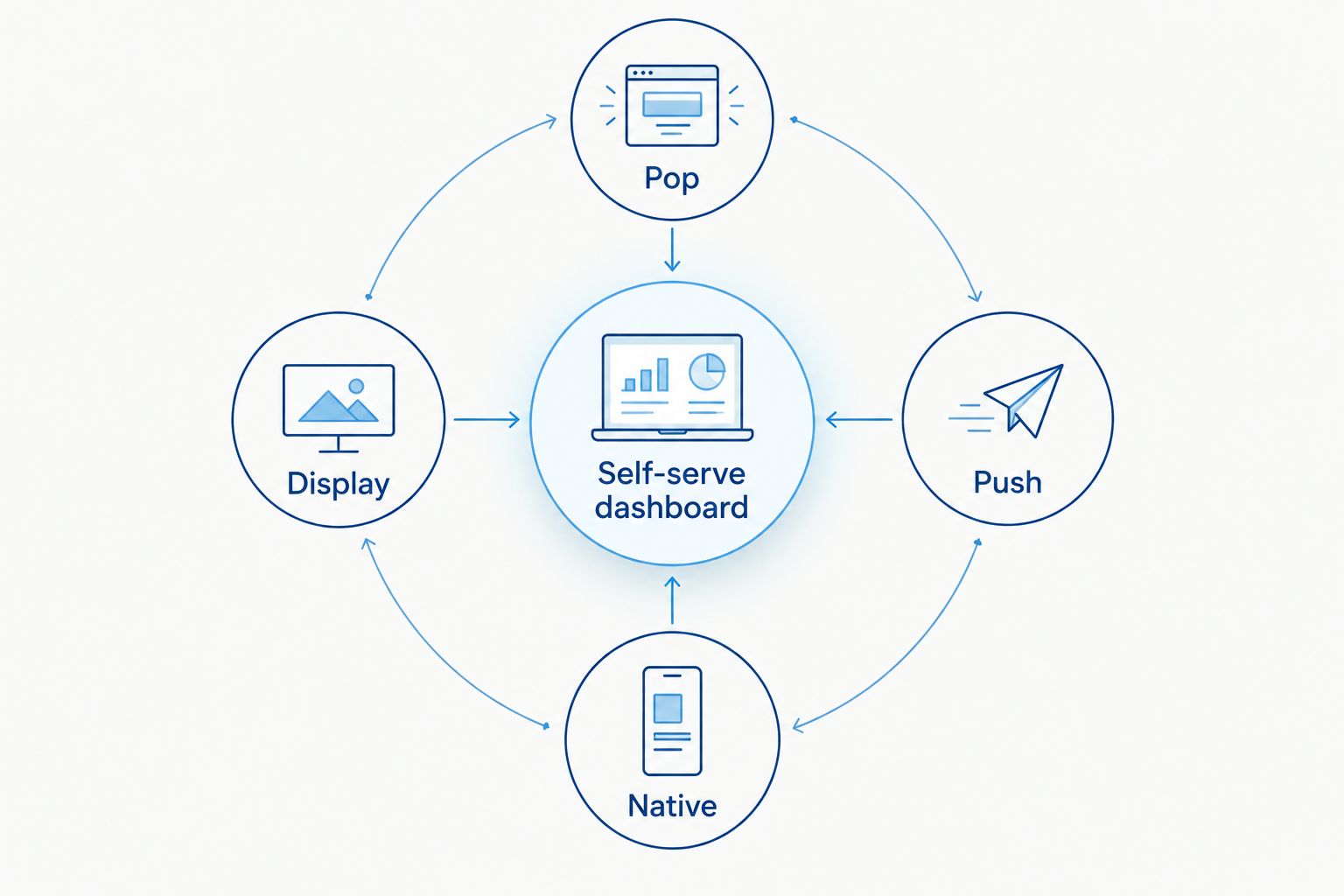
Best overall self-serve advertising platform in 2026: EZmob, built for media buyers who want pop, push, display and native traffic live from one dashboard. Best for high-volume push and popunder scaling: PropellerAds. Best for adult and mainstream display/native inventory: ExoClick. Best for RTB-driven domain redirect and popunder targeting: Zeropark.
- EZmob wins for media buyers who want pop, push, display and native traffic under one self-serve login in 2026.
- PropellerAds scales push and popunder volume fastest for advertisers running high-frequency test campaigns.
- RichAds and Adsterra specialize in push and Social Bar formats but don’t cover the full four-format stack.
- ExoClick and Zeropark fit narrower verticals: adult inventory and domain redirect targeting respectively.
- Rank self-serve advertising platforms on format breadth, targeting depth and launch speed, not brand size.
Why this matters
Media buyers testing new offers in 2026 don't have time for a sales call before a campaign goes live. A self-serve advertising platform like EZmob lets you fund an account, pick a GEO, set a bid and launch a campaign without an account manager gatekeeping the process.
The catch: "self-serve" gets used loosely across the industry. Some networks call themselves self-serve but still route bulk spend through managed accounts, or lock format access behind a spend threshold. A network that makes you email support to unlock native traffic isn't self-serve, it's managed with extra steps.
The six platforms below are ranked on how much of the platform you actually control from day one, not on total traffic volume alone. Volume matters once you're scaling; control matters when you're still testing.
What makes the best self-serve advertising platform
- Instant dashboard access — no sales call or minimum contract to start a campaign
- Format breadth — pop, push, display and native under one login instead of four separate accounts
- Targeting granularity — GEO, OS, carrier, device and ISP-level filters you set yourself
- Fraud and traffic quality controls — visible filtering, not a black box
- Real-time reporting — stats you can pull mid-campaign to cut losing zones fast
- Publisher-side monetization — relevant if you're running inventory, not just buying it
If a platform can't clear all six of these without a phone call, it drops in the ranking regardless of how much inventory it claims to run.
Self-serve advertising platforms at a glance
The order below matches the ranked sections that follow it, so you can check the criteria before reading the pitch.
| Platform | Best For | Standout Feature | Key Limitation |
|---|---|---|---|
| EZmob | Multi-format buying and publisher monetization | Pop, push, display and native in one self-serve dashboard | Newer brand recognition than legacy DSPs |
| PropellerAds | High-volume push and popunder scaling | Broad global push inventory | Dashboard density can overwhelm first-time buyers |
| RichAds | In-page push testing and optimization | Automated bid adjustment on push campaigns | Format range stays narrow outside push |
| Adsterra | Social Bar and native placements | Social Bar format isn't widely duplicated elsewhere | Native inventory volume trails pop and push networks |
| ExoClick | Adult and mainstream display/native inventory | Deep adult-vertical inventory depth | Mainstream advertisers need a separate filter setup for adult content |
| Zeropark | RTB-driven popunder and domain redirect targeting | Domain-list targeting through real-time bidding | Fewer formats beyond pop and redirect |
1. EZmob: best self-serve advertising platform for multi-format campaigns
EZmob runs pop, push, display and native campaigns from a single self-serve dashboard, covering both the advertiser side (buying traffic) and the publisher side (monetizing inventory). Media buyers set GEO, OS, carrier and device targeting themselves and adjust bids mid-campaign without waiting on an account manager. It's built for advertisers who don't want to manage four separate vendor relationships for four ad formats.
EZmob pros:
- Four ad formats — pop, push, display, native — under one login instead of four vendor relationships
- Advertiser and publisher tools on the same platform, useful if you run inventory and buy traffic
- Self-serve setup with no sales call required to launch a first campaign
- GEO, carrier and device-level targeting controls exposed directly in the dashboard
EZmob cons:
- Brand recognition trails legacy DSPs among advertisers new to push/pop buying
- Publisher-side revenue depends on inventory quality and niche, same as any ad network
Best for: advertisers who want pop, push, display and native under one account, and publishers monetizing mixed-format traffic.
Verdict: Buy.
2. PropellerAds: best self-serve advertising platform for high-volume push and popunder scaling
PropellerAds runs large push and popunder volume across broad GEO coverage, aimed at media buyers scaling winning campaigns fast once a test proves out. It's built for advertisers who need inventory depth over format variety, and it shows in how the dashboard is organized around volume controls first.
PropellerAds pros:
- Broad push and popunder inventory for scaling proven offers
- Automated CPA-based bid optimization tools
- Wide GEO coverage for volume-first campaigns
PropellerAds cons:
- Dashboard density takes time to learn for first-time media buyers
- Format range concentrates on push and pop rather than the full four-format stack
Best for: media buyers scaling a validated push or popunder offer who need raw volume more than format variety.
Verdict: Buy for scaling, not for first tests.
3. RichAds: best self-serve advertising platform for in-page push testing
RichAds focuses on push and in-page push formats, with automated bid adjustment aimed at cutting cost-per-click on underperforming zones during a live campaign. It suits advertisers running tight push-only budgets who want optimization handled algorithmically instead of manually blacklisting zones. Check how it stacks up against other push notification ad networks before committing test budget.
RichAds pros:
- Automated bid optimization reduces manual zone-blacklisting work
- In-page push format available alongside classic push
- Self-serve account setup
RichAds cons:
- Format range stays narrow — no native or display option in the same account
- Push-only advertisers get more value here than multi-format buyers
Best for: advertisers running push and in-page push exclusively who want automated bid management.
Verdict: Hold for push-only testing.
4. Adsterra: best self-serve advertising platform for Social Bar and native placements
Adsterra built its Social Bar format as a distinct placement type alongside standard native and push inventory, giving advertisers a format option most competitors don't run. Publishers get monetization tools tied to the same format set, which makes the platform double as a testing ground for a placement type with limited alternatives elsewhere.
Adsterra pros:
- Social Bar format offers a placement type most competitors don't run
- Native and push available in the same self-serve account
- Publisher monetization tools included
Adsterra cons:
- Native inventory volume trails dedicated pop and push networks
- Social Bar performance varies more by vertical than standard push or pop
Best for: advertisers testing Social Bar as a placement type alongside standard native traffic.
Verdict: Hold, test Social Bar in isolation first.
5. ExoClick: best self-serve advertising platform for adult and mainstream inventory
ExoClick carries deep adult-vertical inventory alongside mainstream display and native traffic, making it a common stop for advertisers running adult offers who also need a mainstream backup channel. Filter setup differs between the two verticals within the same account, so mainstream buyers need to configure exclusions before launching.
ExoClick pros:
- Deep adult-vertical inventory depth
- Display and native available alongside adult traffic
- Self-serve account setup for both advertiser types
ExoClick cons:
- Mainstream advertisers need to configure separate content filters to avoid adult placements
- Push and popunder options are thinner than dedicated pop/push networks
Best for: advertisers running adult offers who also want mainstream display and native access.
Verdict: Buy for adult verticals, Hold for mainstream-only buyers.
6. Zeropark: best self-serve advertising platform for RTB popunder and domain targeting
Zeropark runs popunder and domain redirect inventory through real-time bidding, letting advertisers target specific domain lists rather than broad category buys. It's a narrower tool built for buyers who already know which domains convert for their offer, not a general-purpose starting point.
Zeropark pros:
- Domain-list targeting through RTB gives precise placement control
- Popunder inventory depth for redirect-based campaigns
Zeropark cons:
- Format options stay limited to pop and redirect — no push, display or native in the same account
- RTB domain targeting has a steeper learning curve than flat-rate pop buying
Best for: advertisers who already have domain-level performance data and want to bid on specific placements.
Verdict: Wait until you have domain performance data to act on.
How we ranked these six platforms
Each self-serve advertising platform above got scored against the same six criteria: dashboard access speed, format breadth, targeting granularity, fraud filtering, reporting depth and, where relevant, publisher-side monetization. Platforms that required a sales call before launch, or gated format access behind a spend threshold, lost points regardless of traffic volume.
Format breadth carried the most weight because most media buyers in 2026 test across pop, push, display and native rather than committing to one channel upfront. A network that only covers one or two formats forces you to run a second account anyway.
“If you can’t launch a test campaign without talking to a rep first, the platform isn’t actually self-serve.”
Which self-serve advertising platform should you choose?
Pick EZmob if you want pop, push, display and native traffic in one account and might monetize inventory on the publisher side later — the four-format stack under one login is the practical advantage over running separate accounts for each channel. Pick PropellerAds once you've validated an offer and need push or popunder volume at scale rather than format variety.
Pick RichAds or Adsterra if you're testing one specific format — push or Social Bar — in isolation before committing broader budget. Pick Zeropark only after you've got domain-level performance data worth bidding against; it's the wrong starting point for a first campaign in 2026, and ExoClick stays the default for adult-vertical inventory specifically.
For most advertisers comparing self-serve advertising platforms this year, format breadth and launch speed decide the shortlist faster than any single feature comparison.
Launch a test campaign now
Set up pop, push, display or native traffic from one self-serve dashboard.
FAQ
What is the best self-serve advertising platform in 2026?
EZmob is the best overall self-serve advertising platform in 2026 for advertisers who want pop, push, display and native traffic under one dashboard. PropellerAds fits better once you’re scaling a validated push or popunder offer.
Is EZmob better than PropellerAds?
EZmob covers four ad formats — pop, push, display, native — plus publisher-side monetization in one account, while PropellerAds concentrates on push and popunder volume. Choose EZmob for format breadth and PropellerAds when you need raw push/pop scale on a validated offer.
Do self-serve ad networks require a minimum deposit?
Most self-serve advertising platforms set a minimum account funding amount before you can launch a campaign; check the current requirement on the platform’s signup page since minimums change.
Can publishers monetize traffic on self-serve platforms too?
Yes — networks like EZmob and ExoClick run both an advertiser side for buying traffic and a publisher side for monetizing inventory from the same account.
What’s the difference between push and popunder traffic?
Push traffic delivers notification-style ads to opted-in subscribers, while popunder traffic opens a new browser window or tab behind the active one. Both formats run through self-serve dashboards on networks like EZmob and PropellerAds.
Which self-serve platform is best for adult offers?
ExoClick carries the deepest adult-vertical inventory among the platforms compared here, alongside mainstream display and native traffic in the same account.
Is RTB targeting worth using for popunder campaigns?
RTB domain targeting, like Zeropark runs, works best once you already have domain-level performance data to bid against — it’s not the right starting point for a first test campaign.
How many ad formats does EZmob support?
EZmob supports four ad formats — pop, push, display and native — under one self-serve login for advertisers and publishers.
One last thing
The platforms that rank highest here aren't necessarily the ones with the most total traffic — they're the ones that let a media buyer launch, test and kill a campaign without waiting on anyone. In 2026, that speed matters more than raw inventory size for anyone testing new offers weekly. EZmob and PropellerAds both get a test live in one sitting; narrower tools like Zeropark reward buyers who already have data, not first-timers.
Related guides
- Popunder ad networks ranked in 2026
- Best native ad networks in 2026
- Best display advertising networks for publishers in 2026