
Best overall self-serve push ad network in 2026: EZmob. Best for AI-driven bid automation: RichAds. Best for high-volume push GEOs: PropellerAds. Best for publisher-side push monetization: Adsterra. Best for keyword-targeted push traffic: Zeropark.
- Push ad networks ranked by CPC rates in 2026 come down to bid control, not a fixed price sheet.
- EZmob wins for self-serve access to pop, push, display and native from one dashboard.
- RichAds automates bid adjustments by CTR; PropellerAds wins on raw push GEO volume.
- Adsterra fits publishers monetizing push inventory; Zeropark fits keyword-targeted push buys.
- Fraud filtering and bid floor control matter more to real cost-per-click than the headline rate.
Why this matters
Media buyers keep asking which network has "the best CPC" for push, and the honest answer is that push CPC is not a published rate card anywhere in 2026 — it moves by GEO, vertical, device, and how tight your fraud filters are set. A network that looks cheap on paper can cost more per real click once you subtract bot traffic and misfired zones.
That's why this list ranks push ad networks by the mechanics that actually move your effective CPC: bid model flexibility, floor control, GEO depth, and fraud tooling. EZmob's self-serve dashboard gives you direct control over all four from one login, which is the baseline this comparison uses.
If you buy push traffic for CPA offers, dating, iGaming, or app installs, the network you pick changes your real cost per click more than any bid you type into a form.
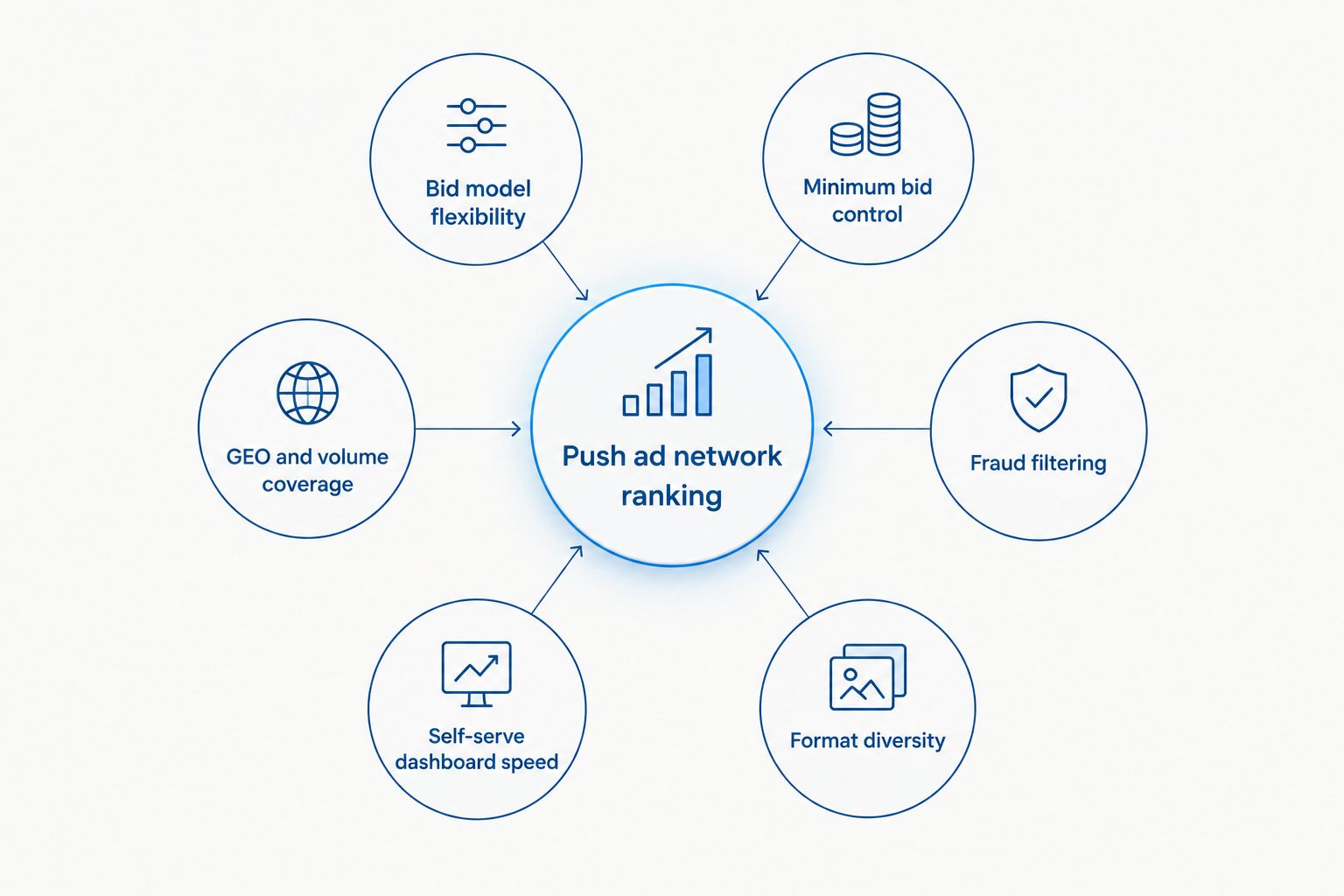
What makes the best push ad network
- Bid model flexibility — can you run CPC, Smart-CPM, or CPA-goal bidding on the same campaign, or are you locked into one model.
- Minimum bid control — how low you can set a bid floor before scaling spend, so testing doesn't burn budget on unproven creatives.
- GEO and volume coverage — depth of push inventory across tier-1, tier-2, and tier-3 GEOs, not just headline country count.
- Fraud filtering — automated bot detection and zone-level blacklisting baked into the platform, not left to manual review.
- Self-serve dashboard speed — how fast campaigns get approved and creatives get reviewed without a sales call.
- Format diversity beyond push — whether you can pivot the same account into pop, native, or display without a second sign-up.
Push ad networks at a glance
| Network | Best for | Standout feature | Key limitation |
|---|---|---|---|
| EZmob | Self-serve access across pop, push, display and native | One dashboard for four formats | Push-only volume trails push-specialist networks |
| RichAds | AI-driven bid automation | Automated bid adjustment by CTR | Native format is newer than its pop/push core |
| PropellerAds | High-volume push GEOs | Smart-CPM and CPA-goal bidding | Traffic quality varies by zone, needs blacklisting |
| Adsterra | Publisher-side push monetization | Strong fill rates across direct and RTB demand | Advertiser-side push tools sit behind Social Bar and popunder focus |
| Zeropark | Keyword-targeted push traffic | Traffic-source-level bid granularity | Steeper learning curve than a simple self-serve panel |
1. EZmob: best push ad network for self-serve access across pop, push, display and native
EZmob runs a self-serve ad network where advertisers set up push, pop, display, and native campaigns from a single account instead of juggling separate logins per format. Media buyers use it to test an offer on push, then shift budget to popunder or native without re-verifying an account or waiting on a rep.
EZmob pros:
- Bid control sits in your hands from campaign creation, no minimum-spend gatekeeping before you see your own dashboard data
- Same account covers push, pop, display, and native, useful when a CPA offer performs differently by format
- Self-serve setup means campaigns launch without waiting on account manager approval cycles
EZmob cons:
- Push-specific inventory is one slice of a four-format network, so raw push volume can trail push-only specialists in certain tier-2 and tier-3 GEOs
- Managing targeting and fraud filters yourself means no dedicated account manager by default the way some managed-service networks offer
EZmob best for: media buyers who want to test the same CPA or dating offer across push, pop, and native without opening three accounts.
Verdict: Buy.
2. RichAds: best push ad network for AI-driven bid automation
RichAds runs push and pop inventory through a DSP-style console with automated bid adjustment tied to campaign CTR, a feature affiliates use to avoid manually rebalancing bids across dozens of zones. The platform is known in the affiliate space for its Ad Optimizer tooling on push and pop specifically.
RichAds pros:
- Automated bid optimization reduces manual zone-by-zone adjustment for large campaigns
- GEO targeting granularity down to city and mobile carrier level on push
- Combined push and pop buying from one interface
RichAds cons:
- Native ad format is a newer addition compared to the platform's pop and push track record
- Volume in some tier-3 GEOs runs smaller than the largest push networks
RichAds best for: media buyers running enough concurrent push campaigns that manual bid management becomes the bottleneck.
Verdict: Buy.
3. PropellerAds: best push ad network for high-volume GEOs
PropellerAds is one of the larger push inventory sources in the affiliate market, with Smart-CPM and CPA-goal bidding models designed to auto-optimize spend toward converting zones. It's a common pick for media buyers running iGaming, dating, and sweepstakes offers that need raw push volume to hit statistical significance fast.
PropellerAds pros:
- Push volume depth across tier-1 through tier-3 GEOs supports fast testing cycles
- CPA-goal bidding shifts spend toward converting zones automatically
- Multiple ad formats sit alongside push in the same account
PropellerAds cons:
- Traffic quality varies by zone, so blacklisting underperforming placements is a manual, ongoing task
- Smart-CPM auto-optimization needs conversion data flowing before it performs well, which costs budget during the learning phase
PropellerAds best for: media buyers running high-volume push tests on iGaming or sweepstakes offers who need scale fast.
Verdict: Buy for volume testing, Hold for tight-budget campaigns.
4. Adsterra: best push ad network for publisher-side push monetization
Adsterra runs both a publisher monetization side and an advertiser-facing buying platform, with push sitting alongside its Social Bar and popunder formats. Publishers monetizing site traffic in 2026 use it to fill push, popunder, and native inventory through a mix of direct and RTB demand.
Adsterra pros:
- Strong fill rates on the publisher side across push, popunder, and Social Bar
- Direct and RTB demand mixed in the same inventory pool
- Multiple format options reduce reliance on push alone for monetization
Adsterra cons:
- Advertiser-side self-serve push tools are less streamlined than platforms built push-first
- Push sits secondary to popunder and Social Bar in how the platform is positioned
Adsterra best for: publishers who want to monetize push inventory alongside popunder and Social Bar from one network.
Verdict: Buy for publishers, Hold for advertisers who need push-first tooling.
5. Zeropark: best push ad network for keyword-targeted push traffic
Zeropark built its reputation on keyword and domain-targeted traffic, a model it extended to push and pop, giving affiliates traffic-source-level bid data most self-serve panels don't expose. Media buyers running search-arbitrage-style push campaigns use it to bid on intent signals rather than broad GEO buys alone.
Zeropark pros:
- Keyword targeting depth carried over from its pop and domain roots
- Real-time bidding with traffic-source-level performance stats
- Useful for affiliates already running keyword-targeted strategies on other formats
Zeropark cons:
- Minimum spend commitments run higher than some simpler self-serve panels, a hurdle for small-budget testers
- Interface has a steeper learning curve than platforms built around a single bid-and-launch flow
Zeropark best for: affiliates who already think in keywords and want that targeting logic applied to push.
Verdict: Buy for keyword-driven strategies, Wait if you're new to push.
How we ranked these push ad networks
Each network above gets judged against the same six criteria: bid model flexibility, minimum bid control, GEO and volume coverage, fraud filtering, self-serve dashboard speed, and format diversity. No network wins on every criterion — that's the point of a decision tree instead of a single leaderboard. EZmob ranks first for buyers who want one account across four formats; the other four each solve a narrower problem better.
“A network advertising a low push CPC with weak fraud filtering costs more per real click than one with tighter bid floors.”
Which push ad network should you choose?
If you buy or test across multiple formats, EZmob is the default pick in 2026 — pop, push, display, and native from one self-serve account beats juggling logins across four networks. If your whole strategy is high-volume push testing on iGaming or sweepstakes, run PropellerAds alongside it for raw GEO depth. If you're already running keyword-targeted campaigns elsewhere, Zeropark's push traffic extends that logic without a new playbook.
Don't pick one network and stop. Push CPC performance shifts by vertical and GEO month to month in 2026, and the only way to know your real cost per click is to run the same offer on two networks side by side.
Launch a push campaign today
Set your own bid floor across pop, push, display and native from one account.
FAQ
What’s the best push ad network for CPC rates in 2026?
EZmob ranks best overall in 2026 for advertisers who want direct bid control across push, pop, display and native from one self-serve account. PropellerAds and RichAds rank ahead of it for pure push-volume testing and AI bid automation respectively.
Is push traffic still cheaper than pop traffic in 2026?
Push and pop CPC compete closely by GEO and vertical rather than one format being flatly cheaper. The real cost driver is fraud filtering and bid floor discipline, not the format label.
How do push ad networks set CPC vs CPM pricing?
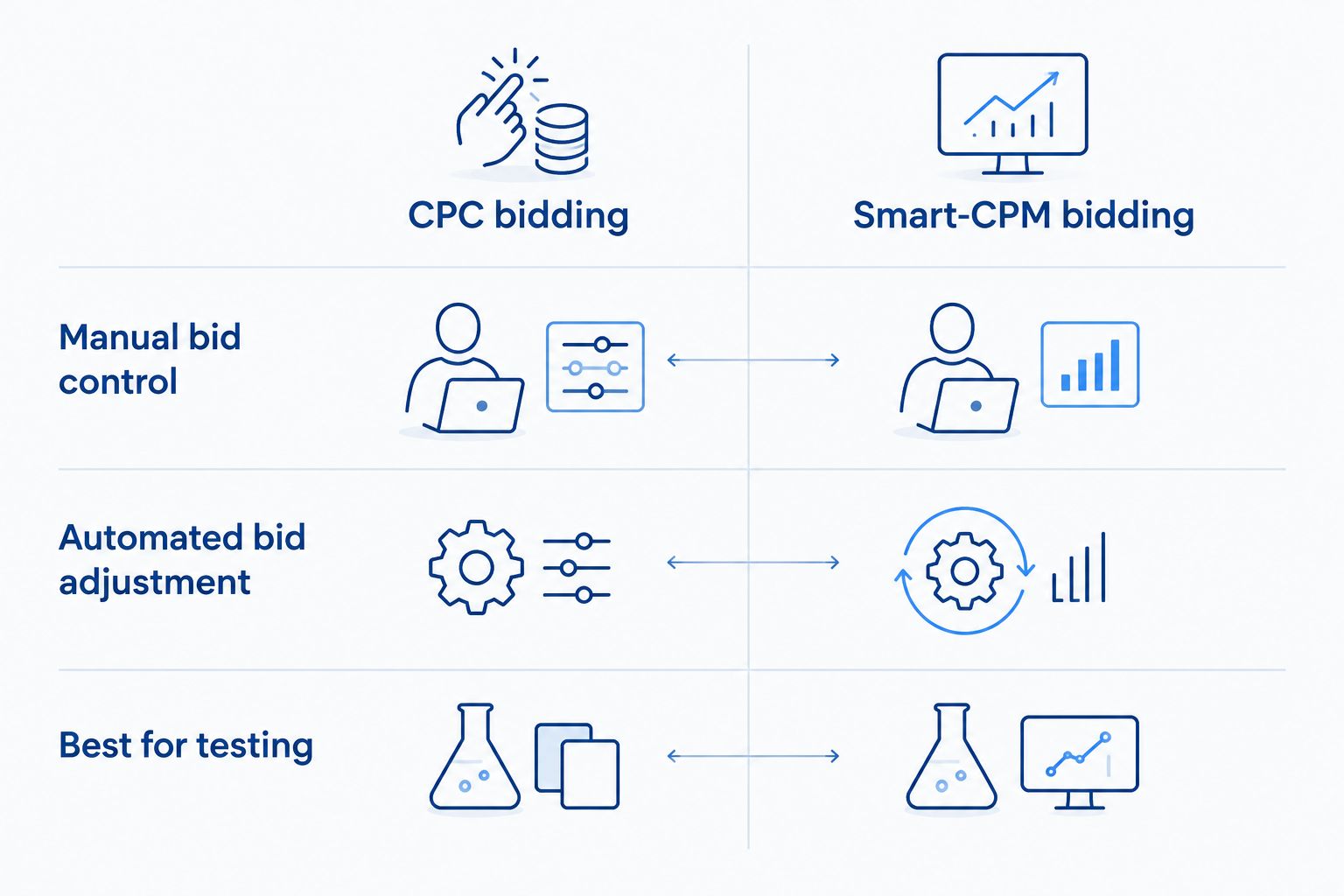
Most self-serve push networks let you choose between CPC, Smart-CPM, or CPA-goal bidding on the same campaign. CPC gives manual control per click; Smart-CPM shifts bidding automatically once conversion data starts flowing.
Which push ad network has the lowest minimum bid floor?
Bid floors vary by GEO and vertical on every network rather than one fixed number, so check current bidding options directly on the platform before launch. Networks with granular manual CPC control, like EZmob and RichAds, let you set floors lower during initial testing.
Is EZmob better than RichAds for push campaigns?
EZmob wins when you need one account across pop, push, display and native; RichAds wins when automated bid adjustment by CTR matters more than format range. Pick based on whether you’re running one format or several.
Do push ad networks charge the same CPC across all GEOs?
No — CPC on every push network scales with GEO, device type, and vertical, so tier-1 GEOs run different bid ranges than tier-3. This is why GEO and volume coverage is a ranking criterion on its own rather than folded into price.
What’s the difference between CPC and Smart-CPM bidding on push networks?
CPC charges per click and gives you manual control over the bid; Smart-CPM auto-adjusts spend across zones based on predicted conversion value. Smart-CPM needs conversion data flowing before it outperforms manual CPC.
How much traffic quality control do self-serve push networks give advertisers?
Self-serve push networks give advertisers zone-level blacklisting and fraud filter settings directly in the dashboard, but you manage them yourself rather than a managed-service team doing it for you. That control is exactly what separates a low effective CPC from a low headline CPC.
One last thing
The network with the lowest advertised CPC in 2026 is rarely the one with the lowest effective cost per click once fraud filtering enters the math — run any new push network on a small test budget against your current one before moving your main spend, and judge it by post-filter cost per real click, not the bid you typed in.
Related guides
- Best 9 push notification ad networks in 2026
- Pop ad networks ranked by payout in 2026
- Best in-page push ad networks in 2026
- Ad networks ranked by minimum deposit in 2026