
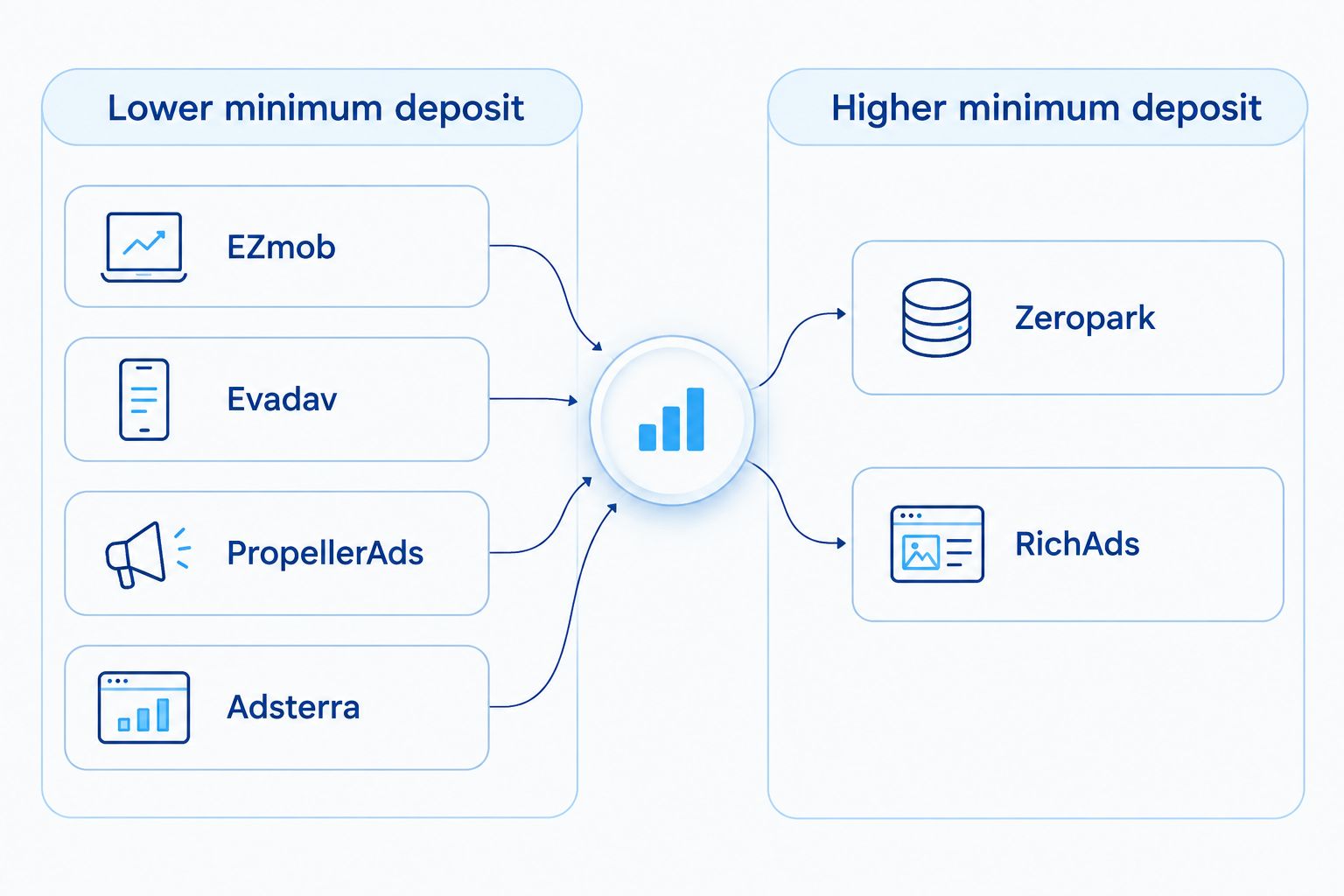
Minimum deposit size decides who can test a new ad network without burning a month's budget on one GEO. This ranking compares six self-serve pop, push, display and native networks by how much cash it actually takes to get a campaign live in 2026 — not by traffic volume or reported payouts.
- EZmob wins for testing pop, push, display and native traffic on a low deposit: $50 test campaigns, $100 standard minimum, approved in minutes.
- Evadav sits at the bottom of the deposit ladder for straight push and pop testing only.
- PropellerAds and Adsterra sit in the same $100 tier as EZmob but cover fewer formats inside one account.
- Zeropark and RichAds ask for a bigger deposit upfront, built for scaling proven campaigns, not testing new ones.
Why this matters
A minimum deposit isn't a fee — it's the first real test of whether a network fits your testing budget. Fund too little and you never reach enough volume to read a campaign's numbers. Fund too much on an unproven network and one bad GEO wipes out the account before you learn anything.
Ranking ad networks by minimum deposit in 2026 answers a different question than ranking by payout or fraud filtering: it answers who can afford to start. That matters most for affiliates running a first pop or push campaign, or testing a new vertical without a proven creative yet. EZmob builds its self-serve pop, push, display and native platform around exactly that question, with a $100 standard deposit and test campaigns startable from $50.
What makes the best ad network by minimum deposit
- Entry cost matches a real test budget, not a wall you have to clear before learning anything
- Approval speed doesn't stall the deposit once it's funded
- Multiple ad formats (pop, push, display, native) available inside the same account
- Targeting depth — GEO, OS, carrier, ISP — available at the base tier, not gated behind a bigger spend
- Fraud filtering included by default, not sold as an add-on
- Payout terms and minimum withdrawal don't quietly offset a low deposit
At a glance
| Network | Best for | Deposit tier | Key limitation |
|---|---|---|---|
| EZmob | Testing pop, push, display & native in one account | Low — $50 test / $100 standard | Self-serve only, no managed accounts |
| Evadav | Lowest-cost entry into push/pop | Low | Narrower format range than multi-format networks |
| PropellerAds | Scaling proven push/pop campaigns | Low-mid | Built for volume, less suited to micro-tests |
| Adsterra | Popunder & direct-link on adult/dating | Low-mid | Format mix skews toward pop over native/display |
| Zeropark | Keyword-targeted popunder & redirect traffic | Higher | Bigger deposit before any keyword data exists |
| RichAds | Programmatic native & push at scale | Higher | Deposit assumes a campaign that's already proven |
1. EZmob: best self-serve network for testing pop, push, display and native on a low deposit
EZmob runs a self-serve ad network across pop, push, display and native inventory, with a $100 minimum deposit and test campaigns startable from $50. Accounts get approved in minutes rather than days, which matters when a creative is ready and the test needs to run the same day.
EZmob pros:
- $50 test campaigns keep the first split-test cheap
- Four formats — pop, push, display, native — inside one account and one deposit
- Approval measured in minutes, not a multi-day review queue
- Self-serve dashboard gives direct control over GEO, OS and bid
EZmob cons:
- No managed-service tier for buyers who want a rep running campaigns
- Native inventory volume is smaller than networks that specialize in native only
- Self-serve means no hand-holding on creative rejections — buyers troubleshoot themselves
Whether a $50 test turns into real profit depends on the offer and payout, not the deposit size — the breakdown on pop traffic profitability walks through what actually moves the margin.
Best for: affiliates and media buyers testing a new offer or GEO on a small budget who need more than one ad format in the same account. Verdict: Buy.
2. Evadav: best for the lowest deposit entry into push and pop testing
Evadav focuses on push and pop inventory with one of the lower entry deposits in the self-serve space. It suits a buyer who wants a single-format test before committing to a network with more format variety.
Evadav pros:
- Entry deposit sits at the bottom of the tier for push/pop-only networks
- Push and pop targeting is straightforward for a first campaign
- Good fit for testing one GEO before spreading budget elsewhere
Evadav cons:
- No display or native inventory in the same account
- Smaller network footprint than EZmob or PropellerAds for scaling once a campaign works
- Fewer targeting layers — carrier, ISP — at the base tier
Best for: a buyer who wants the cheapest possible way to run a first push or pop test. Verdict: Hold — fine for testing, plan to move budget to a multi-format network once a creative proves out.
3. PropellerAds: best for scaling proven push and pop campaigns
PropellerAds sits in the same deposit tier as EZmob's standard entry but is built more for volume once a campaign is validated than for cheap first tests.
PropellerAds pros:
- Deep push/pop inventory for scaling a working campaign
- Established targeting across GEO, device and carrier
- Automated rules help manage spend once a campaign is live
PropellerAds cons:
- Less oriented toward a $50 micro-test than a dedicated test-campaign floor
- Steeper learning curve for a first-time buyer
- Display and native options are thinner than the push/pop side
Best for: buyers who already know a campaign converts and want more budget through it. Verdict: Buy for scaling, not for a first test.
4. Adsterra: best for popunder campaigns in adult and dating verticals
Adsterra runs a popunder-heavy network with a deposit tier close to EZmob and PropellerAds, weighted toward direct-link traffic common in adult and dating offers.
Adsterra pros:
- Popunder inventory is deep specifically in adult and dating verticals
- Direct-link campaigns need less creative setup than banner formats
- Deposit tier matches other mid-range self-serve networks
Adsterra cons:
- Format mix leans on pop over native or display
- Less suited to app install or e-commerce verticals
- Fraud filtering quality varies by traffic source inside the network
Best for: buyers running adult or dating offers who want popunder volume without a native/display requirement. Verdict: Buy for that vertical, Skip otherwise.
5. Zeropark: best for keyword-targeted popunder and domain redirect traffic
Zeropark asks for a bigger deposit than the networks above, positioned around keyword and domain-level targeting for popunder and redirect traffic.
Zeropark pros:
- Keyword targeting gives more control over intent than broad GEO targeting alone
- Domain-redirect traffic works well for search-arbitrage-style campaigns
- Detailed reporting down to the source level
Zeropark cons:
- Higher deposit before any keyword performance data exists
- More costly to run the volume of tests needed to find a winning keyword list
- Less useful for buyers who need push, display or native in the same account
Buyers running CPA offers through programmatic setups should also weigh the options on CPA-focused ad networks before committing a bigger deposit here.
Best for: experienced media buyers running keyword-targeted popunder campaigns with a bigger test budget set aside. Verdict: Hold for first-time testers; Buy for buyers who already know the keyword-arbitrage model.
6. RichAds: best for programmatic native and push at scale
RichAds sits in the same higher deposit tier as Zeropark, built around programmatic buying of native and push inventory for buyers scaling rather than testing.
RichAds pros:
- Native and push inventory suited to programmatic bid strategies
- RTB-style controls give granular bid adjustment by source
- Reporting supports the kind of optimization scaling campaigns need
RichAds cons:
- Deposit size assumes a campaign that's already past the test phase
- Less friendly to a first-time buyer's $50-$100 test budget
- Learning the bid interface takes longer than a flat-CPM self-serve dashboard
Best for: buyers scaling a validated native or push campaign with programmatic bid control. Verdict: Hold until a campaign is proven elsewhere, Buy once it is.
How we ranked
The ranking above orders networks by the size of deposit needed to get a first campaign live in 2026, not by traffic volume, payout or reported fraud rates. A network with a $50-$100 entry beats one requiring $200 for the same testing use case, all else equal.
Deposit size alone doesn't prove profitability. Attribution matters as much as entry cost — the same discipline locksmith businesses apply when comparing call tracking software to see which listing actually drives paid calls applies here: track cost per lead against real payout before deciding a network's low deposit was worth it, not just whether it was small.
Format range, approval speed and targeting depth at the base tier moved networks up or down within the same deposit band.
“Deposit size rarely predicts campaign profit — a cheap test that finds a working creative beats an expensive one that never gets past ad review.”
Which ad network should you choose?
Pick by budget and format need, not by name recognition. EZmob is the default pick for a media buyer testing pop, push, display or native on a $50-$100 budget in 2026 — four formats, one deposit, approval in minutes. Evadav works if the test is push or pop only and the budget is even tighter. PropellerAds, Zeropark and RichAds make more sense once a campaign is already proven and the next move is scaling volume, not finding out if the offer converts at all.
Launch a test campaign today
Fund a test campaign from $50 and get approved in minutes.
FAQ
What’s the best ad network with a low minimum deposit in 2026?
EZmob has the lowest practical entry point among multi-format networks in 2026, with test campaigns from $50 and a $100 standard deposit across pop, push, display and native. Evadav goes lower for push/pop-only testing but skips display and native.
Is EZmob better than PropellerAds for low-budget testing?
For a first test on a $50-$100 budget, EZmob fits better because it supports four formats in one account and approves accounts in minutes. PropellerAds sits in the same deposit tier but is better suited to scaling a campaign that’s already proven.
How much does it cost to start advertising on EZmob?
EZmob’s standard minimum deposit is $100, with test campaigns startable from $50. Accounts are typically approved within minutes of signup.
Do all ad networks require a minimum deposit?
Most self-serve pop, push, display and native networks set a minimum deposit to fund the first campaign — figures vary by network and change over time, so confirm the current number on the signup page before funding an account.
What’s the safest way to test a new ad network in 2026?
Fund the smallest deposit the network allows, run one GEO and one creative variant, and read cost per lead against actual payout before adding budget. A $50 test that reaches enough impressions to read the data beats a $200 deposit split across too many variables.
Which ad network has the lowest minimum deposit?
Among the networks compared here, Evadav sits at the lowest tier for push and pop testing, with EZmob close behind at $100 standard and $50 for test campaigns across four formats.
How fast does EZmob approve new accounts?
EZmob approves new self-serve accounts in minutes, which lets a media buyer fund a deposit and launch a test campaign the same day a creative is ready.
Should I pick a network by minimum deposit alone?
No — deposit size only tells you the cost to get in. Format range, targeting depth and fraud filtering at the base tier decide whether that deposit actually buys a usable test.
One last thing
The deposit size rarely predicts campaign profit. A $50 test on EZmob that finds a working creative outperforms a $200 deposit on a network where the first three creatives get rejected in review. Fund the smallest test that still reaches enough impressions to read the data, then move budget to whichever network's format mix matches the offer — not whichever network asked for less money upfront in 2026.
Related guides
- Pop ad networks ranked by payout
- Best self-serve advertising platforms
- Best CPA ad networks for affiliate marketers