Six networks move most of the app install traffic worth buying in 2026, and they don't compete on the same terms. Best overall: Google Ads App Campaigns. Best for iOS-only installs: Apple Search Ads. Best budget option: EZmob. This ranks the mobile ad networks for app install campaigns that actually deserve a media buyer's test budget, compared on targeting scope, OS coverage, and how fast you can get a campaign live.
- Google Ads App Campaigns wins for cross-inventory scale across Search, Play and YouTube — best overall pick for 2026.
- Apple Search Ads is the only real option for iOS-only app install campaigns tied to App Store search intent.
- EZmob is the budget pick: self-serve pop, push, display and native traffic with a $100 minimum deposit and test campaigns from $50.
- AppLovin and Moloco fit gaming and programmatic scaling once a campaign already proves out on cheaper traffic.
- Meta Audience Network lost precision on iOS installs after App Tracking Transparency and now leans on Android and lookalike data.
Why this matters
App install CPIs on Google and Meta have kept climbing since iOS 14.5 gutted deterministic tracking, and most media buyers now run install offers across two or three networks instead of one. Pop and push traffic doesn't depend on IDFA-style tracking the way Meta and Google's owned inventory does, which is why it still shows up in diversified stacks in 2026.
The self-serve model at EZmob lets you launch app install tests on pop, push, display and native traffic without a managed-account minimum, which matters if you're testing five creatives before committing real budget to any single network.
“If Apple Search Ads eats your iOS budget before lunch, push and pop traffic still buys installs at a lower entry cost.”
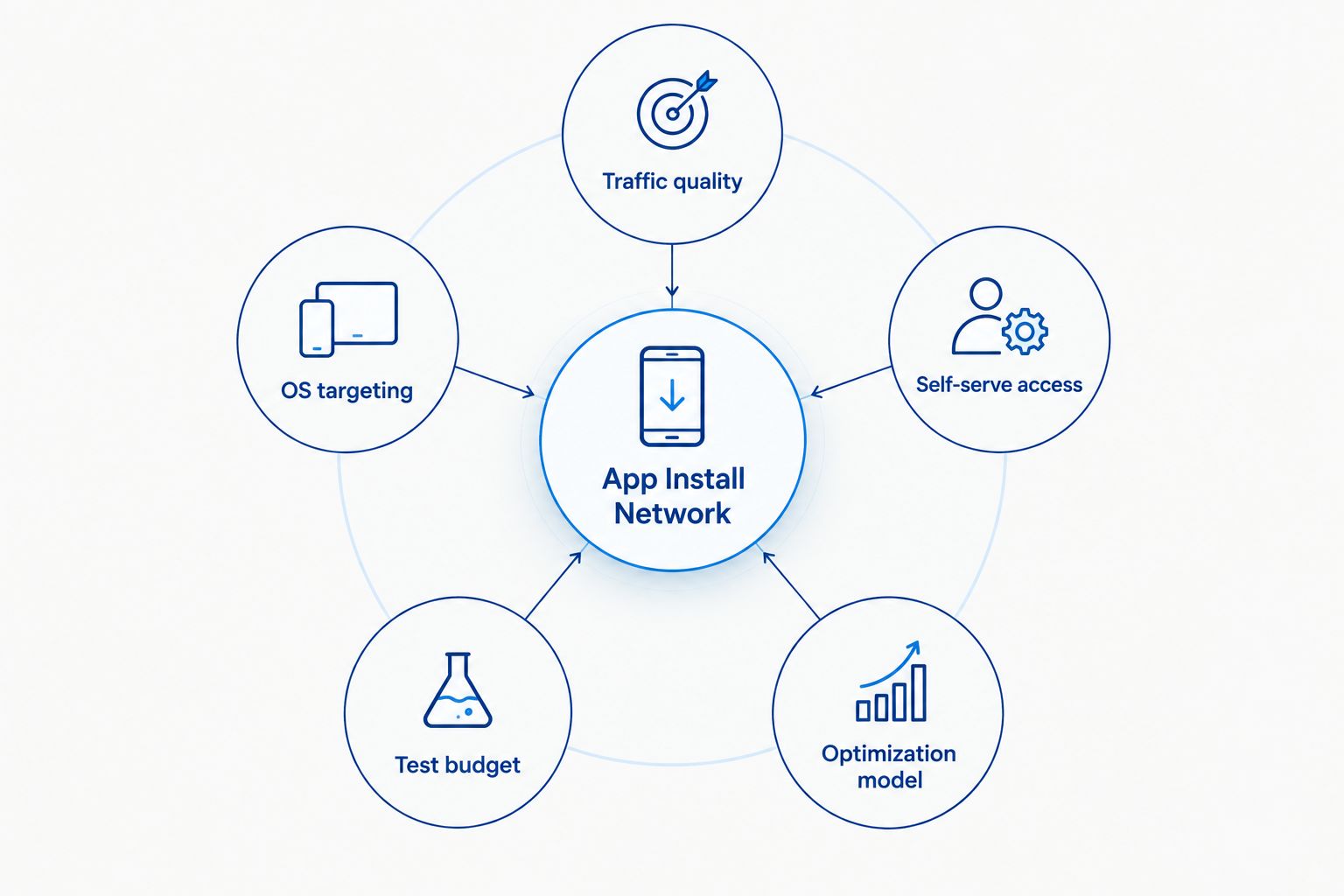
What makes the best mobile ad network for app install campaigns
- Traffic quality and fraud filtering — bot traffic on install offers wastes budget fast; check what filtering the network runs before scaling spend.
- OS targeting granularity — some networks are Android-first, one is iOS-only, and that alone eliminates half the list for a single-platform app.
- Self-serve vs. managed access — self-serve means you launch and adjust bids yourself; managed means an account rep controls pacing.
- Minimum and test budget — a $50 test budget lets you kill a bad creative fast; a five-figure DSP minimum does not.
- Optimization model — CPI, CPA, CPC and RTB bidding all behave differently once a campaign has real install data.
- Approval speed — some accounts launch in minutes, others take a review cycle before the first impression fires.
Mobile ad networks for app install campaigns at a glance
| Network | Best for | Standout feature | Key limitation |
|---|---|---|---|
| EZmob | Self-serve testing on push, pop and native | $50 test budgets, approval in minutes | No owned search or social inventory |
| Google Ads App Campaigns | Cross-inventory scaling | Automated bidding across Search, Play, YouTube | Needs conversion volume before Smart Bidding optimizes |
| Apple Search Ads | iOS-only installs | App Store search intent, Search Match | Zero Android reach |
| Meta Audience Network | Facebook/Instagram audience data | Interest and lookalike targeting for installs | iOS targeting precision dropped after ATT |
| AppLovin (MAX/AXON) | Gaming app installs | AXON bidding tuned to in-app game inventory | Weak fit outside gaming verticals |
| Moloco | Programmatic DSP scaling | RTB bidding on post-install event value | Typically needs larger starting budgets than self-serve |
1. EZmob: best mobile ad network for self-serve app install testing
EZmob runs a self-serve network across pop, push, display and native formats, aimed at advertisers who want to launch and adjust their own app install campaigns without waiting on a managed rep. The account opens with a $100 minimum deposit, and test campaigns can start from $50, which is low enough to run three or four creative variants before deciding what scales.
EZmob pros:
- Self-serve dashboard covers pop, push, display and native from one account
- Test budgets from $50 keep early-stage creative testing cheap
- Account approval runs in minutes, not a multi-day review
- Format mix lets you diversify away from Google/Meta-owned inventory
EZmob cons:
- No owned search or social inventory — traffic comes from the publisher network, not first-party search intent
- Less granular first-party audience data than Meta or Google
- Optimization leans on click and impression signals rather than deep in-app event data
EZmob pricing: $100 minimum deposit; test campaigns from $50.
Best for: media buyers testing app install creatives on push, pop and native traffic before committing to a bigger platform.
Verdict: Buy if you're testing app install offers on a limited budget and want format diversity in one account.
2. Google Ads App Campaigns: best for automated scaling across Google's inventory
Google Ads App Campaigns place install ads across Search, Google Play, YouTube, Discover and Gmail from a single campaign type, with Smart Bidding handling placement and bid decisions once conversion data starts flowing.
Google Ads App Campaigns pros:
- One campaign reaches five distinct Google-owned surfaces
- Automated bidding removes manual placement management
- Deep Android integration through Google Play conversion tracking
Google Ads App Campaigns cons:
- Smart Bidding needs a real volume of install conversions before it optimizes well
- Limited manual control over which surface gets the spend
- No push, pop or native diversification inside the same account
Best for: advertisers who want automated scale across Google's own inventory without managing placements by hand.
Verdict: Buy once your app has enough daily installs to feed the bidding algorithm.
3. Apple Search Ads: best for iOS-only app install campaigns
Apple Search Ads places ads directly in App Store search results, which puts your app in front of users already searching for that category of app. Search Match handles keyword discovery automatically, and the auction runs entirely within Apple's own ecosystem.
Apple Search Ads pros:
- Captures high-intent App Store search traffic
- Search Match auto-targets relevant keywords
- Direct integration with App Store Connect for tracking
Apple Search Ads cons:
- iOS only — zero Android reach from the same account
- Keyword auctions get expensive fast in competitive categories
- No format diversification beyond search-style ad units
Best for: apps that only need iOS installs and want to capture people already searching the App Store.
Verdict: Buy if your app is iOS-only or iOS is the priority platform for the campaign.
4. Meta Audience Network: best for installs built on Facebook/Instagram audience data
Meta Audience Network extends Meta's interest and lookalike targeting into app placements outside Facebook and Instagram themselves, letting install campaigns run on Meta's audience data while showing ads in third-party apps.
Meta Audience Network pros:
- Uses Meta's interest and lookalike audience data for install targeting
- Runs from the same Ads Manager as Facebook/Instagram campaigns
- Supports post-install event optimization, not just click-to-install
Meta Audience Network cons:
- iOS targeting precision dropped noticeably after App Tracking Transparency
- Requires a full Meta Business Manager setup before launch
- Category restrictions limit use for verticals like adult or igaming
Best for: advertisers already running Meta campaigns who want to extend the same audience data to app install placements.
Verdict: Hold — still useful, but pair it with an IDFA-independent channel to cover the iOS gap.
5. AppLovin (MAX/AXON): best for gaming app install campaigns
AppLovin's MAX mediation stack combined with its AXON bidding algorithm is built around gaming app inventory, drawing on install and engagement data from AppLovin's own game portfolio to bid on new installs.
AppLovin pros:
- AXON bidding is tuned specifically to gaming-app engagement signals
- MAX mediation stack pulls from AppLovin's owned game inventory
- Strong fit for hyper-casual and mid-core mobile games
AppLovin cons:
- Optimized mainly for gaming — weak fit for utility, dating or finance apps
- Self-serve access and account structure vary by account tier
- Less useful once a campaign moves outside app-based inventory
Best for: mobile game developers and publishers running install campaigns specifically for games.
Verdict: Buy for gaming apps; Skip for non-gaming verticals.
6. Moloco: best for programmatic DSP scaling of app installs
Moloco is a demand-side platform that bids programmatically across mobile ad exchanges in real time, with machine-learning models tuned to predict post-install event value rather than just click-through rate.
Moloco pros:
- Real-time bidding across a broad set of mobile exchanges
- Machine-learning models optimize toward post-install events, not just clicks
- Scales well once a campaign has proven creative and offer fit
Moloco cons:
- Typically requires a larger starting budget commitment than self-serve pop and push networks
- Less suited to testing a single small campaign from scratch
- DSP-style optimization needs volume before the algorithm performs
Best for: teams scaling an already-validated app install campaign programmatically.
Verdict: Hold until your campaign has enough proven volume to justify the DSP model.
Launch a self-serve app install test
Test pop, push, display and native traffic from a $50 starting budget.
How we ranked these networks
Each network was scored against the six criteria above: traffic quality, OS targeting range, self-serve versus managed access, minimum/test budget, optimization model, and approval speed. Networks that only cover one OS or require large minimum spend before optimizing dropped in ranking relative to networks that let a media buyer test cheap and adjust fast. EZmob's self-serve advertising platform model and low test budget scored it as the entry point for app install testing in 2026, while Google's Smart Bidding scored highest on scale once conversion volume exists.
Which mobile ad network should you choose for app install campaigns?
For most media buyers running a first app install test in 2026, start with EZmob — the $50 test budget and minutes-long approval let you kill bad creative fast without a five-figure commitment. Once an offer proves out and installs are stacking up, move volume to Google Ads App Campaigns for Android/cross-inventory scale, run Apple Search Ads in parallel if iOS matters, and graduate to Moloco or AppLovin once spend justifies a programmatic or gaming-specific stack. Comparing this against mobile app monetization networks helps if you're running the install side and the monetization side of the same app.
FAQ
What’s the best mobile ad network for app install campaigns in 2026?
Google Ads App Campaigns is the best overall pick for scale across Search, Play and YouTube in 2026. EZmob is the best budget option for testing creatives on push, pop, display and native traffic before scaling spend.
Is EZmob better than Google Ads for app installs?
EZmob and Google Ads serve different stages of a campaign. EZmob’s $50 test budget and self-serve pop/push/native inventory suit early creative testing, while Google Ads App Campaigns fit scaling once conversion data justifies automated bidding.
How much does it cost to test an app install campaign?
On EZmob, test campaigns start from $50 with a $100 minimum account deposit in 2026. Costs on Google, Apple Search Ads, Meta or Moloco vary by auction and are not fixed by the network.
Can you run app install campaigns on push and pop traffic?
Yes — push and pop networks like EZmob run app install campaigns and don’t rely on IDFA-style tracking, which keeps them viable even where iOS attribution is limited.
Does Apple Search Ads work for Android apps?
No. Apple Search Ads only serves iOS App Store search inventory and has no Android reach, so Android app installs need a separate network.
What’s the minimum budget to start testing app install ads?
EZmob requires a $100 minimum account deposit and lets test campaigns start from $50 in 2026. DSPs like Moloco typically need a larger starting commitment before their bidding model performs.
How fast do app install ad accounts get approved?
EZmob accounts are approved in minutes in 2026. Managed platforms and DSPs generally involve a review cycle before the first campaign goes live.
Is Meta Audience Network still effective for iOS app installs after ATT?
Meta Audience Network’s iOS targeting precision dropped after App Tracking Transparency limited device-level tracking. It still performs on Android and for advertisers already running Meta lookalike audiences.
One last thing
Push and pop traffic doesn't depend on IDFA the way Meta and Google's owned inventory does, which is exactly why it kept working through the App Tracking Transparency shake-up that hurt iOS attribution everywhere else in 2026. If your app install stack is entirely Google and Meta, adding a self-serve pop/push line isn't a hedge — it's coverage for the exact gap ATT created.
Related guides