Anstrex helps affiliate marketers research native and push advertising before building campaigns. Its role is ad intelligence, not the traffic buying needed to test an offer. The best Anstrex alternative in 2026 is EZmob if you need to buy traffic; AdPlexity if you need another dedicated ad-research tool.
- Compare Anstrex alternatives by job: ad research, traffic buying, or public ad discovery.
- EZmob is best for media buyers who need self-serve pop, push, display, and native traffic.
- AdPlexity is the closer alternative when you still need dedicated affiliate ad intelligence.
- Meta Ad Library suits public Meta ad research, not native or push campaign execution.
Why this matters
Replacing a research tool with an ad network solves a different problem. You gain a place to launch campaigns, but that does not replace competitor discovery.
For affiliate marketers, the decision starts with the next blocked task. If you cannot find relevant creative angles, compare research tools. If you already have an offer, landing page, and tracking plan, another research subscription does not launch the campaign for you.
Choose the missing capability, not the longest feature list. This comparison separates research from execution so you can decide whether to replace Anstrex, keep it, or use a different tool alongside it.
Anstrex alternatives at a glance
The options below serve different jobs. Anstrex remains in the table because a useful comparison must show when the original tool still fits.
| Tool | Best for | Standout capability | How it differs from Anstrex | Main limitation |
|---|---|---|---|---|
| Anstrex | Native and push ad research | Dedicated ad intelligence | The research benchmark | Observed ads do not establish your offer's profitability |
| EZmob | Launching paid traffic campaigns | Self-serve pop, push, display, and native traffic | Buys traffic rather than replacing competitor research | Not a like-for-like ad intelligence replacement |
| AdPlexity | Dedicated affiliate ad research | Research products organized around traffic categories | Another specialist research option | You still need a traffic source to execute a campaign |
| Meta Ad Library | Researching ads on Meta platforms | Public access to searchable ad creative | Focuses research on Meta advertising | Does not replace native or push ad intelligence |
This is a workflow comparison, not a ranking based on measured campaign performance. No tool earns a profitability claim simply because it helps you discover ads or launch them.
1. EZmob: best for launching traffic tests
EZmob is a self-serve ad network for advertisers who need to move from research into campaign execution. You can sign up, fund your account, and launch campaigns without a sales call; new campaigns go through creative moderation before going live.
The supported formats include popunder, push notifications, display, native, video, and direct-click traffic. That makes the platform relevant when your bottleneck is buying traffic, rather than finding another competitor ad to inspect.
Where EZmob shines
- Execution: You can turn an offer and creative concept into a traffic campaign.
- Format choice: Pop, push, display, and native support different campaign approaches.
- Self-serve access: Advertisers manage the launch process themselves, without a required sales call.
- Affiliate relevance: The advertiser focus includes performance marketers, affiliates, and media buyers running CPA offers.
Where EZmob falls short
- It is not a direct substitute for Anstrex's competitor ad research.
- Self-serve access still requires you to make campaign, creative, and measurement decisions.
- Creative moderation sits between campaign submission and launch; submission does not mean an ad is already running.
Head-to-head: traffic buying versus ad research
| Dimension | EZmob | Anstrex |
|---|---|---|
| Primary job | Launch paid traffic campaigns | Research advertising |
| Main decision | What campaign should you run? | What advertising should you investigate? |
| Workflow stage | Campaign execution | Campaign research |
| Evidence to judge | Your campaign's tracked outcomes | Observed creative and advertising patterns |
Best for: Media buyers who have an offer ready and need self-serve access to traffic in 2026.
Verdict: Buy traffic here when execution is the missing step; keep a separate research process.
2. AdPlexity: best for dedicated affiliate ad research
AdPlexity is the closer category match when you want to replace Anstrex without changing the job you are buying a tool to do. Its research products address different traffic categories, so start with the advertising channel you actually use.
Do not choose on the assumption that every research product covers every format. Evaluate the relevant product against a specific research brief: your GEO, offer category, device context, and creative requirements.
Where AdPlexity shines
- Category fit: It belongs on a shortlist for affiliate ad intelligence rather than traffic purchasing.
- Focused evaluation: A traffic-category approach lets you assess the research environment relevant to your campaigns.
- Workflow continuity: You can keep research separate from your traffic source and tracking setup.
Where AdPlexity falls short
- Switching research tools does not give you a campaign delivery channel.
- A relevant ad example is not proof that the advertiser earns a profit.
- You still need to establish whether the selected research product covers your actual use case.
Head-to-head: compare research fit, not brand familiarity
| Dimension | AdPlexity | Anstrex |
|---|---|---|
| Primary job | Affiliate ad intelligence | Affiliate ad intelligence |
| Selection question | Which research product fits your traffic category? | Does its research coverage fit your campaign? |
| Evidence required | Relevant examples for your research brief | Relevant examples for the same brief |
| Execution requirement | Separate traffic source | Separate traffic source |
A meaningful 2026 comparison uses the same brief in both tools. Search for the same offer category and GEO, then record whether the results help you build a distinct, compliant campaign concept.
Best for: Affiliates who still need specialist ad research and want a closer Anstrex substitute.
Verdict: Buy only after confirming that the relevant research product fits your channel.
3. Meta Ad Library: best for public Meta ad research
Meta Ad Library lets you inspect searchable advertising from Meta platforms. It is a sensible option when your research question concerns advertising on Facebook or Instagram, rather than native or push inventory.
That channel boundary matters. A strong social ad concept does not tell you how the same offer will perform as a push notification or popunder landing page.
Where Meta Ad Library shines
- Public discovery: You can inspect advertising without treating every research task as a specialist-tool purchase.
- Advertiser context: You can investigate how a named advertiser presents its offer on Meta platforms.
Where Meta Ad Library falls short
- It does not provide a like-for-like replacement for native and push research.
- Seeing an ad does not reveal its acquisition economics or prove it is worth copying.
Best for: Advertisers whose immediate research question concerns Meta creative and messaging in 2026.
Verdict: Hold off on a specialist replacement if public Meta ad research answers your actual question.
Why people switch from Anstrex
There is no need to claim a pricing change, outage, or product failure to explain a switch. The practical reasons below concern a change in what you need, not an unsupported criticism of Anstrex.
You need campaign execution
If your landing page and offer are ready, the next task is buying traffic and measuring outcomes. Another research environment does not perform that task.
Choose an ad network for execution. Judge the campaign through your own conversion data, not through the amount of competitor creative you collected beforehand.
Your research channel has changed
A move toward Meta advertising creates a different research question from a native or push campaign. Public Meta ad discovery can answer part of that question without being a universal replacement for specialist research.
Match the research environment to the channel. Do not transfer confidence from one inventory type to another without a campaign test.
Your current research workflow misses the brief
A research tool should help you answer a defined question about an offer category, GEO, or creative approach. If it does not, evaluate another specialist against that same question.
Do not use the number of search results as the deciding criterion. A smaller set of relevant examples is more actionable than a large collection you cannot use.
Evaluate alternatives with a campaign brief
Before changing tools in 2026, write down the decision the replacement must support. Use a short sequence that keeps research, delivery, and measurement separate.
Define the job
State whether you need competitor discovery, traffic buying, or campaign measurement. Avoid a brief that asks one platform to solve all three without checking its actual role.
Match the channel
Name the format and GEO you intend to use. A research result from another channel is inspiration, not evidence about your planned inventory.
Check the evidence
Separate an observable fact from an inference. An ad's message is observable; the advertiser's profit is not established by the creative alone.
Launch the test
Build an original campaign around the offer's requirements. Keep the landing page, conversion event, and tracking plan aligned before spending on delivery.
Review conversions
Use your campaign's outcomes to decide what to change. Creative discovery supports a hypothesis; conversion measurement decides whether that hypothesis works for your offer.
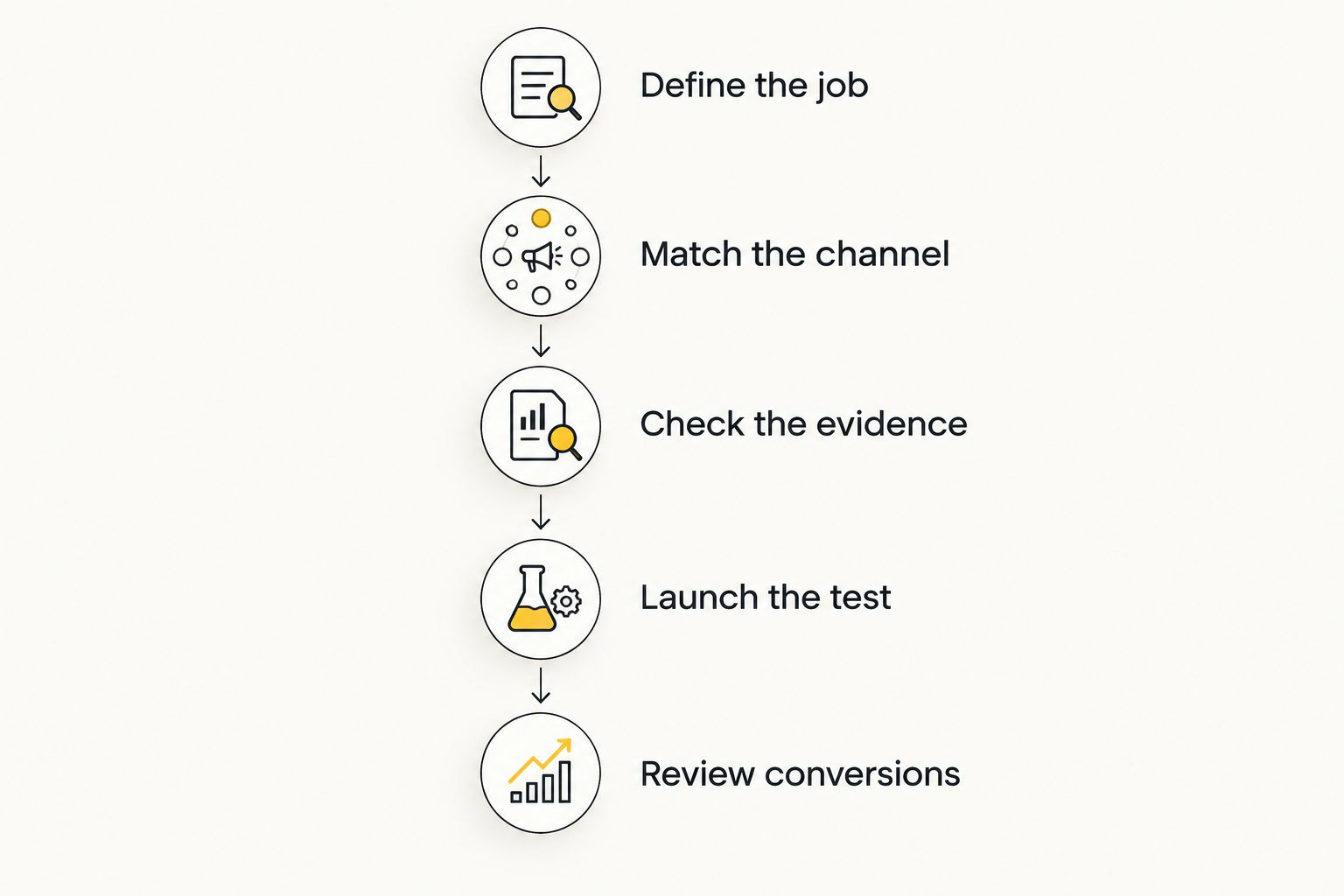
The sequence also prevents a common comparison error: blaming a research tool for a delivery problem, or blaming a traffic source for an unverified offer assumption. Diagnose the failed step before replacing software.
Separate publisher economics from advertiser results
Native advertising connects two different commercial interests: publishers monetize attention, while advertisers pay to acquire an outcome. Those interests meet at the placement, but they do not share the same success metric.
The economics of native advertising for publishers concern monetizing inventory; your advertiser decision concerns whether that inventory produces conversions at an acceptable acquisition cost. A placement that earns revenue for a publisher does not, by itself, establish advertiser profitability.
Keep that distinction when reviewing competitor ads. Their presence on a publisher's property tells you where advertising appeared, not what the advertiser earned after spend, rejected leads, or other campaign costs.
The same discipline applies to an alternatives shortlist. Research coverage, traffic access, and profitable acquisition are separate questions; evaluate each with the appropriate evidence.
When staying with Anstrex is the right call
Keep Anstrex if it answers your native or push research questions and your execution setup already works. Changing tools without a defined gap adds a new evaluation task without resolving an existing one.
Staying also makes sense when the problem sits downstream. An unclear landing page, incorrect conversion event, or unsuitable offer cannot be diagnosed from competitor creative alone.
For 2026, the sensible choice is not automatically a replacement. It can be retaining the research tool and adding the missing execution capability, or improving the way you judge campaign results.
FAQ
What’s the best Anstrex alternative in 2026?
AdPlexity is the closer alternative for dedicated affiliate ad research; EZmob fits advertisers who need to buy traffic instead. Choose according to whether your next task is research or campaign execution.
Is an ad network a replacement for Anstrex?
An ad network is not a like-for-like replacement for Anstrex. It delivers paid traffic, while Anstrex supports ad research; the two roles can sit in the same workflow.
Is AdPlexity better than Anstrex?
Neither tool is the universal winner for every affiliate research brief. Compare the relevant research products using the same channel, GEO, and offer category before choosing.
Can I use Meta Ad Library instead of Anstrex?
Meta Ad Library can answer research questions about advertising on Meta platforms. It does not replace specialist native or push ad intelligence.
Does seeing a competitor ad prove that an offer is profitable?
A competitor ad does not prove profitability. The creative does not establish spend, accepted conversions, revenue, or the advertiser’s acquisition costs.
Should I cancel Anstrex before testing an alternative?
Keep Anstrex until the alternative answers the research question you need resolved. If your problem is campaign execution rather than research, replacing the research tool addresses the wrong step.
What should I prepare before buying traffic?
Prepare your offer, creative, landing page, and conversion tracking before buying traffic. Define the outcome you will measure so the campaign produces evidence you can act on.
One last thing
Write down the campaign decision you expect an alternative to change before opening another dashboard. If you cannot name that decision, you do not yet have a reason to switch.
A useful shortlist ends with a next action: research a missing angle, launch a prepared campaign, or fix measurement. Collecting more ads is not a substitute for choosing one.
Related guides
- Best self-serve advertising platforms
- Best traffic sources for affiliate marketing
- Direct click vs popunder traffic: which should you buy?
Ready to launch a campaign? Start advertising on EZmob.