Best overall for self-serve paid traffic testing: EZmob. Best for existing search demand: paid search. Best without buying media: organic search. Among traffic sources for affiliate marketing in 2026, EZmob is best for media buyers who want self-serve access to pop, push, display, and native traffic.
- EZmob is the pick among traffic sources for affiliate marketing when you need self-serve, multiformat paid testing.
- Paid search suits explicit search intent; organic search suits affiliates building useful content around buying decisions.
- Email suits an existing permission-based audience, not affiliates starting without subscribers.
- Choose traffic by offer permissions, conversion tracking, landing-page fit, and approved CPA—not clicks alone.
Why this matters
A traffic source is a way to reach a buyer, not a guarantee that an offer converts. A search visitor actively looking for a solution and a visitor arriving through a popunder enter your funnel with different expectations. Sending both to the same page without adjustment ignores that difference.
For a 2026 campaign, start with the affiliate program's permitted promotion methods. Check the allowed GEOs, direct-linking rules, creative restrictions, and conversion approval conditions before choosing inventory. Traffic that violates the offer terms is not a useful test, even when your tracker records conversions.
What makes the best affiliate traffic source?
Judge each source against these criteria before choosing where to spend your time or campaign budget:
- Offer permission: The affiliate program explicitly allows your traffic method, audience, and promotional claims.
- Audience intent: The visitor's reason for arriving matches what the landing page asks them to do.
- Measurement: You can connect acquisition activity to approved conversions rather than stopping at clicks or registrations.
- Creative fit: You can produce the ads, landing pages, articles, or videos the channel requires.
- Operational control: You can identify what to change when performance misses your target.
- Repeatability: You can keep producing content or managing campaigns after the initial launch.
Choose the channel you can measure and operate, not the one with the most attractive headline claims. A source that needs editorial production is a poor fit when you only have campaign-management capacity.
Traffic sources at a glance
These recommendations separate an advertising platform from acquisition channels. The platform recommendation covers self-serve campaign access; the channel recommendations cover distinct buyer situations.
| Source | Best for | Standout feature | Key limitation |
|---|---|---|---|
| EZmob | Self-serve multiformat paid testing | Pop, push, display, and native campaign access | Requires campaign tracking and ongoing optimization |
| Paid search | Capturing explicit search intent | Ads aligned with a user's query | Offer and platform rules restrict eligible campaigns |
| Organic search | Building an owned content asset | Pages that answer purchase-related questions | Requires publishing, maintenance, and search visibility |
| Permission-based email | Reaching an existing subscriber audience | Direct communication with people who opted in | Requires a permission-based list and deliverability management |
| Paid social | Demonstrating a product or use case visually | Feed-based creative and audience targeting | Requires suitable creative and policy compliance |
| Native advertising | Explaining an offer through editorial content | An ad-to-article-to-offer journey | Requires alignment across several funnel stages |
| Organic creator video | Teaching or demonstrating before referral | Visible explanations and demonstrations | Requires sustained production and audience development |
1. EZmob: best affiliate traffic source for self-serve paid testing
EZmob lets advertisers sign up, fund an account, and launch campaigns without a sales call. Its formats include popunder, push notifications, display, native, video, and direct-click traffic. New campaigns go through creative moderation before going live.
Best for: Affiliates and media buyers who want to manage paid campaigns across different ad formats. This is a platform choice, not a claim that every format suits every offer.
EZmob pros:
- Self-serve campaign access without a required sales call.
- Pop, push, display, and native options within the advertiser offering.
- Direct-click traffic provides another format to evaluate against your offer.
EZmob cons:
- New campaigns require creative moderation before launch.
- Access to several formats does not remove the need to adapt landing pages.
- Advertisers still need reliable attribution and an optimization process.
For your 2026 launch, isolate a format and define the conversion you will evaluate before expanding. Testing unrelated offers and formats together makes the result harder to interpret. Confirm that the affiliate program permits the selected traffic method before submitting creative.
Verdict: Buy traffic here when you need self-serve format testing and have conversion tracking ready.
2. Paid search: best affiliate traffic source for explicit search intent
Paid search places ads against search activity. Its clearest affiliate use case is a query that already describes a problem, product category, or buying decision your landing page can answer.
Best for: Offers with permitted search promotion and a clear match between the query and the destination page. Do not assume permission to bid on a merchant's brand terms; check the program agreement.
Paid search pros:
- Query language gives you a concrete starting point for the ad message.
- Separate keyword themes can lead to separate landing pages.
- Search intent provides context for interpreting conversions.
Paid search cons:
- Merchant restrictions can exclude branded queries or other keyword groups.
- Ad platform policies also apply to the offer and destination.
- A relevant click still does not guarantee an approved conversion.
Build around the question the searcher actually asked. A comparison query needs a useful comparison; a problem query needs an explanation before a product recommendation. Sending every search to a generic affiliate bridge page wastes that context.
Verdict: Buy paid search when query intent, offer permissions, and landing-page relevance line up.
3. Organic search: best affiliate traffic source for an owned content asset
Organic search brings visitors to pages that appear in unpaid search results. For affiliates, the useful work is answering buying questions with original explanations, relevant evidence, and clear recommendations.
Best for: Publishers who can maintain a website and improve articles as products, policies, and reader needs change. In 2026, a date in the headline is not a substitute for checking the content.
Organic search pros:
- You control the destination and can improve it after publication.
- Different pages can address distinct stages of a buying decision.
- Useful content can also support email and creator distribution.
Organic search cons:
- Publishing does not guarantee rankings or visits.
- Articles need maintenance when the underlying facts change.
- Thin comparisons give readers little reason to trust a recommendation.
Start with a question you can answer better, not a keyword you can repeat more often. Explain who should choose an option, who should avoid it, and what evidence supports the distinction. Disclose the affiliate relationship clearly.
Verdict: Hold off on relying on organic search for immediate campaign feedback; choose it for sustained publishing.
4. Permission-based email: best affiliate traffic source for subscribers
Permission-based email distributes recommendations to people who opted in to receive your messages. It is an audience channel, not a shortcut for reaching strangers through purchased contact lists.
Best for: Affiliates with a relevant subscriber base and a clear reason to send another message. The offer should fit what subscribers expected when joining.
Permission-based email pros:
- You can explain why a recommendation fits the audience.
- Follow-up messages can address questions left unanswered initially.
- Subscriber interests can guide which offers you promote.
Permission-based email cons:
- It does not solve acquisition when you have no subscribers.
- Poor relevance can produce unsubscribes and complaints.
- Delivery, consent, and unsubscribe handling require ongoing attention.
Write the email around the reader's decision rather than the commission. State who the offer fits, disclose your relationship, and make the destination clear. Check both the affiliate program's email rules and the requirements that apply to your audience.
Verdict: Hold email promotion until you have permission-based subscribers and an offer that matches their expectations.
5. Paid social: best affiliate traffic source for visual discovery
Paid social introduces an offer through ads in social environments. It suits campaigns where a demonstration, recognizable problem, or clear use case can explain why someone should pay attention.
Best for: Affiliates who can create policy-compliant visual advertising and landing pages that continue the same message.
Paid social pros:
- Visual creative can show a use case before the landing-page visit.
- Different messages can address different buyer motivations.
- Comments and engagement can expose unanswered questions.
Paid social cons:
- The offer, claims, and destination must meet platform policies.
- Creative production adds work beyond campaign setup.
- Engagement is not a substitute for approved affiliate conversions.
Keep the promise consistent from the opening creative to the destination. If an ad demonstrates a specific use case, the landing page should explain that use case rather than switch to an unrelated sales pitch. Avoid claims you cannot substantiate, especially in sensitive categories.
Verdict: Buy paid social when you can demonstrate the offer clearly and support the claims throughout the funnel.
6. Native advertising: best affiliate traffic source for explanation-led funnels
Native advertising presents sponsored placements within a publisher's content environment. An affiliate can use the placement to introduce an explanatory article before asking the visitor to consider the offer.
Best for: Offers that need context, qualification, or an explanation of how the product addresses a problem. This recommendation concerns the funnel approach, not a separate platform ranking.
Native advertising pros:
- An explanatory page gives you room to address buyer questions.
- The headline can identify a specific problem or use case.
- The article can qualify readers before the merchant visit.
Native advertising cons:
- The ad, article, and offer each need a coherent message.
- Sensational headlines can create expectations the destination cannot meet.
- Sponsored content and affiliate relationships require clear disclosure.
In a 2026 native campaign, evaluate the entire path rather than celebrating article visits alone. A headline that attracts readers but produces no suitable merchant visits needs revision. So does an article that hides its recommendation until the reader loses interest.
Verdict: Buy native traffic when the explanation earns its place between the ad and the offer.
7. Organic creator video: best affiliate traffic source for demonstrations
Organic creator video uses published demonstrations, explanations, or tutorials to introduce an affiliate recommendation. It is useful when seeing a process answers questions that a short ad cannot.
Best for: Creators with relevant subject knowledge and the ability to demonstrate what they recommend accurately.
Organic creator video pros:
- A demonstration can show the reasoning behind a recommendation.
- Tutorials can answer practical questions before referral.
- Audience questions can inform follow-up content.
Organic creator video cons:
- Publishing requires preparation, recording, and editing.
- Distribution is not guaranteed after uploading.
- Views and audience growth do not prove affiliate profitability.
Choose a topic where the demonstration changes the buying decision. Show limitations as well as benefits, and distinguish actual use from information supplied by a merchant. Make the affiliate disclosure understandable without forcing viewers to search for it.
Verdict: Hold this channel unless you can sustain useful demonstrations; choose it when teaching is your strength.
How we ranked these traffic sources
The ranking prioritizes operational fit: offer permission, audience intent, measurement, creative requirements, control, and repeatability. It is not a claim that any source produces the highest conversion rate across affiliate offers.
Self-serve paid testing comes first for the media buyer audience. Search, email, social, native, and creator content each occupy a different decision slot. There is no shared campaign dataset here that supports a universal profitability ranking.
Turn the recommendation into a campaign decision
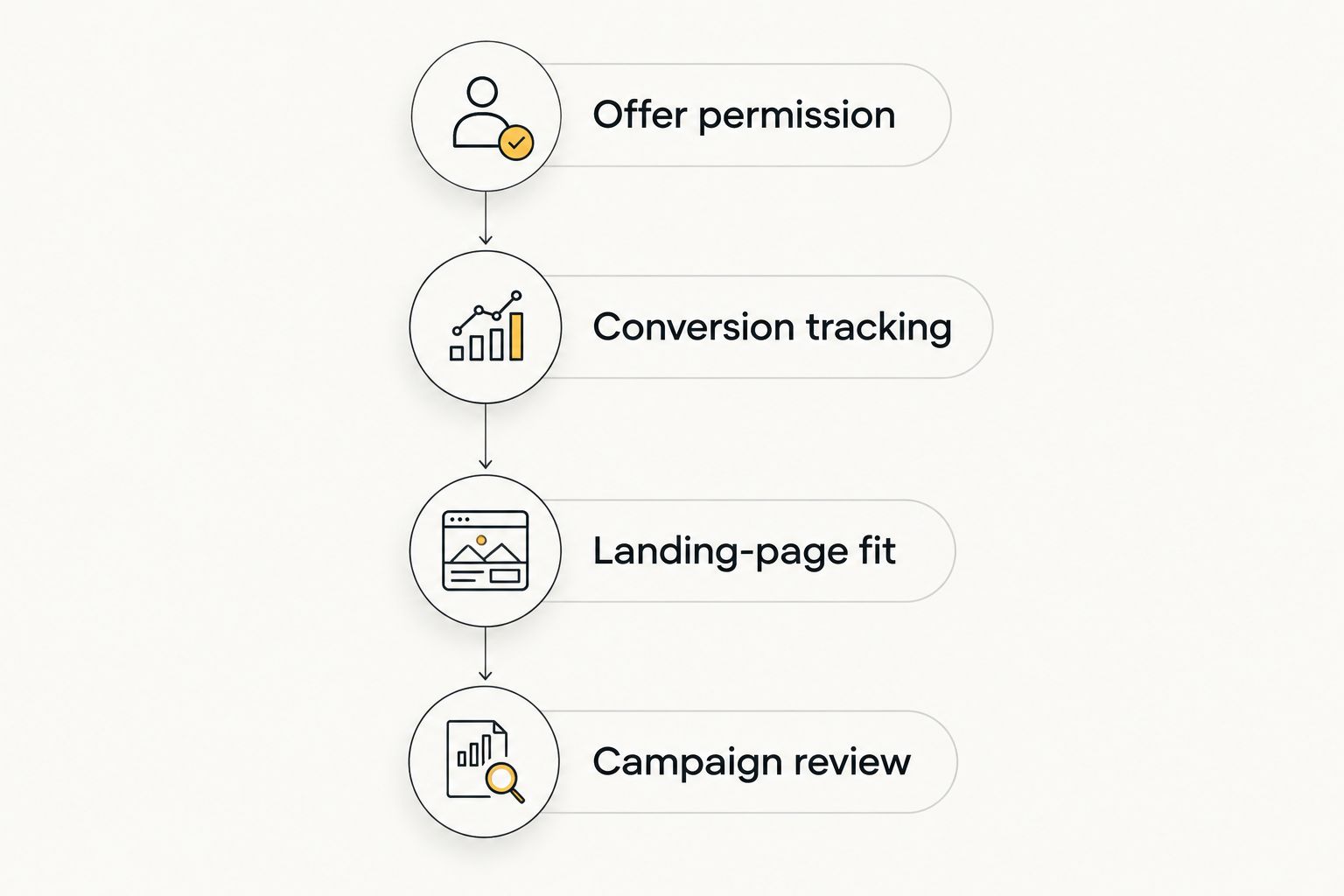
Use this sequence before committing to a source. It keeps channel selection tied to the offer rather than a general ranking.
- Offer permission: Confirm the traffic method, GEO, destination, and promotional claims are allowed.
- Conversion tracking: Verify that the intended conversion reaches your tracker and that you can distinguish approved outcomes.
- Landing-page fit: Match the page to the visitor's context and the promise that brought them there.
- Campaign review: Evaluate traffic segments against your own approved-conversion economics before expanding.
Change a defined part of the campaign, then evaluate the result. If you change the source, offer, landing page, and conversion event together, you cannot attribute the outcome to a particular change. Keep a record of what changed and why.
Which traffic source should you choose?
For a media buyer starting a measurable paid test, choose the self-serve platform recommendation first. For an affiliate with clear search demand, evaluate paid search. For a publisher with subject expertise and publishing capacity, build organic search content.
An existing subscriber list changes the decision: permission-based email deserves attention before adding another acquisition channel. A strong demonstration changes it again, making paid social or creator video relevant. The best 2026 choice is the source that fits your offer and operating capacity—not the source with the broadest promise.
FAQ
What’s the best traffic source for affiliate marketing beginners?
The best starting source is one your affiliate program permits and you can measure reliably. Self-serve paid traffic suits a beginner prepared to manage tracking and campaigns; organic content suits someone prepared to publish and maintain useful material.
Is paid traffic better than organic traffic for affiliate marketing?
Paid traffic and organic traffic serve different operating models. Paid campaigns require media buying and attribution, while organic search requires useful publishing and search visibility; neither guarantees approved conversions.
Can I send paid traffic directly to an affiliate offer?
Direct linking is appropriate only when the affiliate program and traffic platform permit it. Check the destination rules and confirm that conversion attribution survives the full redirect path.
Are push and popunder traffic the same?
Push and popunder are different ad formats. Push uses a notification-style message, while popunder opens a page behind the active browser window; the landing experience should account for that difference.
Can I use email if I don’t have an affiliate website?
Email promotion does not inherently require an affiliate website, but it does require a permission-based audience and compliance with the offer’s rules. Check destination requirements, disclosures, and the rules applicable to your subscribers.
How do I know whether an affiliate traffic source is profitable?
Compare attributable commission from approved conversions with the campaign’s costs. Clicks, registrations, and pending conversions alone do not establish profitability.
Should I test several affiliate traffic sources at once?
Start with a clearly defined test rather than combining unrelated sources and offers. Expand when you can distinguish which traffic and funnel changes produced the approved outcomes.
One last thing
A conversion in your tracker is not automatically payable commission. Reconcile campaign results with the affiliate program's approved outcomes before increasing spend. That check can change your decision even when the click and conversion reports look encouraging.
Related guides