
Publishers earn from in-page push ads according to their monetized impressions and realized publisher eCPM—not a fixed amount per visitor. Calculate revenue as paid impressions divided by 1,000, multiplied by publisher eCPM; then check whether that revenue adds to your total site earnings rather than displacing other income.
- Estimate in-page push ads earnings from paid impressions and publisher eCPM, not total visits.
- Compare revenue per 1,000 sessions before expanding an in-page push placement.
- EZmob supports publisher monetization with push, pop, display, and native formats; confirm in-page implementation details before testing.
- Keep an in-page push placement only when total site revenue improves without damaging your primary user journey.
Why this matters
A higher ad-unit eCPM does not automatically mean higher website earnings. An in-page placement can earn revenue while taking clicks away from another ad or interrupting a signup flow. Your decision needs to account for both effects.
EZmob offers publisher monetization through push, pop, display, and native formats. For a publisher evaluating in-page push in 2026, the useful starting point is a placement-level test—not a network-wide earnings promise.
How much can publishers earn from in-page push ads?
There is no fixed publisher payout per visitor. Your earnings depend on how many impressions qualify for monetization and the publisher revenue attributed to those impressions.
Use this calculation for a measured reporting period:
Publisher revenue = paid impressions ÷ 1,000 × realized publisher eCPM.
The formula works only when the impression count and eCPM use the same reporting basis. Do not multiply one placement's impressions by an account-wide eCPM that includes other formats or websites.
Follow these steps to build a usable estimate:
- Choose the inventory. Identify the website, placement, GEO, and device segment you intend to monetize.
- Count paid impressions. Use the network's relevant impression metric, not raw pageviews or ad requests.
- Match publisher eCPM. Take the realized eCPM for that same inventory and reporting period.
- Calculate revenue. Apply the formula without mixing advertiser spend with publisher earnings.
- Check total yield. Compare total website revenue against the baseline, using matched traffic segments.
For your 2026 forecast, separate observed results from assumptions. A forecast based on your own measured traffic is useful; treating another publisher's earnings screenshot as your expected payout is not.
What if you have no earnings history?
Start with a measurement plan rather than a payout forecast. Record the metrics you need, confirm the reporting definitions, and test a clearly identified placement before projecting revenue across your website.
Keep any unmeasured input visibly separate in your working sheet. An assumed impression count multiplied by an assumed eCPM produces a scenario, not evidence of what your site earns.
Measure earnings at the right level
In-page push revenue needs several denominators because each answers a different question. Use placement eCPM to understand monetized inventory, then page and session revenue to judge the website outcome.
| Metric | What it measures | Best for | Limitation |
|---|---|---|---|
| Publisher eCPM | Publisher revenue per 1,000 impressions | Comparing matched placement inventory | Does not show how many visits produce those impressions |
| Page RPM | Revenue per 1,000 pageviews | Comparing page-level monetization | Changes when the page and audience mix changes |
| Session RPM | Revenue per 1,000 sessions | Comparing total visit yield | Requires consistent session definitions and revenue scope |
| Total publisher revenue | Earnings over the selected period | Tracking the business result | Traffic growth can hide weaker yield |
Use total website revenue per 1,000 sessions as the main monetization decision metric. Keep placement eCPM as a diagnostic metric, not the entire verdict.
For example, a stronger placement eCPM does not settle the decision if fewer visitors reach the page where it appears. Likewise, lower placement eCPM does not prove a test failed if total revenue per session improves.
Do not compare impression eCPM with page RPM as though they were interchangeable. A pageview, an ad request, a rendered impression, and a paid impression represent different events.
In-page push versus browser push: what are you earning from?
In-page push is an advertising unit rendered inside a webpage. Browser push uses notification permissions and delivers notifications through supported browser mechanisms.
That distinction changes the revenue opportunity. An in-page unit reaches visitors while they are on the page; browser push depends on an opted-in audience and notification delivery.
| Format | Where the ad appears | Best for | Advantage | Trade-off |
|---|---|---|---|---|
| In-page push | Inside the website page | Monetizing active page visits | Does not require browser notification permission for the on-page unit | Competes for space and attention within the page |
| Browser push | Through browser notification delivery | Reaching an opted-in audience | Delivery is not limited to an open publisher page | Requires permission and supported delivery conditions |
Evaluate in-page push as on-site inventory, not as subscriber revenue. The notification-like appearance does not make the formats operationally identical.
Before comparing reports, confirm which format each line item represents. A combined push total can hide whether revenue came from current page visits or notification delivery to subscribers.
Why in-page push ads earnings vary
Your 2026 earnings analysis should separate audience differences from placement changes. Otherwise, a shift in traffic mix can look like a monetization improvement.
- GEO mix. Advertisers target locations, so separate countries before comparing publisher yield. A blended figure hides the contribution of each audience segment.
- Device and browser mix. Rendering conditions and available demand differ across environments. Check the actual placement on the devices your visitors use.
- Monetizable impressions. Visits do not guarantee paid impressions. Distinguish pageviews, requests, displayed units, and the impressions used in revenue reporting.
- Placement behavior. Position, overlap, and dismissal behavior affect how the unit interacts with the page. Judge those changes alongside earnings.
- Advertiser demand. The campaigns competing for an audience affect the revenue opportunity. Compare matched periods rather than treating one strong reporting window as permanent.
- Traffic validity. Invalid activity is not dependable inventory. Review unexplained traffic changes and any revenue adjustments before scaling a forecast.
Do not change every factor together. If you move the unit while changing traffic acquisition and page layout, the resulting revenue movement will not identify which change mattered.
Keep segmentation practical. Start with the largest meaningful differences in your traffic, then investigate further when a segment shows a clear reason for attention.
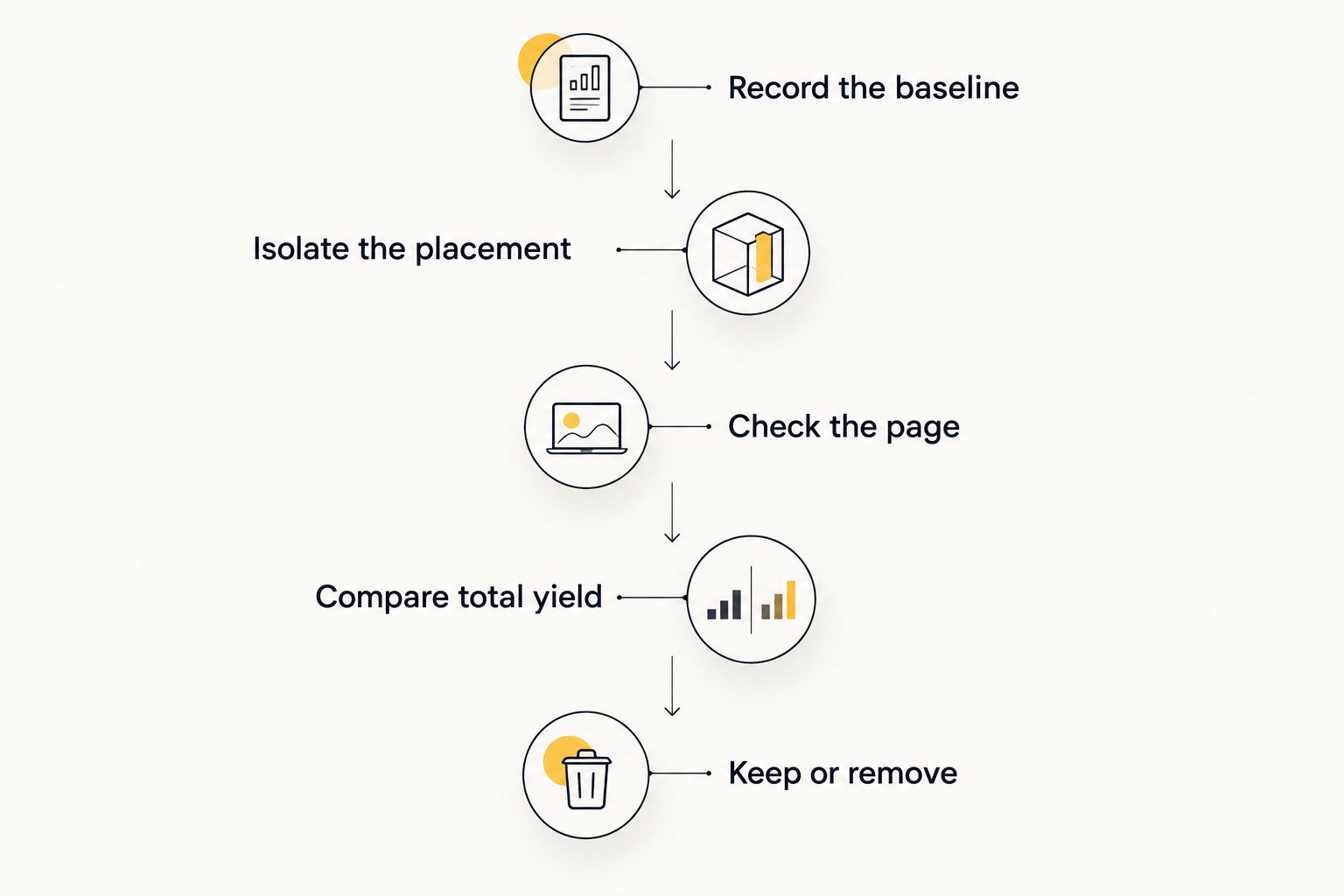
How should you test an in-page push placement?
Use a controlled comparison that measures the whole website outcome. Your test should answer whether adding the unit improves earnings—not merely whether the unit records revenue.
Record the baseline
Capture total ad revenue, sessions, pageviews, and your site's primary business outcome before changing the placement. Keep the reporting timezone and revenue definitions consistent.
Record other active ad formats as well. Without that context, you cannot tell whether in-page push adds income or shifts it from an existing placement.
Isolate the placement
Use a clearly identified test placement and document where it appears. Keep unrelated layout and monetization changes out of the comparison.
Where your setup supports a simultaneous control group, compare exposed and unexposed traffic with similar characteristics. A simple before-and-after comparison is harder to interpret when traffic sources or advertiser demand change.
Check the page
Inspect the placement on representative devices and page types. Confirm that visitors can read the content, use navigation, and complete the page's main action.
Do not judge the implementation solely from the revenue report. A unit that covers a form or interferes with controls creates a separate problem that earnings alone will not reveal.
Compare total yield
Compare total revenue per session, placement earnings, and the site's primary outcome. Break the result down by GEO and device before applying it across all traffic.
A positive blended result does not justify keeping a harmful placement everywhere. Retain the segments that meet your criteria and investigate the rest.
Keep or remove
Keep the placement when the evidence supports additional total income and acceptable page behavior. Remove or revise the placement when the apparent gain comes from displaced revenue or a damaged user journey.
Set that decision rule before inspecting the result. It prevents a high click count from becoming a substitute for a business outcome.
What should publishers confirm before using EZmob?
EZmob publisher monetization is best for website owners evaluating push, pop, display, and native formats. For an in-page push test, confirm the exact implementation, reporting definitions, and placement requirements before adding code.
The useful advantage is access to several publisher ad formats. The trade-off is that format access does not establish which combination produces the strongest result on your website; you still need a measured comparison.
Ask specifically whether in-page push is separately identifiable in publisher reporting. Confirm which impression metric underlies eCPM, whether reported revenue is finalized, and how adjustments appear.
For a 2026 evaluation, save those definitions with your test notes. You need a consistent reporting basis to reproduce a result or challenge an unexpected difference later.
Does more traffic always mean more in-page push revenue?
More traffic creates more potential ad opportunities, but it does not guarantee proportionally higher earnings. The additional visits must generate monetizable impressions, and their realized yield can differ from your existing audience.
Compare revenue per session alongside total revenue. That distinction shows whether growth comes from more visits, stronger monetization, or both.
Should you choose the placement with the highest eCPM?
The highest eCPM is not automatically the best placement. Choose the placement that improves total website yield while preserving the page's main purpose.
A placement-level metric cannot account for every displaced click or abandoned action. Keep the comparison tied to the outcome your website needs.
FAQ
How do I calculate in-page push ads earnings?
Calculate in-page push ads earnings as paid impressions divided by 1,000, multiplied by realized publisher eCPM. Use impressions and eCPM from the same placement, reporting period, and reporting basis.
Can I estimate in-page push income from monthly visitors alone?
Monthly visitors alone are not enough to estimate in-page push income. You also need monetizable impression volume and an observed publisher yield for comparable inventory.
Do in-page push ads require visitors to allow notifications?
In-page push units do not require browser notification permission to appear inside a webpage. Browser push notifications use a separate permission and delivery mechanism.
Is advertiser CPC the same as publisher earnings?
Advertiser CPC is not the same as publisher earnings. Estimate publisher income from publisher-side reporting rather than assuming an advertiser’s bid becomes your payout.
Are in-page push earnings extra income on top of existing ads?
In-page push earnings are additional income only to the extent that total website revenue increases. Compare all relevant revenue sources to identify displaced earnings.
How long should I test in-page push ads in 2026?
Test until your comparison includes enough representative traffic to judge the segments you intend to monetize. Do not treat a brief reporting spike or an unmatched traffic mix as a repeatable result.
Should I show an in-page push unit on every page?
Do not expand an in-page push unit to every page before checking its effect on different page types. Reading pages, signup flows, and transaction pages serve different purposes and need separate evaluation.
One last thing
An ad unit can earn money and still make your website less profitable. Before expanding your 2026 setup, compare the unit's revenue with changes in other ad income and your primary conversion outcome.
Keep a written record of the placement, audience segment, reporting definitions, and decision. That record is more useful for the next test than a screenshot of your strongest day.
Related guides
- Ad network revenue share explained
- How much traffic do you need to monetize a website?
- How long does it take to withdraw ad network earnings?
Monetize your traffic with EZmob.