
You need enough eligible traffic to meet your chosen ad network’s entry requirements, not a universal number of monthly visitors. In 2026, the decision to monetize a website depends on two separate questions: whether a network accepts your site and whether your actual ad revenue justifies the effect on your visitors.
- How much traffic to monetize a website depends on network eligibility, eligible impressions, and your revenue goal.
- EZmob supports website monetization through pop, push, display, and native formats; choose according to visitor experience.
- Measure sessions, pageviews, and monetized impressions separately; they are not interchangeable.
- Judge website monetization by revenue and visitor behavior together, not by traffic volume alone.
How much traffic do you need to monetize a website?
The right threshold is the network’s current eligibility requirement, followed by your own evidence that ads produce worthwhile revenue. A visitor target alone cannot answer either question. A network can assess traffic alongside content, traffic sources, and policy compliance, while your earnings depend on the advertising opportunities that traffic creates.
When reviewing publisher ad networks for website monetization, separate admission requirements from earning potential. Acceptance means you can use the network; it does not establish what your website will earn.
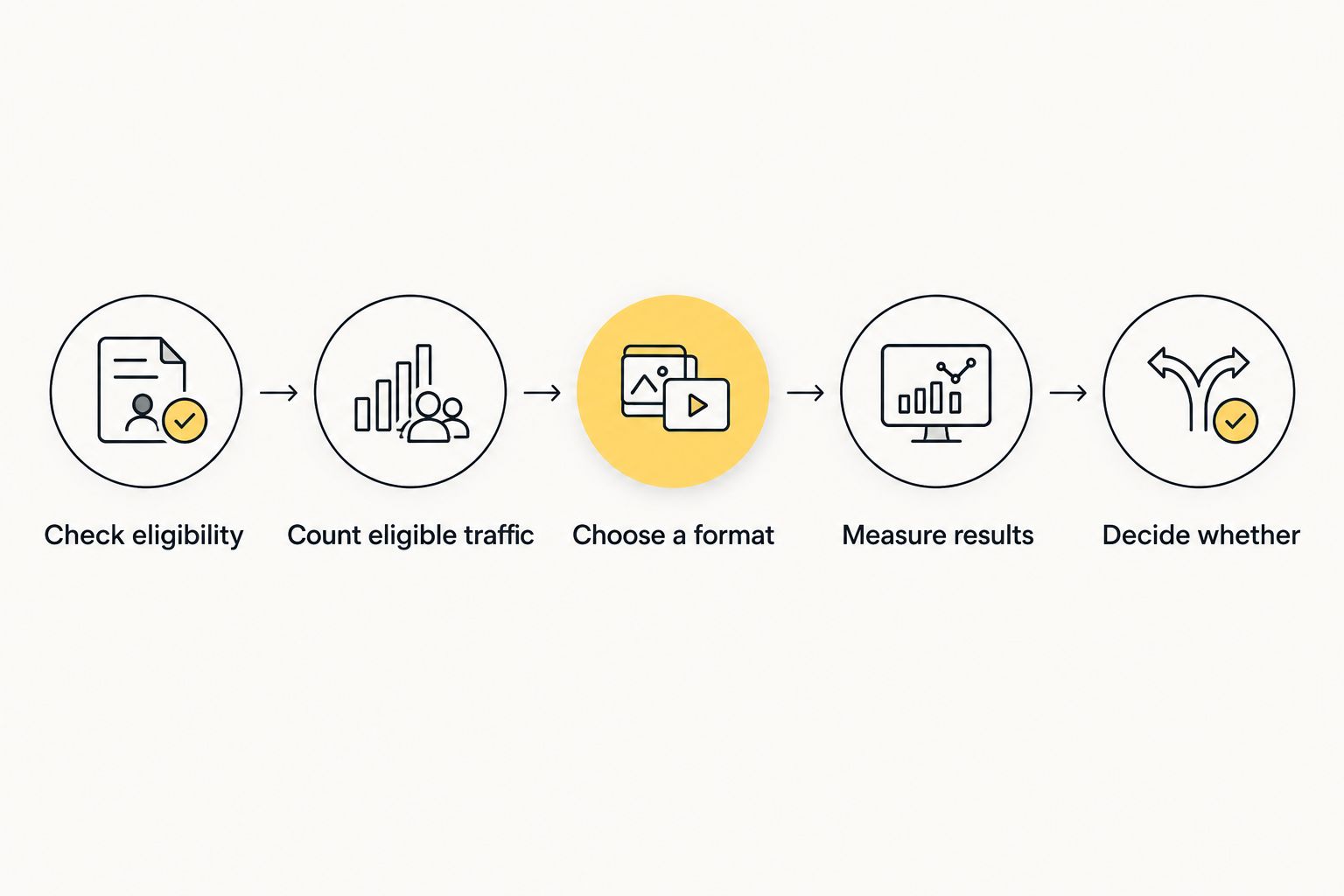
Use this sequence before installing ads:
- Check eligibility. Read the network’s current publisher requirements and acceptable-content rules. Confirm which traffic metric it uses, rather than assuming that visitors, sessions, and pageviews mean the same thing.
- Count eligible traffic. Identify the pages, devices, countries, and traffic sources included in the proposed setup. Do not treat every analytics visit as a billable advertising opportunity.
- Choose a format. Match the placement to the page and the visitor’s task. Decide what interruption you will accept before judging the revenue.
- Measure results. Compare network reporting with your site analytics over the same reporting period. Record earnings alongside engagement and any important website conversions.
- Decide whether to expand. Keep placements that meet your financial and visitor-experience goals. Remove placements that fail those goals, even when they produce revenue.
This process answers the practical question: not whether your site has reached an arbitrary milestone, but whether its current audience supports a useful monetization setup.
Why this matters
A website traffic target is easy to track, but it hides the difference between visits and advertising inventory. Someone who opens several pages creates different placement opportunities from someone who leaves immediately. Ad blockers, consent choices, placement rules, and technical delivery also affect what reaches the network.
For your 2026 monetization plan, keep acquisition and monetization separate. Growing traffic tells you whether more people reach the site. Measuring eligible impressions and revenue tells you whether the advertising setup makes use of that audience.
Do not increase ad load simply because your visitor count is low. More placements change the experience without proving that your inventory attracts enough advertiser demand. First establish whether the existing placements work and whether visitors can still complete the reason they came to your site.
Traffic for network approval
Start with the publisher requirements, not a traffic threshold copied from a discussion thread. Eligibility rules belong to a specific network or program and can change. A requirement for one program is not a rule for website monetization as a whole.
Check the definition behind any stated threshold. Monthly users, monthly sessions, and monthly pageviews measure different things. You cannot establish eligibility by substituting the largest number in your analytics dashboard.
Content and traffic-source rules matter too. A site can meet a volume requirement while failing another condition. Review the entire policy before adding a tag or changing the site to meet a single traffic metric.
Your approval checklist should answer these questions:
- Which traffic metric does the network use?
- Which reporting period does the requirement cover?
- Does the network accept your content category and traffic sources?
- Does your site meet the applicable privacy and consent requirements?
- What installation or verification steps does the publisher account require?
Approval is a gate, not a revenue forecast. Keep those decisions separate when comparing networks or planning the next stage of your site.
Traffic for meaningful earnings
Meaningful earnings depend on your objective. Covering a site’s operating costs and replacing a business income are different goals. Define the outcome before deciding whether your audience is large enough.
For impression-based advertising, the basic relationship is straightforward: revenue depends on monetized impressions and the effective revenue earned per thousand impressions. More visitors help only when they create additional eligible inventory that advertisers buy.
Once your site produces actual results, use those results to assess the traffic you need. Divide your revenue goal by the measured revenue per monetized impression to estimate the required monetized impressions. Treat that estimate as a planning calculation, not a promise that performance stays constant as traffic grows.
Use the same denominator throughout. Impression RPM describes revenue per thousand impressions; page RPM describes revenue per thousand pageviews. Mixing those metrics produces a misleading forecast, even when both numbers come from genuine reports.
In 2026, build your forecast from your own placement results rather than an unrelated publisher’s screenshot. Different GEOs, content, formats, and traffic sources create different inventory. A screenshot without that scope does not establish what your website will earn.
Which ad format fits your website traffic?
Choose formats by how they work on your site, not by an unsupported promise of the highest payout. EZmob is a fit for website owners who want to monetize traffic with pop, push, display, or native ads. That format range gives publishers choices, but each choice still needs an experience check.
The comparison below describes format mechanics, not guaranteed results or eligibility rules.
| Format | Best for | Practical advantage | Main trade-off |
|---|---|---|---|
| Display/banner | Publishers with suitable page placements | Ads occupy defined areas within the page | Placement space and additional loading can affect the page experience |
| Native | Publishers with content layouts that support clearly labeled sponsored units | Units can sit within a content layout | Advertising must remain distinguishable from editorial content |
| Pop/popunder | Publishers willing to test an additional browsing window | Monetization does not depend solely on banner space | Additional windows interrupt the browsing experience and require careful testing |
| Push | Publishers with an appropriate permission-based subscription flow | Consenting subscribers can receive notifications beyond the original page visit | Permission, delivery, and unsubscribe behavior need attention |
EZmob website monetization supports these formats, but the available format is not automatically the right placement. A reading page, a download page, and a utility page involve different visitor tasks. Assess the interruption against that task before expanding the setup.
Start with a format you can evaluate clearly. Combining formats immediately makes it harder to identify which change affected revenue or visitor behavior. Add another format only when you can explain what problem it solves and how you will judge it.
Why the traffic needed for monetization varies
Your traffic requirement changes with the inventory and the outcome you want. These factors explain why websites with similar visitor totals do not necessarily have similar advertising results:
- GEO: Advertiser demand differs by country and campaign targeting. Break out results by GEO instead of applying a blended average to every visitor.
- Ad format: Display impressions, pop opportunities, and push subscriptions are different units. Their totals cannot be treated as interchangeable traffic.
- Page behavior: Pageviews per session influence the number of page-based placement opportunities. Count the opportunities actually created rather than assuming every visit behaves alike.
- Delivery and eligibility: Ad blocking, consent choices, unsupported contexts, and placement rules affect whether an opportunity becomes a delivered ad.
- Traffic quality: Invalid traffic is not a sound basis for monetization. Review unusual source patterns and network reporting rather than celebrating unexplained volume increases.
- Revenue objective: A modest contribution to operating costs and a substantial income target require different outcomes. Set the objective before estimating the audience needed.
These factors are useful because you can investigate them. “Get more traffic” is not a diagnosis. A GEO breakdown, a placement review, or a delivery check identifies what to change next.
What should you measure before adding more ads?
Build a baseline that lets you distinguish traffic growth from monetization changes. Use a consistent reporting period and record both the site metrics and the network metrics. Check time zones before comparing daily reports.
Track the following separately:
- Users: The audience count reported by your analytics system.
- Sessions: Visits according to the analytics system’s session definition.
- Pageviews: Pages viewed, including repeat views where the system counts them.
- Ad impressions: Ads counted as served under the network’s reporting definition.
- Revenue: Earnings recorded for the same period and inventory.
- Website outcomes: The actions your site exists to support, such as reading, registration, or a purchase.
Do not force these totals to match. Analytics systems and ad systems count different events. Investigate discrepancies through their definitions, implementation, and timing instead of treating every mismatch as fraud or lost earnings.
For a 2026 test, write down the decision before making the change: which placement you are testing, which pages it affects, and which outcomes determine whether it stays. That prevents a small revenue increase from becoming an automatic justification for a worse website.
How do you test monetization without confusing the results?
Change one identifiable part of the setup at a time where practical. If you add formats, move placements, and change traffic sources together, the resulting revenue tells you little about which decision helped.
Keep a simple change log. Record the placement, affected pages, launch date, and any technical issues. Include interruptions such as a broken tag or a consent configuration change so you do not mistake an implementation problem for weak demand.
Read performance at a useful level of detail. A sitewide average can hide a placement that earns revenue while hurting an important page. Separate high-value user journeys from pages where visitors have already completed their main task.
Expand a placement because its measured results justify expansion, not because it earned something. Revenue is part of the decision. So are delivery reliability, visitor complaints, page usability, and the actions your business needs visitors to complete.
EZmob’s publisher formats give you several ways to test website monetization. The trade-off is that choosing and evaluating the setup remains your responsibility; format availability does not replace measurement.
Can you monetize a website with low traffic?
You can monetize low traffic when your chosen program accepts the site and the setup meets its requirements. Low volume does not establish a universal rejection rule, but it limits the amount of inventory available and makes performance harder to interpret.
Treat the first setup as an implementation and experience check. Confirm that ads work, reporting appears, and visitors can use the site. Do not turn a brief result into a long-term income forecast.
Do pageviews matter more than visitors for monetization?
Pageviews are more directly connected to page-based placement opportunities, but neither pageviews nor visitors equal paid ad impressions. Format rules, delivery, and eligibility determine what the network actually counts.
Use visitor metrics to understand your audience and network metrics to understand your advertising inventory. Both matter; they answer different questions.
Should you buy traffic to qualify for monetization?
Do not buy traffic solely to reach a publisher threshold. Purchased traffic must comply with the network’s rules, and acquisition spending introduces a separate financial hurdle.
Evaluate the source, content fit, and actual monetization results before treating purchased visits as useful inventory. A higher visitor total is not evidence of a sustainable publisher business.
FAQ
How much traffic do I need to monetize my website?
You need enough eligible traffic to meet your chosen program’s current requirements; there is no universal monthly visitor threshold. Whether monetization is worthwhile depends on your actual revenue and its effect on the website experience.
Can I start monetizing before my website has a large audience?
You can start when a publisher program accepts your site and your setup meets its requirements. Use the initial results to check delivery and visitor experience rather than assuming they establish a stable income.
Does EZmob let website owners monetize their traffic?
EZmob lets website owners monetize traffic with pop, push, display, and native ad formats. Check the current publisher requirements and choose a format that fits how visitors use your site.
Are monthly sessions the same as monthly pageviews?
Monthly sessions and monthly pageviews are different metrics. A session can include multiple pageviews, so use the exact metric requested by the publisher program.
What is the difference between page RPM and impression RPM?
Page RPM measures revenue per thousand pageviews, while impression RPM measures revenue per thousand ad impressions. Keep the denominator consistent when estimating the inventory needed for a revenue goal.
Should I add every available ad format to earn more?
Do not add every format without measuring the effect of each change. Test an identifiable setup and assess revenue alongside usability, delivery, and important website actions.
Can more traffic guarantee more website ad revenue?
More traffic does not guarantee more ad revenue. The additional visits must create eligible inventory, and the outcome also depends on advertiser demand, delivery, format, and traffic quality.
One last thing
A monetization test that tells you to remove an ad is still a useful test. Your objective is not to keep every placement that records earnings; it is to find a setup that earns revenue without defeating the purpose of the website.
Before expanding website monetization in 2026, identify the visitor action you refuse to damage. Make that action part of the decision alongside revenue. It gives you a clear reason to keep, revise, or remove a placement.
Related guides
- Website monetization for bloggers
- Display advertising networks for publishers
- Native advertising for content publishers
Monetize your traffic with EZmob.