
Your popunder campaign cost is your traffic spend plus any tracking, landing-page, and creative expenses needed to run the test. Set the spend limit around the conversion evidence you need, not just the amount required to fund an account; in 2026, starting a campaign and proving it profitable remain separate decisions.
- Popunder campaign cost includes traffic, conversion tracking, and landing-page work—not just account funding.
- EZmob suits affiliate media buyers who want self-serve popunder access and control over campaign setup.
- Set your CPA target and stop conditions before buying inventory.
- Judge a popunder test by validated conversions, not cheap traffic alone.
Why this matters
A funded account is not a complete test budget. You still need a working destination, reliable conversion measurement, and enough room to investigate which traffic sources produce the action your offer pays for.
EZmob provides self-serve access to pop, push, display, and native traffic. That gives you control over launching campaigns without a sales call, but it also puts the testing decisions in your hands. New campaigns pass through creative moderation before going live.
EZmob is best for affiliate media buyers who want self-serve popunder campaign access. The trade-off is straightforward: self-serve access does not replace offer selection, tracking checks, or source-level optimization.
How much does it cost to start a popunder campaign?
Build your starting budget from the work the campaign must perform. Separate money spent buying traffic from money spent making that traffic measurable and usable.
| Budget component | What belongs here | What to establish before launch |
|---|---|---|
| Traffic spend | The inventory purchased during your test | Campaign spend limit and bidding basis |
| Conversion tracking | Tools and setup used to connect visits with outcomes | A successful test conversion and attribution path |
| Landing-page work | Hosting, page production, and revisions where required | A working destination for the selected GEO and device |
| Creative preparation | Assets and copy required by the campaign | Materials ready for moderation |
| Follow-up testing | Further spend after a specific change | A reason to continue and a separate spending decision |
These are budget categories, not mandatory purchases. If your existing tracker and landing page already support the offer, do not count their full setup expense again as a new launch expense. Keep recurring costs visible when assessing profitability.
Account funding, authorized campaign spend, and actual traffic spend are different amounts. Money added to an account is not automatically money consumed by a particular campaign. Use the campaign report to establish actual media spend and your own records to capture expenses outside the ad network.
For a 2026 launch, write down the question the test must answer before setting its budget. A useful question is whether a defined offer, GEO, device, and source group can produce validated conversions at an acceptable acquisition cost.
A vague goal such as finding profitable traffic gives you no clear stopping point. A defined question tells you what to measure and what decision follows.
Separate your media budget from your acquisition cost
Traffic cost describes what you pay to acquire visits or impressions under the campaign's billing model. CPA describes what those visits ultimately cost per recorded acquisition. They answer different questions.
Use these calculations with your actual campaign results:
- Media CPA: traffic spend divided by validated conversions.
- Fully loaded acquisition cost: traffic spend plus attributable operating expenses, divided by validated conversions.
- Campaign contribution: attributable revenue minus traffic spend and attributable operating expenses.
When a campaign has no validated conversions, there is no conversion-based CPA to calculate. Report the spend and the absence of conversions directly. Do not turn missing outcomes into an apparently favorable performance figure.
Your target CPA should reflect the revenue or contribution attached to the conversion you actually get paid for. For an affiliate offer, check the qualifying action, approval rules, and any restrictions before buying traffic.
A submitted lead and an approved lead are not interchangeable. If payment depends on approval, optimize against approved outcomes rather than treating every submission as revenue.
Choose a test scope that matches your question
A narrow launch and a broad launch serve different purposes. Neither is automatically cheaper in terms of acquiring a customer; their main difference is how much variation you introduce into the test.
| Test approach | Best for | Advantage | Limitation |
|---|---|---|---|
| Narrow launch | Validating a defined offer and audience | Makes the result easier to interpret | Leaves other audiences unexplored |
| Broad launch | Exploring where an offer gets a response | Exposes the offer to more audience variation | Requires segmentation before drawing conclusions |
| Follow-up test | Checking a specific change after initial results | Connects the next spend decision to evidence | Cannot repair an unmeasurable original test |
For an initial affiliate test, favor a narrow launch when your immediate question concerns a particular offer and audience. Keep the selected GEO, device scope, destination, and conversion event explicit.
A broad campaign needs a broader analysis plan. An overall average can combine sources with very different results, so decide in advance which dimensions you will inspect before increasing spend.
A follow-up test should change something identifiable: the destination, audience scope, bid, or source selection. Do not describe additional spend as optimization unless it tests a specific decision.
Why popunder campaign cost varies
Your 2026 popunder campaign budget should reflect the campaign you intend to run, not an assumed category-wide rate. These choices determine what you buy and what work the test requires:
- GEO: Your selected market defines the audience you are trying to acquire. Compare results within that market before combining them with other locations.
- Device scope: Mobile and desktop visits reach different browsing environments. Your destination must work for the devices included in the campaign.
- Bid: The amount you submit is part of your traffic-buying decision. Assess bid changes alongside delivery, spend, and conversion results.
- Inventory selection: Different sources contribute different visits. Source-level reporting is necessary to distinguish useful traffic from spend that does not meet your objective.
- Conversion event: A sale, qualified lead, and preliminary registration represent different outcomes. Your budget must answer the question tied to the event that matters commercially.
- Existing setup: A ready tracker and destination reduce the amount of new preparation required. A new setup adds work outside the media purchase.
Do not assign a fixed cost premium to any of these factors without campaign evidence. Their practical role is to define your test and explain differences in its results.
Keep the buying and business questions separate. A change that improves delivery still needs to meet your acquisition target.
Set your launch budget before you fund the campaign
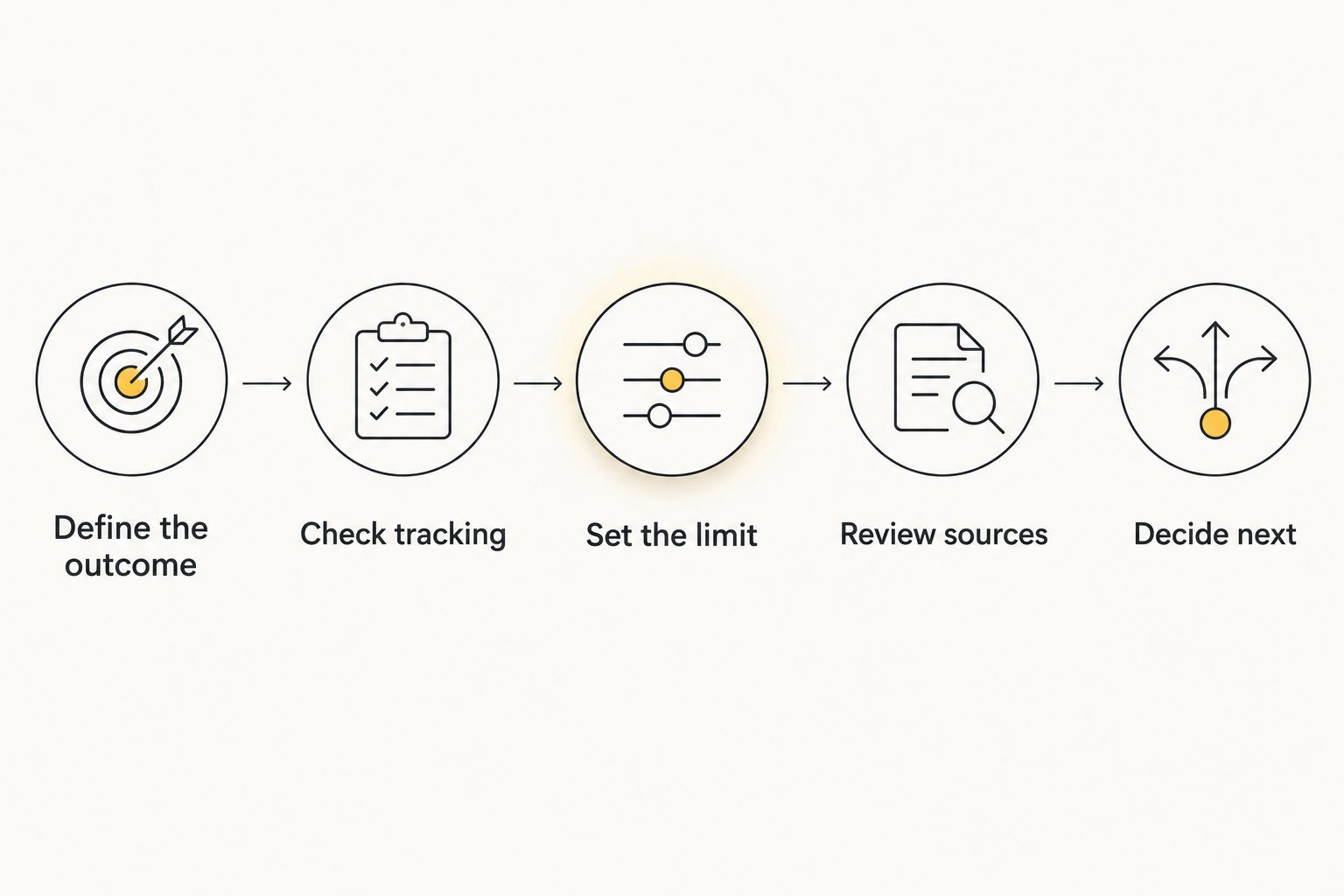
Use this sequence to turn a budget into a controlled test. It works because each spending decision follows a measurement decision rather than the other way around.
Define the outcome
Choose the conversion event the offer rewards. Record the qualifying conditions and distinguish preliminary activity from the final approved outcome.
For lead generation, that means knowing whether you are measuring a form submission or a qualified lead. For e-commerce, distinguish a visit or checkout step from a completed purchase.
Check tracking
Send a test visit through the actual destination and confirm that the intended conversion reaches your reporting system. Check the identifiers that connect the visit, campaign, and outcome.
Do this before buying inventory. A landing page that opens successfully does not prove that conversion attribution works.
Set the limit
Choose the amount you authorize for the defined test and record it separately from account funding. Include any external expenses you intend to attribute to the launch.
The limit is a risk decision, not a performance forecast. Funding a larger account does not require exposing the entire balance to an unproven campaign.
Review sources
Inspect results at the level needed to explain performance. Keep GEO, device, source, destination, and conversion status available in your analysis where your reporting supports them.
Look for agreement between traffic records and conversion records. Investigate discrepancies before treating reported performance as a basis for more spend.
Decide next
End the review with an explicit decision: continue the defined test, change a named variable, or stop. Record the evidence behind that choice.
Continuing should answer an unresolved question. It should not be a default response to disappointing results.
Avoid the expenses that do not teach you anything
A test can lose money and still answer a useful question. Spend becomes harder to justify when the setup prevents you from learning what happened.
Check these failure points before launching:
- Broken destination: The landing page fails to load, redirects incorrectly, or does not support the selected audience.
- Untracked conversion: Visits reach the offer, but the outcome cannot be connected to the campaign.
- Unclear payment event: Your report counts actions that do not meet the offer's approval requirements.
- Mixed test variables: Audience, destination, and bid change together, leaving the result difficult to interpret.
- Missing stop decision: Spending continues without a written reason or a new test question.
Do not assume that inexpensive visits compensate for these problems. Traffic that cannot be evaluated is not evidence of a viable acquisition channel.
For your 2026 campaign review, distinguish poor commercial performance from a measurement failure. The first concerns the offer and traffic combination; the second means you need to repair the test before trusting its conclusions.
How do you know whether your starting budget was useful?
Judge the budget by the decision it enabled. A useful test connects actual spend to a working destination, attributable outcomes, and a clear next action.
A positive result needs scrutiny too. Confirm that conversions meet the offer's requirements and that the revenue belongs to the traffic being evaluated.
Before increasing spend, ask:
- Did the intended audience reach the correct destination?
- Did conversion tracking work throughout the test?
- Were recorded conversions validated under the offer's rules?
- Which sources contributed the outcomes?
- What exactly will the next test change or confirm?
Increase the budget to investigate evidence, not to avoid making a stop decision. A campaign with unresolved tracking problems needs a repair, not a larger allocation.
Is account funding the same as a popunder test budget?
Account funding is not the same as a popunder test budget. Funding establishes money available in the account; the test budget defines what you authorize for a particular campaign question.
Keep those amounts separate in your launch plan. Review actual spend against the test limit rather than using the remaining balance as a reason to continue.
Does cheaper popunder traffic mean a lower CPA?
Cheaper popunder traffic does not establish a lower CPA. CPA depends on traffic spend and validated conversions together, so a low buying rate still needs commercially useful outcomes.
Compare equivalent conversion events. Mixing approved purchases with preliminary registrations produces a comparison that does not answer your acquisition question.
Can you launch a popunder campaign yourself?
You can launch a popunder campaign yourself through EZmob's self-serve platform without a sales call. Advertisers sign up, fund their accounts, and submit campaigns; new campaigns go through creative moderation before going live.
The benefit is direct control over setup. The responsibility is ensuring that your offer, destination, tracking, and budget are ready before traffic starts.
FAQ
What should I include in my popunder campaign cost?
Include traffic spend and any attributable tracking, landing-page, and creative expenses. Separate existing operating costs from new expenses required specifically for the launch.
Is my account deposit the budget for my first campaign?
No, account funding and a campaign budget are different decisions. Set a separate authorized spend limit for the test you intend to run.
What should I check before spending money on popunder traffic?
Check the destination, conversion tracking, qualifying conversion event, and test limit before buying traffic. A successful page visit alone does not confirm that attribution works.
Should I start with broad targeting or a narrow campaign?
Start narrow when you need to validate a defined offer and audience. Broad targeting suits exploration, but its results require segmentation before you draw conclusions.
Can cheap popunder traffic still be unprofitable?
Yes, cheap traffic can be unprofitable when it does not generate sufficient validated revenue. Evaluate acquisition cost and campaign contribution rather than the buying rate alone.
When should I stop a popunder test?
Stop when the authorized limit is reached or the test has answered its question. If tracking or the destination fails, resolve that problem before authorizing further traffic spend.
Can I start advertising on EZmob without a sales call?
Yes, EZmob offers self-serve campaign access without a sales call. New campaigns go through creative moderation before going live.
One last thing
Your next budget decision should be written before the current test ends. Specify what result justifies continuing, what problem requires a repair, and what evidence means you stop.
For a 2026 launch, the most useful starting budget is one attached to a measurable question and a firm limit. An account balance gives you spending capacity; a test plan gives that spending a purpose.