
Popunder advertising is effective only when the value of approved conversions exceeds your traffic spend and other campaign costs. In 2026, judge it by source-level CPA and conversion quality, not by visits delivered. Test popunder for a measurable acquisition goal; skip it when you cannot connect traffic to an accepted conversion.
- Is popunder advertising still effective? Judge approved conversions and acquisition costs, not delivered visits.
- EZmob suits media buyers who want self-serve access to popunder, push, display, and native traffic.
- Popunder traffic needs a landing page that explains the offer without assuming an intentional ad click.
- Validate conversion tracking and review traffic sources before increasing campaign spend.
Is popunder advertising still effective in 2026?
The useful answer is campaign-specific: popunder works when the traffic produces commercially valid actions at an acceptable acquisition cost. A delivered visit alone does not establish effectiveness. Neither does a conversion that the advertiser later rejects.
Start with an outcome you can verify: an approved affiliate conversion, a qualified lead, or a completed purchase. Then connect that outcome to the campaign and traffic source that generated it. The guide to connecting EZmob to Voluum addresses the tracking side of that process.
Use this decision table before launching or expanding a test:
| Campaign condition | What it tells you | Recommended action |
|---|---|---|
| Approved conversions cover acquisition and campaign costs | The tested traffic meets your commercial objective | Continue testing the converting sources |
| Tracked conversions include rejected or invalid actions | Reported CPA does not reflect accepted business | Reconcile conversion status before scaling |
| Visits arrive but conversion tracking is unverified | You cannot distinguish poor performance from measurement failure | Fix tracking before judging the format |
| The landing page requires prior product knowledge | The page assumes context the visitor does not have | Explain the offer and its relevance immediately |
| Aggregate results conceal different source outcomes | The campaign average is insufficient for source decisions | Evaluate sources separately |
The decision is not whether popunder is universally good or bad. It is whether your offer, landing page, and purchased inventory work together. Keep that distinction throughout your 2026 evaluation.
Why this matters
Popunder delivers a different starting context from an intentional search visit. The visitor has not necessarily selected your offer from an ad message. Your landing page therefore carries the explanation that another format might provide before the visit.
That difference changes what you should inspect. A page opening is a delivery event; a purchase or accepted lead is a business outcome. Treating the former as proof of the latter creates an optimization problem before you change a bid.
For an affiliate marketer, the relevant result is the conversion the offer owner accepts. For an e-commerce advertiser, it is a completed transaction evaluated against acquisition costs and business economics. Define success before buying traffic, not after seeing the dashboard.
Popunder versus push, display, and native traffic
Choose the format according to how much context your offer needs before a visitor reaches the landing page. These formats present the advertising message differently; the comparison below describes their mechanics, not a ranking of conversion rates.
| Format | Best for | Practical advantage | Limitation to account for |
|---|---|---|---|
| Popunder | Testing a landing-page-led acquisition approach | The landing page can present the full explanation | A page opening does not establish intentional interest |
| Push | Testing a concise notification-led message | The message introduces an angle before the destination visit | The destination must match the notification's promise |
| Display | Testing a visual message before the click | The banner can introduce the offer visually | The banner has limited space for explanation |
| Native | Testing a headline-led introduction to content or an offer | The placement can introduce a topic before the visit | The destination must fulfill the headline's expectation |
Popunder's advantage is the space available on the destination page. Its limitation is the visitor's starting context. Push, display, and native introduce a message before the destination visit, but that introduction does not prove the visitor will convert either.
Choose popunder for a landing-page-led test; choose another format when your hypothesis depends on a message being selected before the visit. Compare accepted outcomes rather than declaring a winner from traffic volume.
How to test popunder effectiveness in 2026
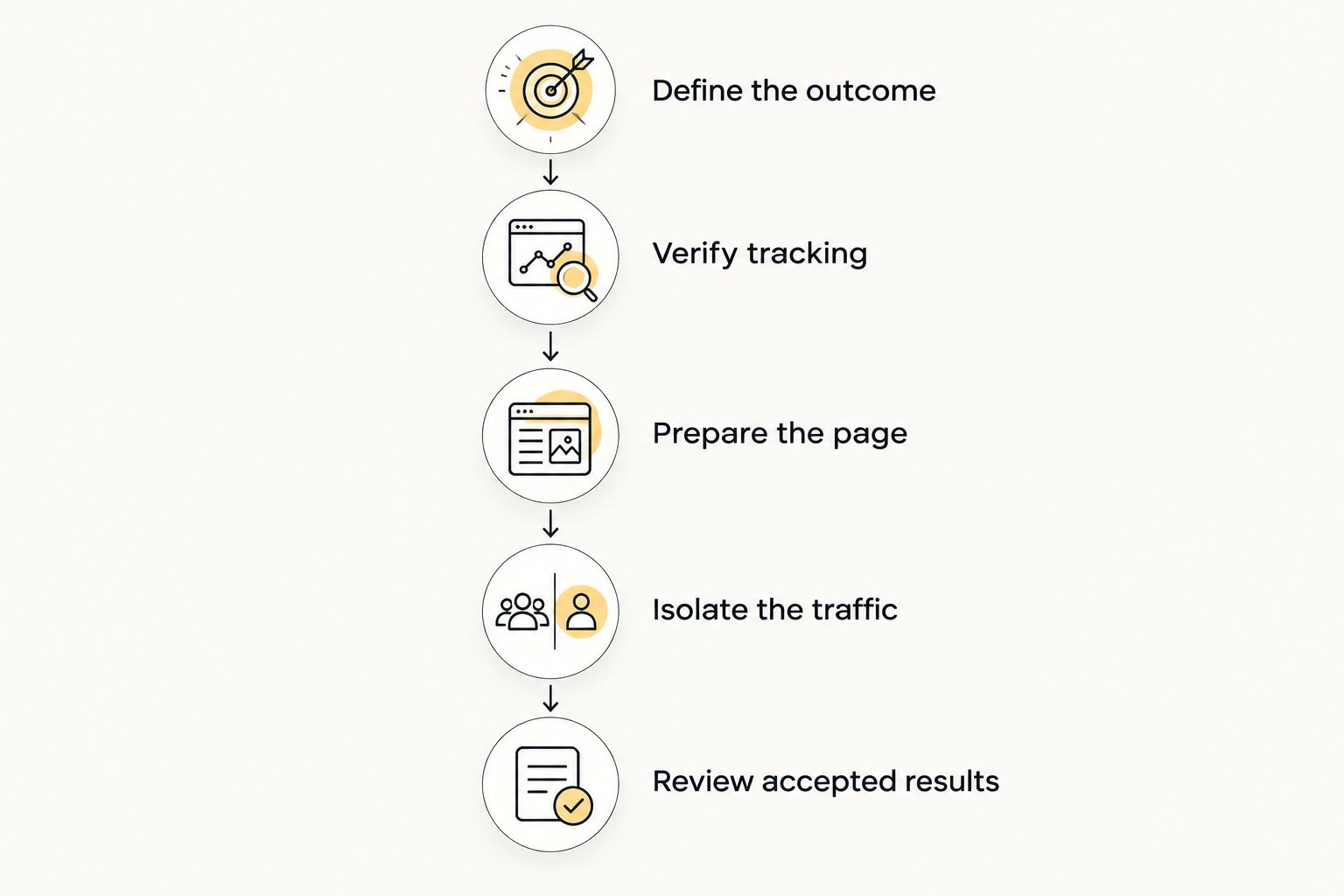
A useful test follows a sequence: define the outcome, verify measurement, prepare the page, isolate the traffic, and review accepted results. Changing everything together prevents you from identifying what helped or failed.
Define the outcome
Write down the action that counts as success and the conditions under which it is accepted. For an affiliate offer, distinguish a tracked event from an approved conversion. For lead generation, specify the qualification requirement rather than counting every form submission equally.
Set the acquisition-cost boundary using your own offer economics. Include costs that affect profitability, not just the traffic purchase. An attractive dashboard result is not a substitute for a commercially valid result.
Verify tracking
Check that the campaign visit reaches the intended landing page and that the conversion event returns to your measurement system. Preserve the identifiers needed to attribute the action to its source. Confirm that redirects do not remove information required for attribution.
Review what your conversion event actually means. A button click, registration, and accepted sale are different outcomes. Do not optimize for an event merely because it is easier to record.
Prepare the page
Make the first screen explain the offer, who it serves, and the next action. Do not assume the visitor remembers an ad headline or already understands your product. Remove claims that the destination cannot support.
Test the page on the devices and browsers relevant to the campaign. Check the destination, form, and completion path yourself. A broken page prevents a fair evaluation of the inventory that reached it.
Isolate the traffic
Keep the offer and page stable while evaluating a traffic segment. Separate GEOs or devices when they require different languages, eligibility conditions, or user experiences. Record meaningful changes so you can interpret the results afterward.
Avoid changing the bid, page, offer, and audience at the same time. If the outcome changes, you need to know which variable you were testing. A clear question produces a more useful decision than a collection of unrelated edits.
Review accepted results
Compare spend with approved outcomes at the source level. Investigate discrepancies between delivery, landing-page arrivals, tracked actions, and accepted conversions. Each stage answers a different question.
Increase exposure only when the result supports the commercial objective. Keep evaluating conversion quality as the campaign changes. A successful test establishes a result for that tested traffic, not a guarantee for every subsequent purchase.
Why popunder effectiveness varies
The format stays the same while the campaign conditions change. These factors explain why a result from one offer does not establish what another advertiser will achieve:
- Offer eligibility: Your offer must accept the traffic type, GEO, and intended conversion action. Check those conditions before launching.
- Visitor context: A popunder landing page must explain relevance without relying on an intentional ad click.
- Landing-page function: Language, device compatibility, redirects, and forms affect whether a visitor can complete the intended action.
- Traffic-source mix: A campaign average combines results from its underlying sources. Source-level reporting separates those outcomes.
- Conversion measurement: Incorrect event definitions or lost identifiers undermine the CPA you use for decisions.
- Conversion acceptance: Rejected leads or invalid affiliate actions do not have the same commercial value as approved conversions.
Use this list to diagnose a result, not to excuse it. A weak outcome still requires a decision: repair a measurable problem, change the test hypothesis, or stop the campaign.
What counts as a fair popunder test?
A fair test has a working destination, a valid offer, verified conversion measurement, and a clearly defined business outcome. It also has a stopping rule tied to your acquisition economics. Decide that rule before launch rather than extending the test simply because you want a different answer.
Separate a technical failure from a commercial failure. If attribution is broken, you cannot use the recorded CPA to judge the traffic. If measurement works but accepted outcomes do not cover the campaign's costs, the tested setup has not met its objective.
For your 2026 campaign log, record the offer, GEO, device scope, landing-page version, conversion definition, and campaign changes. Those details make the result interpretable. Without them, a later comparison can mix different tests under the same format label.
How do you separate traffic quality from page problems?
Check the conversion path before assigning blame to the source. Confirm that visitors reach the intended page, see the correct language, and can complete the action. Then inspect the source-level results rather than relying on the combined campaign total.
A delivery discrepancy is a reason to investigate, not proof of ad fraud. Redirect errors, measurement differences, and invalid traffic are distinct issues. Identify the issue you can demonstrate and address that issue directly.
Likewise, a failed conversion path does not establish that popunder cannot work. It establishes that the tested path failed. Do not change networks to solve a broken form, and do not redesign a working page to avoid reviewing poor source results.
When is EZmob relevant to this decision?
EZmob is best for media buyers who want self-serve access to popunder, push, display, and native traffic. Advertisers can sign up, fund an account, and launch campaigns without a sales call. New campaigns go through creative moderation before going live.
That access supports testing different campaign approaches; it does not remove the need to verify tracking, review offer restrictions, or evaluate accepted outcomes. EZmob's popunder advertising offering is a traffic-buying option, not a promise that your offer will be profitable.
Use the platform when self-serve campaign access fits your buying process. Keep the same evaluation standard you would apply elsewhere: a working conversion path, source-level analysis, and costs measured against accepted business.
Should you stop popunder campaigns that do not convert?
Stop or revise a campaign when it fails your predefined decision rule after you have verified the conversion path. First exclude a measurement or destination problem. Then assess whether the tested traffic meets your acquisition objective.
Do not continue spending solely to accumulate more visits. Additional delivery does not repair a mismatch between the offer and the visitor, and it does not validate a broken conversion event.
Is popunder better than push for affiliate offers?
Neither format is inherently better for every affiliate offer. Popunder tests the landing page as the primary introduction; push tests a notification-led introduction followed by the destination experience.
Compare the same accepted conversion outcome and respect the offer's traffic restrictions. A comparison using registrations for one format and approved sales for another does not answer which produces better business results.
Can popunder work for e-commerce campaigns?
Evaluate popunder for e-commerce through completed purchases and acquisition economics, not product-page visits alone. The destination must explain the product and provide a working purchase path.
Include the costs and order outcomes relevant to your business before calling the campaign profitable. A recorded checkout event is not interchangeable with an accepted, completed order.
FAQ
Is popunder advertising still effective in 2026?
Popunder advertising is effective when approved conversions justify traffic spend and other campaign costs. Evaluate your offer and traffic sources rather than treating visits as proof of success.
What’s the best way to measure popunder advertising?
Measure popunder advertising through accepted conversion outcomes and source-level acquisition costs. Verify attribution before using the results to change bids or expand a campaign.
Is popunder traffic the same as a search ad click?
Popunder traffic does not establish the same intentional offer selection as a search ad click. The landing page must explain the offer without assuming the visitor selected an advertising message.
Should I use a landing page for popunder campaigns?
Use a destination that explains the offer and provides a working conversion path. Whether that is an intermediate landing page or the offer page depends on the offer requirements and the experience you are testing.
Does a low traffic cost mean a popunder campaign is profitable?
A low traffic cost does not establish profitability. Compare campaign costs with the value of approved conversions, including the business costs relevant to your offer.
What’s EZmob best for when testing popunder advertising?
EZmob is best for media buyers seeking self-serve access to popunder, push, display, and native traffic. Advertisers still need to verify tracking and evaluate accepted conversions.
How can I tell whether poor results come from ad fraud?
Poor conversion results alone do not prove ad fraud. Investigate delivery, attribution, destination function, and conversion acceptance separately before identifying the cause.
One last thing
Your cheapest source is not necessarily your most economical source. The relevant comparison is what you spend to obtain accepted business, not what you spend to generate a visit.
For your next 2026 test, write the success condition before opening the campaign dashboard. That single decision keeps traffic volume from becoming a substitute for the outcome you actually need.
Related guides
- Popunder traffic for affiliate marketers
- Connect EZmob to Keitaro for postback tracking
- Self-serve advertising platforms