
Choose EZmob if you need to buy pop, push, display, or native traffic; choose Mobidea if you need affiliate offers to promote. The 2026 decision is traffic acquisition versus offer monetization—not which platform promises a lower CPA.
- EZmob vs Mobidea compares self-serve advertising with affiliate offer access, not interchangeable traffic sources.
- Choose EZmob for buying pop, push, display, and native inventory.
- Choose Mobidea when your missing campaign component is an affiliate offer.
- Judge CPA campaigns on accepted conversions and attributable spend, not clicks alone.
Why this matters
An affiliate campaign needs both something to promote and a way to reach people. An advertising network supplies the traffic side; an affiliate network connects promotion to an offer and its conversion terms. Confusing those roles produces the wrong shortlist.
For your 2026 campaign, identify the missing component before opening another account. If you already have an approved offer, your next decision concerns inventory and campaign execution. If you already have an audience but lack an offer, buying more traffic does not solve the problem.
The distinction also matters when reviewing Mobidea alternatives. An alternative for sourcing offers is not automatically an alternative for buying impressions or clicks.
At a glance
| Dimension | EZmob | Mobidea |
|---|---|---|
| Best for | Media buyers who need paid traffic | Affiliates who need offers to promote |
| Traffic acquisition | Self-serve advertising network | Affiliate network; not an interchangeable inventory source |
| Offer selection | Advertisers bring the destination and campaign objective | Affiliate offers are the central reason to evaluate it |
| Launch workflow | Sign up, fund an account, submit campaigns for creative moderation | Select an offer and establish the permitted promotion setup |
| Pricing model | Advertiser funds campaign delivery | Affiliate earnings follow the selected offer's commission terms |
| Performance measurement | Evaluate traffic spend against attributable outcomes | Evaluate accepted conversions under offer terms |
| Campaign responsibility | Buyer must connect traffic to a suitable destination | Affiliate must connect an offer to suitable traffic |
| Standout feature | Self-serve access across pop, push, display, and native | Affiliate offer access |
EZmob is the better fit for media buyers who need self-serve advertising traffic. Mobidea addresses a different need: choosing what to promote through an affiliate relationship.
Traffic acquisition: EZmob wins when you already have an offer
Buying traffic is a distribution decision. You need a format that fits the destination, an appropriate GEO, a campaign budget, and a way to attribute conversions. The affiliate offer does not provide those ingredients by itself.
The self-serve advertising platform supports popunder, push notifications, display/banner, native, video, and direct-click/redirect traffic. Advertisers can sign up, fund an account, and launch campaigns without a sales call. New campaigns pass through creative moderation before going live.
That is the advantage when your offer is ready but you still need visitors. You can work on traffic acquisition rather than treating an affiliate-network account as a substitute for an advertising account.
The limitation is equally clear: traffic access is not an offer-selection service or a conversion guarantee. You still need a destination that works, permission to use the chosen traffic source, and an offer that matches the audience.
Before launching, settle these questions:
- Which traffic format does the offer permit?
- Which GEO and device conditions apply?
- Does the destination explain the action clearly?
- Can you attribute the conversion back to the campaign?
Buying traffic before answering those questions turns a platform decision into an avoidable campaign risk.
Offer selection: Mobidea wins when you need something to promote
Mobidea belongs on your shortlist when the missing component is an affiliate offer. Its role as an affiliate network makes it relevant to affiliates choosing a monetization opportunity, rather than advertisers choosing an inventory source.
That distinction is useful for a publisher with an existing audience or a media buyer preparing a new affiliate campaign. The immediate question is what conversion to pursue and under which terms—not which ad format to purchase.
Evaluate the offer before planning acquisition. Read the eligible GEOs, conversion definition, permitted promotion methods, and restrictions attached to the specific opportunity. Network membership does not make every offer suitable for every traffic source.
Mobidea wins the offer-access decision; it does not win a traffic-buying comparison by default. An affiliate still needs a distribution channel, whether that is an existing audience or a separate paid traffic source.
The tradeoff is control. Your campaign operates within the selected offer's rules, and your earnings depend on qualifying outcomes. A persuasive landing page cannot compensate for sending traffic that falls outside those rules.
Keep a written offer brief. It should identify the conversion event, allowed traffic, destination, and attribution requirements so the buying decision starts from the offer rather than from an attractive ad format.
Launch workflow: EZmob fits independent campaign execution
Self-serve access matters when you want to build and manage an advertising campaign without arranging a sales call. The advertiser workflow starts with registration and account funding, followed by campaign submission and creative moderation.
Do not confuse independent setup with bypassing review. Prepare the creative and destination for moderation before you plan delivery. Check that the ad accurately represents the landing page and that the promoted offer permits the intended traffic.
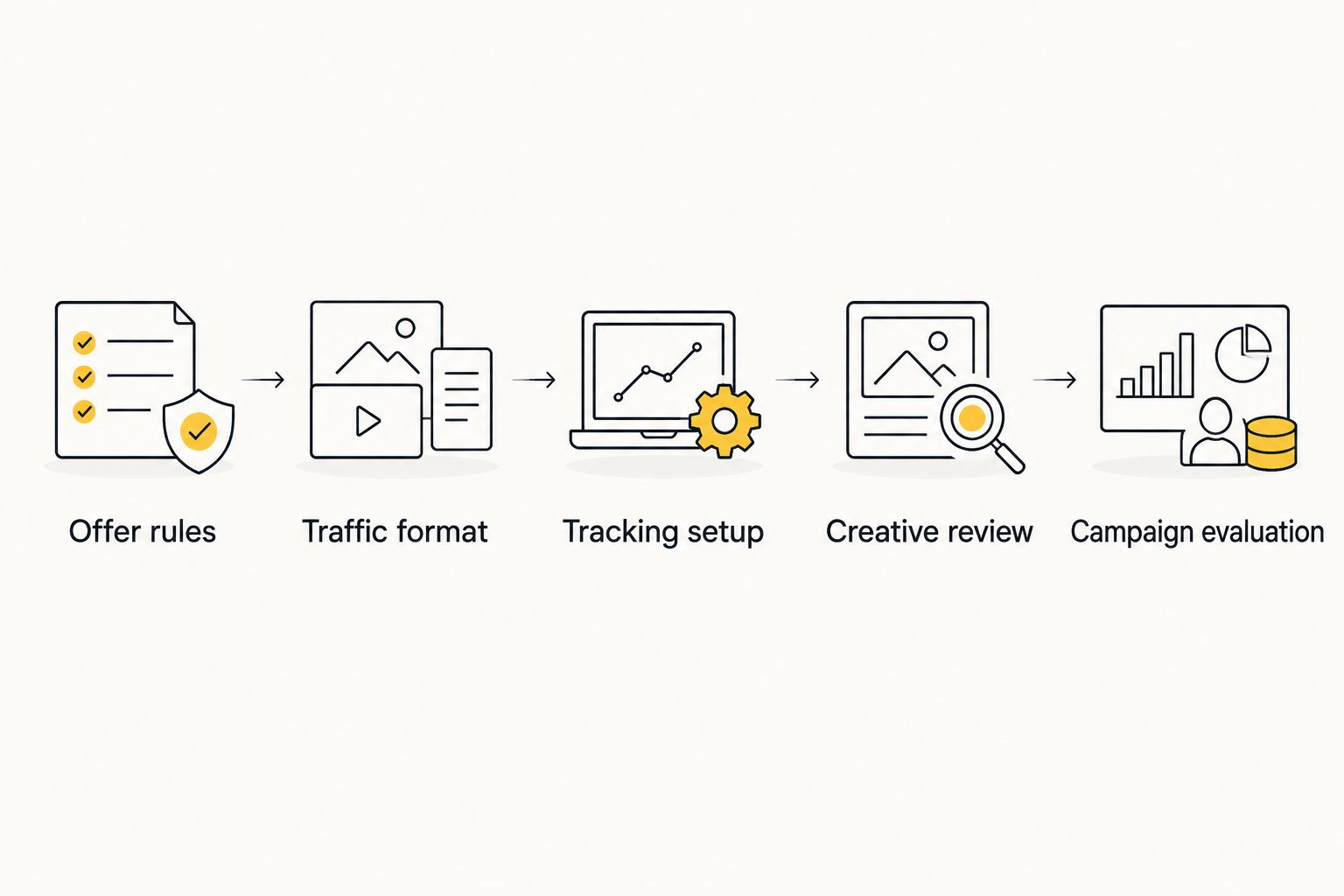
For an affiliate campaign, the preparation sequence is straightforward:
- Offer rules: Confirm the destination and permitted promotion methods.
- Traffic format: Choose the ad format that fits the destination.
- Tracking setup: Connect campaign visits to the conversion event.
- Creative review: Submit a consistent ad and landing-page combination.
- Campaign evaluation: Assess delivery and attributable results after launch.
Mobidea serves the offer side of that sequence. Establishing the affiliate relationship and understanding the conversion terms comes before paying for distribution.
Neither workflow removes your responsibility for the other half of the campaign. Self-serve buying makes campaign execution accessible; affiliate offer access gives you something to promote. You need both roles covered before a paid affiliate campaign is ready.
Campaign responsibility: Mobidea makes offer terms central
Mobidea is the more relevant starting point when you need to define how an affiliate conversion becomes an earning event. The offer's conditions determine which outcomes count, so they belong at the beginning of your planning process.
A media buyer often focuses first on creative, bid, and inventory. Those decisions matter, but an affiliate campaign can fail before any of them become relevant if the chosen promotion method is prohibited.
For example, permission to promote an offer does not establish permission to use every ad format. Confirm the specific rules instead of treating acceptance into an affiliate network as blanket approval.
The advantage of an offer-first workflow is clarity: you know what action you are pursuing before choosing the traffic. The downside is that your acquisition plan must fit someone else's conversion and promotion conditions.
Use Mobidea to resolve the offer question, then evaluate the traffic source against that offer. Reverse the sequence only when you already understand the audience you control and are deliberately selecting an offer for it.
For advertisers promoting their own products, the offer-network step is not automatically necessary. They can define their own campaign objective and focus directly on acquisition.
Performance: neither platform wins without campaign evidence
There is no defensible universal CPA winner in this comparison. CPA is an outcome of the traffic, offer, destination, attribution, and conversion acceptance—not a property of a brand name.
A 2026 platform decision should separate access from performance. Knowing where you can buy traffic or find an offer answers the access question. It does not establish the return from your particular campaign.
Use the same economic definition throughout your evaluation:
Effective CPA = attributable advertising spend divided by accepted conversions.
That definition matters because clicks, landing-page visits, and recorded conversion events represent different stages. A campaign with inexpensive visits can still have poor acquisition economics if those visits do not produce qualifying outcomes.
For each campaign, compare:
- Advertising spend attributable to the evaluated traffic.
- The conversion event used for optimization.
- Accepted conversions under the offer's terms.
- Affiliate earnings attributable to those conversions.
The honest verdict is a tie on automatic profitability: neither access to inventory nor access to offers guarantees a profitable campaign. Treat performance claims as campaign-specific evidence, not as a substitute for testing your own combination.
Do not compare one source's clicks with another source's accepted conversions. Match the measurement scope before deciding where the result is better.
Tracking: both require a complete conversion path
Neither an advertising account nor an affiliate account replaces campaign attribution. You need to connect the traffic origin, the destination, and the qualifying action before making optimization decisions.
Map that path before launch. Decide how campaign identifiers reach your tracker or destination, how the conversion is recorded, and how you reconcile it with the relevant reporting system. Confirm the actual integrations available for your setup rather than assuming compatibility.
The useful checks are practical:
- Does the destination load correctly for the intended audience?
- Do campaign identifiers survive redirects?
- Does the conversion event represent the action you intend to buy?
- Can you distinguish recorded events from accepted affiliate conversions?
- Are reporting periods and attribution definitions consistent?
Both sides require tracking discipline; neither deserves a tracking win based on its category alone. The advertising side explains acquisition activity, while the affiliate side explains offer outcomes. Your campaign reporting must join them.
When reports disagree, investigate definitions before changing the bid. An attribution mismatch is not proof of bad inventory, and an unaccepted conversion is not automatically a tracking failure.
Pricing models: compare campaign spend with commission economics
For 2026, the useful financial comparison is money spent acquiring traffic versus money earned from qualifying affiliate outcomes. These are different roles in the campaign budget, not interchangeable subscription choices.
The advertising model requires you to fund campaign delivery. You commit acquisition spend and evaluate whether the resulting outcomes justify it. The advantage is direct access to the buying workflow; the disadvantage is exposure to spend before you know the campaign's final return.
The affiliate model ties earnings to the selected offer's terms. You evaluate the conversion requirement and commission structure before deciding how much acquisition risk to take. The advantage is a defined monetization event; the disadvantage is dependence on qualifying, accepted outcomes.
Keep advertising spend and affiliate earnings separate in your calculations. An affiliate-network account does not eliminate paid acquisition costs when you choose to buy traffic elsewhere.
Account for the rest of your workflow too. Tracking, creative production, and landing-page work belong in your campaign economics when they create real costs. Evaluate the complete operation rather than only the figures shown in an advertising dashboard.
Final verdict for 2026
Choose EZmob if you are a media buyer with an offer ready
Your immediate need is paid distribution. You want self-serve access to pop, push, display, or native inventory and are prepared to handle creative moderation, destination quality, and campaign measurement.
Choose EZmob for traffic acquisition. Start with the offer's allowed traffic conditions, then build a campaign around the format and conversion event you can measure.
Choose Mobidea if you are an affiliate seeking an offer
Your immediate need is something to promote and a clear definition of the qualifying outcome. You already have an audience, or you will arrange acquisition after selecting an appropriate offer.
Choose Mobidea for affiliate offer access. Establish the offer rules before committing acquisition spend, and do not assume that an offer-network account includes a substitute for a traffic-buying platform.
| Decision | Winner |
|---|---|
| Buy advertising traffic | EZmob |
| Find an affiliate offer | Mobidea |
| Launch a self-serve advertising campaign | EZmob |
| Start with affiliate conversion terms | Mobidea |
| Guarantee campaign profitability | Neither |
| Remove the need for tracking | Neither |
| Compare campaign spend with earnings | Different roles; no shared winner |
FAQ
Is EZmob better than Mobidea?
EZmob is better for buying self-serve advertising traffic; Mobidea is the relevant choice for affiliate offer access. The decision turns on which campaign component you need, not a universal quality ranking.
Are EZmob and Mobidea the same type of platform?
No. EZmob operates an advertising network, while Mobidea operates an affiliate network. One addresses traffic acquisition; the other addresses affiliate offers and qualifying outcomes.
Can I use an affiliate offer with paid traffic?
Use paid traffic only when the selected offer permits that promotion method. Confirm the format, GEO, destination, and other applicable restrictions before launching a campaign.
Which platform is better for push and popunder campaigns?
EZmob is the relevant choice here for buying push and popunder traffic. Mobidea’s affiliate-network role does not make it an interchangeable traffic source.
Which platform gives me a lower CPA?
Neither platform has a universal CPA advantage. Compare attributable advertising spend with accepted conversions for the specific offer, audience, and traffic format you run.
Do I need tracking when using an affiliate network?
Yes, you need a way to connect acquisition activity with qualifying conversions. Check the integrations available for your setup and reconcile conversion definitions before optimizing.
How should I compare the financial models in 2026?
Separate advertising spend from affiliate earnings. Traffic buying creates acquisition costs, while an affiliate offer defines the outcomes that qualify for commission; your campaign economics must include both.
One last thing
The useful outcome of this 2026 comparison is not necessarily replacing one platform with another. A traffic source and an affiliate offer network can fill different parts of the same campaign, provided the offer permits the traffic and your tracking connects the results.
Before opening an account, write one sentence: My next campaign is missing traffic, an offer, or reliable attribution. Solve that problem first.
Related guides
- Is buying pop traffic profitable for affiliate marketers?
- Best CPA ad networks for affiliate marketers
- Best self-serve advertising platforms
Ready to buy traffic for an approved offer? Start advertising on EZmob.