
Choose EZmob if you want self-serve pop, push, display or native campaigns for affiliate offers; choose SmartyAds if you need a DSP for programmatic media buying. This 2026 comparison separates those buying models so you can choose around your campaign requirements, not a generic platform ranking.
- EZmob vs SmartyAds is a choice between self-serve ad-network buying and a programmatic DSP workflow.
- EZmob is the better fit for affiliates seeking pop, push, display and native campaigns.
- SmartyAds fits advertisers evaluating a DSP and publishers evaluating an SSP.
- Compare conversion quality, campaign controls and funding terms before committing to either buying model.
Why this matters
An affiliate testing an offer and a programmatic buyer planning media across supply sources have different jobs. The affiliate needs a suitable format, a working conversion path and a campaign they can launch independently. The programmatic buyer needs to evaluate the buying platform against a broader media plan.
Neither job gets easier because a vendor offers more products. Extra scope matters only when it solves a requirement you actually have.
For your 2026 shortlist, write the requirement before the platform name: popunder traffic for an affiliate funnel, push traffic for an offer, or a DSP for programmatic buying. That sentence is more useful than a feature count. It also stops you from comparing a traffic-buying decision with an advertising-infrastructure decision.
At a glance
In the table below, self-serve network refers to the client's advertising network, and DSP refers to SmartyAds' demand-side buying platform. The distinction concerns platform fit, not a claim that either platform delivers better campaign results.
| Dimension | EZmob | SmartyAds |
|---|---|---|
| Best for | Affiliates and media buyers buying traffic for offers | Advertisers evaluating programmatic buying through a DSP |
| Standout feature | Self-serve access to pop, push, display and native | DSP buying within a business that also offers supply-side technology |
| Format fit | Explicitly offers popunder, push, display, native and video | Evaluate the DSP against the formats your media plan requires |
| Buying workflow | Sign up, fund the account and launch without a sales call | Evaluate the DSP workflow against your buying requirements |
| Supply-side scope | Publishers monetize traffic through the advertising network | SSP offering for supply-side programmatic requirements |
| Conversion measurement | Judge traffic against your tracked campaign outcomes | Judge media buying against your tracked campaign outcomes |
| Pricing model | Account funding before campaign launch | Confirm the commercial terms for the selected offering |
| Operational fit | Direct campaign execution for performance marketers | Programmatic buying and supply-side platform evaluation |
SmartyAds fits a DSP brief; the network fits an affiliate brief
Start with the object you are buying. An affiliate buying traffic for a CPA offer needs a route from ad exposure to a tracked conversion. An advertiser choosing a DSP is evaluating the platform through which programmatic media buying happens.
SmartyAds is the clearer shortlist candidate when the brief explicitly calls for a DSP. Its demand-side offering addresses that platform category. That does not establish an advantage in conversion rate, inventory quality or campaign profitability; those are separate questions.
For an affiliate brief, direct access to the required traffic format is the more relevant starting point. You do not need an advertising-technology stack simply because your offer needs visitors.
The limitation cuts both ways. A network's straightforward campaign proposition does not establish every control a programmatic team requires. A DSP's category does not establish that it suits your particular affiliate funnel.
SmartyAds has the stronger fit for a broader ad-tech evaluation
SmartyAds offers demand-side and supply-side advertising technology. That scope matters when your evaluation includes both buying media and the technology used to sell advertising inventory.
The self-serve network's standout feature is narrower and directly relevant to performance marketers: access to pop, push, display and native campaigns in the same platform. It also supports publishers monetizing traffic, but that is not the same proposition as selecting an SSP.
Choose the broader ad-tech scope only when your requirements call for it. A publisher assessing supply-side infrastructure has a different checklist from an affiliate preparing a push campaign.
Breadth also creates an evaluation task. Identify the specific SmartyAds offering you need before comparing onboarding, commercial terms or controls. Treating every offering under a vendor's name as one interchangeable product produces a misleading comparison.
EZmob wins on an explicit pop-and-push buying brief
EZmob is a self-serve advertising network for affiliates buying pop, push, display and native traffic. That is the clearest reason to put it on an affiliate marketer's shortlist.
The inputs also identify video and direct-click/redirect traffic. Those formats expand the campaign options, but they do not prove that any particular offer will convert. Start with the format your landing page and offer can support.
Popunder and push create different user journeys. A popunder introduces a landing page through a browser window; push uses a notification-based entry point. Your creative and landing-page approach should reflect that difference rather than recycling the same assumptions across both.
The practical limitation is clear: format access is not a performance result. For a deeper planning checklist, use the guide to buying pop traffic for affiliate marketing. Keep the decision tied to funnel fit, not the number of available formats.
Self-serve access wins when you want to launch independently
The network's advertiser workflow is explicit: sign up, fund your account and launch campaigns without a sales call. That fits a media buyer who wants to handle campaign execution directly.
New campaigns go through creative moderation before going live. Self-serve does not mean immediate delivery or automatic approval. Build that review step into your launch plan, and keep your creative, destination and offer consistent.
For SmartyAds, judge the selected DSP offering against the workflow you need. Ask how you create campaigns, what permissions your team requires and which controls are available before committing your media plan.
The winner here is the documented no-sales-call route, not an unsupported speed comparison. There is no basis for declaring one interface faster, one approval process shorter or one support team better. Your requirement is independent execution; evaluate that directly.
SmartyAds fits an SSP brief better than network monetization
A publisher choosing an SSP is making a supply-side technology decision. SmartyAds belongs on that shortlist because it offers an SSP, alongside its demand-side business.
Network monetization answers a different question: how a website or app owner can monetize traffic through available ad formats. The client's publisher offering includes pop, push, display and native, but those formats alone do not establish an SSP-equivalent feature set.
For an SSP requirement, evaluate SmartyAds; for network-based traffic monetization, evaluate the network model. Do not turn that distinction into a payout ranking. The platform category does not tell you which option will produce better revenue for your property.
For advertisers, this section has a narrower implication. A vendor's publisher products are not evidence that its advertiser traffic will perform better. Keep the buying-side assessment focused on the inventory and campaign controls relevant to your offer.
Neither platform wins conversion measurement by default
A network or DSP label cannot tell you which platform will produce a lower CPA. Your campaign results depend on the offer, audience, creative, destination, traffic source and measurement setup.
Use the same conversion definition when you compare traffic. A lead submission and an approved lead are not interchangeable outcomes. Neither are an install and the downstream action your offer actually pays for.
Before launching, confirm how each selected platform connects to your tracker and records the conversion event you need. Do not assume a specific integration, postback setup or reporting breakdown without checking it.
The honest verdict is no default winner on conversion performance. Neither an ad-network format list nor a DSP feature list proves profitability. Your 2026 comparison should distinguish a platform's capabilities from the results of a particular campaign.
Pricing: compare funding and commercial terms, not a headline bid
The self-serve network requires advertisers to fund an account before launching campaigns. That gives you a concrete operational question: how will you allocate campaign spend, monitor delivery and manage the account balance?
For SmartyAds, evaluate the commercial terms of the specific offering you intend to use. A DSP buying arrangement and an SSP arrangement serve different participants; do not mix their terms in one comparison.
Ask both providers about billing events, funding requirements, payment options, balance treatment and any fees that apply to your selected service. Confirm those details directly before budgeting a 2026 campaign.
There is no defensible pricing winner from a platform label. A predictable spending arrangement helps planning; flexible funding helps adjustment. The useful comparison is which arrangement matches your campaign operations, not an assumed minimum deposit or an unsupported claim of cheaper traffic.
The network is the better operational fit for offer-first buying
An offer-first media buyer begins with the conversion goal, then chooses traffic and builds a campaign around it. Self-serve access to affiliate-relevant formats matches that order of work.
A platform-first programmatic evaluation begins with the buying requirements: the media plan, necessary controls, supply requirements and operating process. SmartyAds fits that evaluation because its DSP is the relevant product category.
Neither approach removes the need for campaign discipline. Separate format tests, keep destinations consistent with the advertised offer, and decide what qualifies as a usable conversion before spending.
The network's limitation is that direct launch access is not a substitute for a broader technology assessment. The DSP's limitation is the reverse: broader platform scope is not a substitute for a working affiliate funnel. Buy the operating model your team needs, not the longest product list.
Run a comparison your campaign can actually answer
For a 2026 evaluation, separate platform qualification from traffic performance. Qualification asks whether the selected product supports your requirements. Performance asks whether a particular campaign produces the outcomes you need.
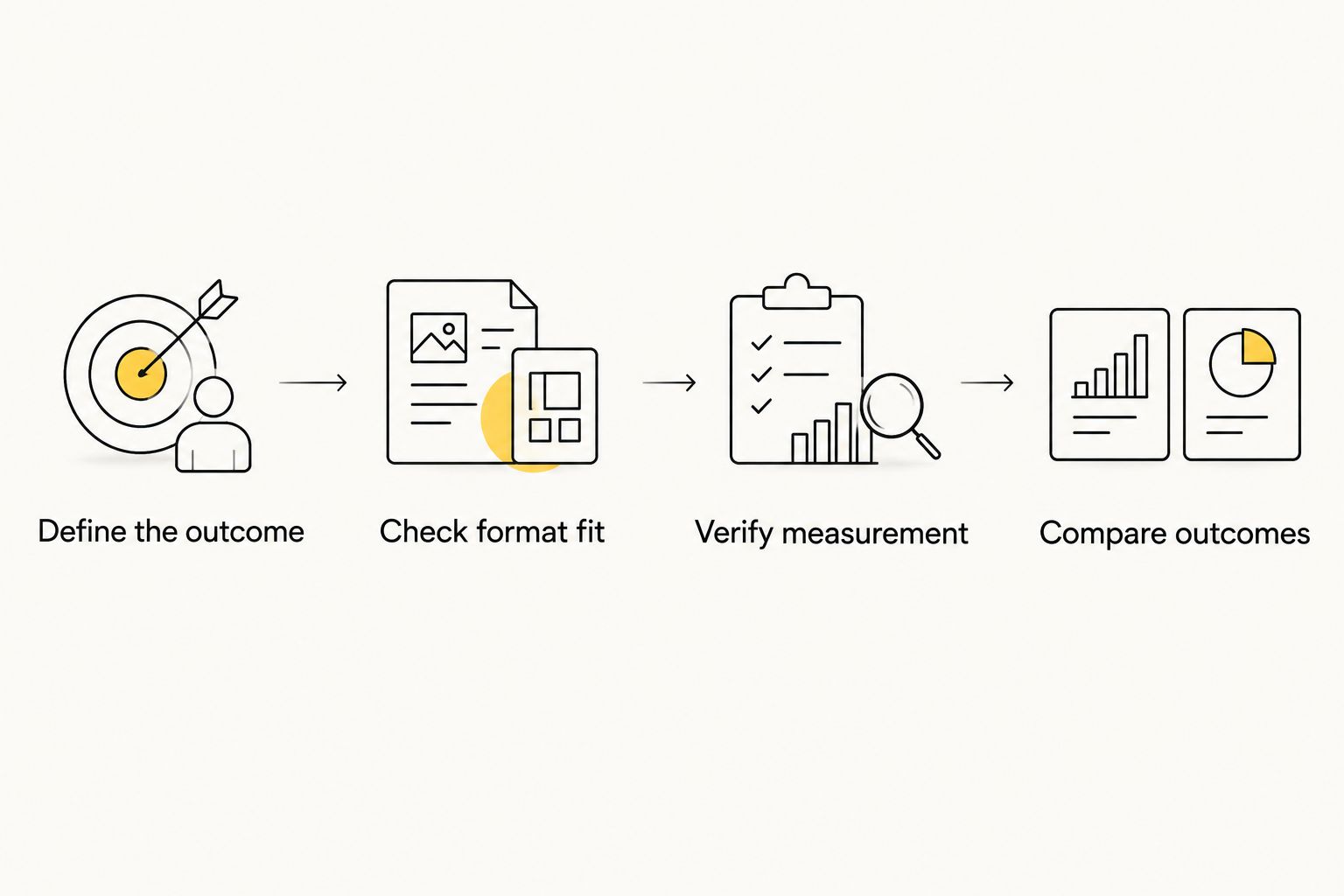
Use this sequence before deciding where to concentrate your buying:
- Define the outcome. Name the conversion event and the downstream quality requirement. Your evaluation should not reward cheap activity that does not satisfy the offer.
- Check format fit. Confirm that the selected platform supports the format and GEO you intend to use. Check the offer rules and destination requirements as well.
- Verify measurement. Confirm the tracking setup and inspect the path from campaign traffic to the recorded outcome. Resolve measurement problems before interpreting results.
- Compare outcomes. Evaluate campaigns using the same definition of success. Keep platform suitability separate from the performance of a particular creative or traffic segment.
This process does not assume that the platforms have identical inventory. It gives you a consistent decision standard while allowing each buying model to serve a different brief.
A useful comparison also records what changed between campaigns. Different offers, landing pages or conversion definitions make a platform verdict harder to defend. Keep those differences visible instead of attributing every result to the traffic provider.
Final verdict for 2026
Choose EZmob if you are an offer-first affiliate buyer
You want to buy pop, push, display or native traffic, manage campaigns yourself and launch without a sales call. Your next task is a campaign, not an SSP procurement exercise.
The self-serve network is the better fit for this profile. Plan for creative moderation and validate the tracking path before evaluating traffic performance.
Choose SmartyAds if you are a programmatic platform buyer
You have a DSP brief, or you are a publisher evaluating an SSP. Your decision centers on the selected platform's buying or supply-side requirements rather than simply obtaining traffic for an affiliate offer.
SmartyAds is the better fit for this profile. Evaluate its relevant offering directly; vendor breadth alone does not establish the controls, terms or outcomes your operation requires.
| Dimension | Winner |
|---|---|
| Best for | Split: network for affiliates; SmartyAds for a DSP brief |
| Standout feature | SmartyAds for broader ad-tech scope |
| Format fit | Self-serve network for the explicit pop-and-push brief |
| Buying workflow | Self-serve network for documented independent launch |
| Supply-side scope | SmartyAds for an SSP brief |
| Conversion measurement | No default winner; verify the setup and outcomes |
| Pricing model | No declared winner; compare applicable terms |
| Operational fit | Self-serve network for offer-first execution |
FAQ
Is EZmob better than SmartyAds for affiliate marketers?
EZmob is the clearer fit for affiliate marketers seeking self-serve pop, push, display and native campaigns. SmartyAds is the clearer fit when the requirement is a programmatic DSP, rather than a traffic-format buying brief.
Which platform should I choose for programmatic buying?
Choose SmartyAds for a DSP evaluation. Confirm the selected offering’s controls, inventory requirements and commercial terms against your media plan before committing.
Can I launch campaigns without a sales call?
The self-serve network lets advertisers sign up, fund their account and launch without a sales call. New campaigns still go through creative moderation before they go live.
Which platform is cheaper in 2026?
There is no substantiated pricing winner in this comparison. Check the applicable funding, billing and fee terms, then evaluate campaign spend against the conversion outcome you need.
Does choosing a DSP guarantee better traffic quality?
No, a DSP designation does not guarantee better traffic quality or conversion performance. Evaluate the selected inventory against tracked outcomes and downstream conversion quality.
Should publishers compare an ad network with an SSP?
Publishers should compare them only after defining the monetization requirement. Network monetization and SSP selection are different operating models, so ad formats alone do not settle the choice.
What should I check before testing either platform?
Check format fit, offer rules, GEO requirements and conversion measurement before launching. Use the same success definition when comparing campaign outcomes.
One last thing
A campaign can record conversions correctly and still fail your commercial goal. The event in your tracker must match the outcome your offer accepts, not merely the easiest action to count.
Put that definition in the campaign brief before choosing a platform. It makes the eventual decision about traffic performance rather than dashboard activity.
Related guides
Ready to launch a self-serve campaign? Start advertising on EZmob.