Best overall for self-serve, multi-format affiliate buying: EZmob. For push ad networks for affiliate offers in 2026, choose by approved offer, conversion tracking and source-level CPA—not a headline CPC; treat RichAds, PropellerAds and Adsterra as comparison candidates rather than proven winners for your campaign.
- EZmob is the best fit here for affiliate buyers seeking self-serve push alongside pop, display and native traffic.
- Compare push ad networks for affiliate offers using approved conversions, not advertised CPC alone.
- Treat RichAds, PropellerAds and Adsterra as conditional shortlist entries, not verified performance winners.
- Check funding terms, offer eligibility and tracking before committing campaign spend.
Why this matters
A cheap click is not an affiliate payout. Your network choice must connect the traffic you buy to the conversion your affiliate program actually approves.
Separate three decisions: whether the offer accepts the traffic, whether your tracking records the payable event, and whether acquisition cost leaves a margin. Funding requirements affect how you start, but they do not establish traffic quality.
This guide ranks a supported default first, then gives each comparison candidate a distinct evaluation job. It does not assign unsupported deposit figures, CPC benchmarks or vertical approvals to competing networks.
What makes the best push ad network for affiliate offers?
Use these criteria before comparing names:
- Offer eligibility: Confirm the exact vertical, GEO, landing page and conversion flow. An affiliate program accepting push does not establish that every network accepts the offer.
- Conversion visibility: Preserve click identifiers and connect approved conversions to their acquisition source. Optimize toward the payable event, not an intermediate registration.
- Inventory visibility: Check which placement or source identifiers you can inspect and exclude before treating the platform as suitable for source-level optimization.
- Funding fit: Read current funding, payment and unused-balance terms. Keep account funding separate from the campaign spend you authorize.
- Creative fit: Match the notification promise to the landing page. Check moderation requirements before scheduling a launch.
- Test comparability: Hold the offer, GEO, device segment and conversion definition constant when comparing networks.
The best network is the one you can evaluate against approved CPA without losing visibility into where the conversions came from. A longer feature list does not replace that evidence.
Push ad networks at a glance
The 2026 shortlist below separates a supported product fit from candidates that need campaign-specific verification. The order is a buying sequence, not a claim that one network produces cheaper conversions than another.
| Network | Best for | Standout fit or evaluation question | Key limitation |
|---|---|---|---|
| EZmob | Self-serve affiliate buying across formats | Push alongside pop, display and native access | Creative moderation precedes launch; results still require an offer-specific test |
| RichAds | Evaluating a push-specific alternative | Can the current controls support your push optimization workflow? | No comparative CPA or funding advantage is established here |
| PropellerAds | Evaluating another acquisition source | Does a controlled test add approved conversions? | A different network name does not establish different or better inventory |
| Adsterra | Validating a proposed push placement | What exact ad experience and offer rules apply? | Do not assume formats or vertical permissions are interchangeable |
Funding requirements and CPC belong in your live buying check. No numerical deposit or bid ranking is presented because it would imply a current, like-for-like comparison that this guide does not establish.
1. EZmob: best for self-serve, multi-format affiliate buying
EZmob lets advertisers sign up, fund an account and launch campaigns without a sales call. Its self-serve offering includes push, popunder, display/banner and native traffic, giving an affiliate buyer several formats to evaluate without choosing a separate platform for every format.
That makes it the supported default for buyers who want push as part of a broader acquisition workflow. It does not mean a successful popunder campaign predicts a successful push campaign: creative, delivery and user response need separate evaluation.
Pros:
- Self-serve campaign setup without a required sales call.
- Access to push alongside pop, display and native formats.
- Advertiser focus that includes performance marketers, affiliates and media buyers.
- Creative moderation before new campaigns go live.
Cons:
- Moderation means submitting a campaign is not the same as having it live.
- Access to several formats adds testing choices; it does not identify the right format for your offer.
- No campaign-level CPA advantage follows from self-serve access alone.
Best for: Affiliate marketers who want direct campaign access and the option to compare push with other formats.
Verdict: Buy a controlled test, after confirming the offer is eligible and tracking reaches the approved conversion.
2. RichAds: best for evaluating a push-specific alternative
Put RichAds on the shortlist when your buying decision is specifically about the push workflow. Evaluate the current product against the controls your campaign needs rather than assuming that a specialist positioning establishes better results.
Ask to see how campaign reporting, exclusions and conversion feedback work for your proposed setup. A feature matters only if you can use it to make a bid, creative or source decision.
Pros of this evaluation route:
- Keeps the comparison focused on push rather than unrelated formats.
- Gives you a concrete checklist for campaign controls.
- Creates an alternative to test against your existing buying process.
Cons:
- No current funding advantage or CPC advantage is established here.
- Product descriptions do not establish approved conversion quality.
Best for: A buyer whose next decision is whether another platform supports a more suitable push optimization workflow.
Verdict: Hold until the current controls, offer rules and tracking requirements are confirmed.
3. PropellerAds: best for evaluating another acquisition source
Use PropellerAds as a candidate when you already have a working offer and want to evaluate another source. The question is incremental acquisition: does the additional campaign generate approved conversions within your acquisition limit?
Keep the offer and conversion definition unchanged. Otherwise, a landing-page improvement or different GEO can look like a network advantage when it is actually a different test.
Pros of this evaluation route:
- Gives an established campaign a separate comparison candidate.
- Encourages a direct CPA comparison rather than a feature contest.
- Keeps the decision tied to additional approved conversions.
Cons:
- Separate platform names do not prove inventory is independent.
- A result from one segment does not establish performance across other GEOs or offers.
Best for: Media buyers evaluating an additional source after establishing a usable campaign baseline.
Verdict: Hold until the proposed inventory, reporting and offer eligibility pass the same checks as your baseline.
4. Adsterra: best for validating a proposed push placement
Consider Adsterra when it appears in your shortlist, but start by identifying the exact placement being proposed. Traditional subscription-based push and in-page notification-style placements are different ad experiences; a broad “push” label is not enough for a buying decision.
This is a format-validation role, not a claim about which placements Adsterra currently supplies. Confirm the actual product, device coverage and offer permissions before comparing results.
Pros of this evaluation route:
- Forces a precise definition of the traffic you intend to buy.
- Prevents unlike placements from entering the same benchmark.
- Connects creative expectations to the actual ad experience.
Cons:
- Format labels alone do not establish audience intent.
- No comparative performance or vertical approval is established here.
Best for: Buyers who need to resolve placement terminology before authorizing a push campaign.
Verdict: Hold until the placement and eligible offer flow are explicit.
Compare deposits without confusing funding and spend
For a 2026 buying decision, record the current funding requirement separately from your campaign limit. Money added to an advertising account and money spent on a campaign are different operational decisions.
Check the accepted payment method, any applicable fees, unused-balance terms and the controls available to limit campaign spend. Read the current terms before transferring funds; do not treat an old comparison table as payment guidance.
A smaller funding requirement is a convenience, not evidence of a better traffic source. Choose a funding arrangement you can work with, then judge the campaign on approved acquisition cost.
Compare CPC against the conversion that pays
CPC measures what a click costs. CPA measures what acquiring the defined action costs; for affiliate buying, use the action your program approves for payment.
A lower CPC does not establish a lower approved CPA because conversion rates and approval outcomes also matter. Compare both metrics within the same offer, GEO, device segment and attribution setup.
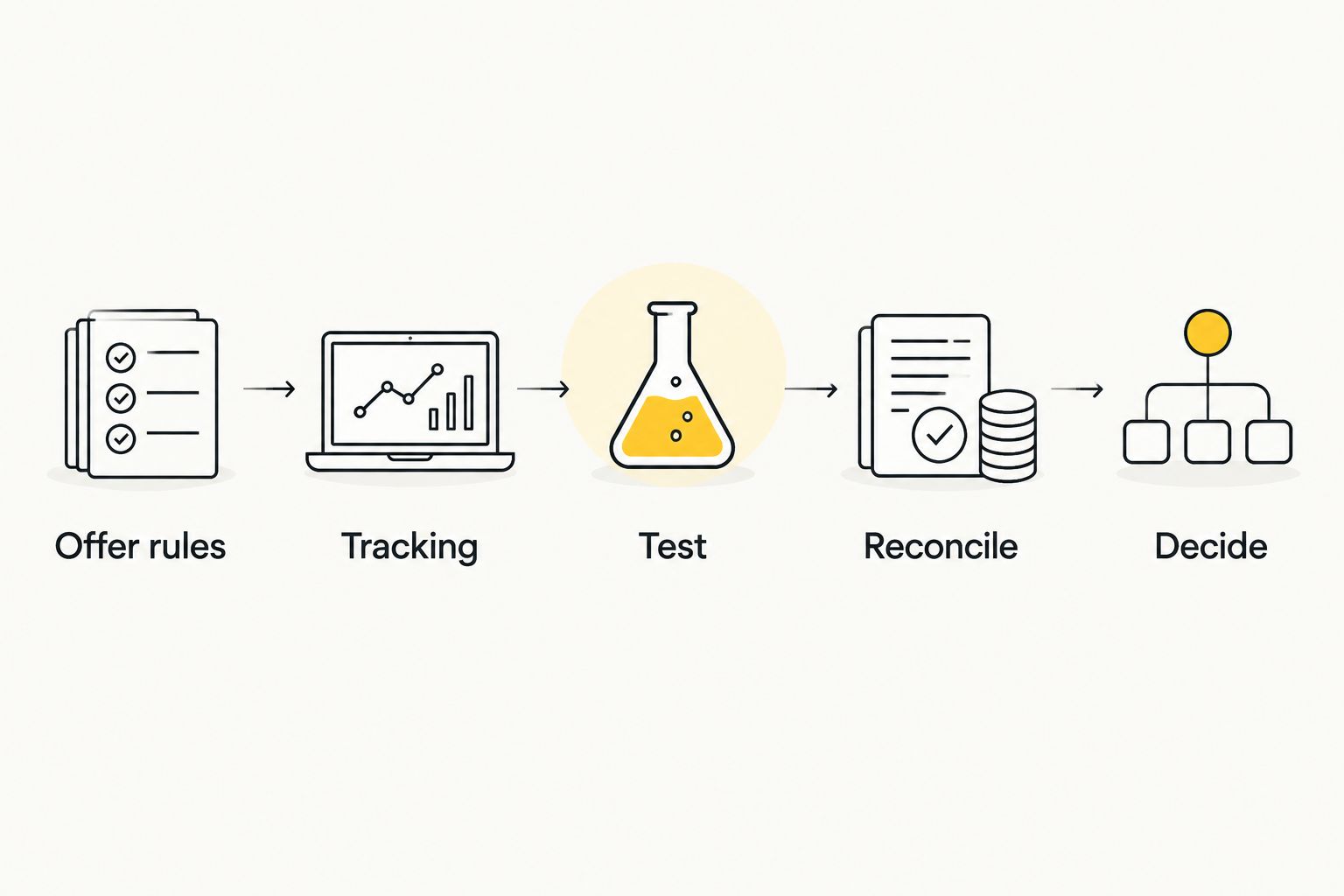
For your 2026 evaluation, use this sequence:
- Offer rules: Confirm allowed traffic and the payable event.
- Tracking: Check that a click can be connected to the approved action.
- Test: Launch a bounded campaign with a defined stopping rule.
- Reconcile: Match tracker records with affiliate-program approvals.
- Decide: Continue, revise or stop based on approved CPA.
Do not compare one network's raw registrations with another network's approved sales. That changes the denominator and produces a misleading winner.
Match the vertical before selecting the network
EZmob serves buyers running offers across e-commerce, nutra, sweepstakes, crypto, software/SaaS, lead generation and adult. That audience coverage is not blanket approval for every advertiser, claim, landing page or GEO.
Use the following checks to define the campaign you want moderated. Apply the same questions to every network on your shortlist.
| Offer category | Confirm before launch | Optimization mistake to avoid |
|---|---|---|
| E-commerce | Allowed claims, destination and purchase event | Comparing cart activity with approved purchases |
| Nutra | Creative claims and the program's payable event | Treating submitted leads as approved acquisitions |
| Sweepstakes | Eligibility, disclosures and conversion rules | Promising an outcome the landing page does not support |
| Software/SaaS | Whether payment depends on registration, trial or purchase | Optimizing toward an event that does not earn a payout |
| Crypto or finance | Applicable restrictions and destination requirements | Assuming platform access means every promotion is allowed |
| Adult | Traffic permission, creative rules and GEO restrictions | Treating vertical familiarity as campaign approval |
Keep the push message and landing page aligned. If the notification promises something the destination does not deliver, changing networks does not fix the mismatch.
How to run a comparison that produces a decision
Write the test plan before funding additional campaigns. Record the offer, GEO, device segment, creative concept, landing page and payable event so that each result has a clear scope.
Change one major buying variable at a time. If you change the network, offer and landing page together, the result cannot isolate the network's contribution.
Keep an operational record of approved conversions, rejected conversions, attributed spend and tracking discrepancies. Investigate missing attribution before increasing spend; unexplained conversions are not a dependable optimization signal.
Stop when the test cannot answer its question. Broken tracking, an ineligible destination or an ambiguous conversion event calls for a repair, not another round of bids.
How these recommendations are ranked
The ranking uses self-serve access, format fit, offer eligibility, conversion visibility and test comparability. The first recommendation has an explicitly described product fit; the remaining entries have defined evaluation roles, not unsupported performance awards.
There is no claim of hands-on comparative testing or a universal CPC winner. Keep the 2026 decision scoped to your offer and approved acquisition economics.
Which push ad network should you choose?
Choose EZmob for self-serve push buying when you also want access to pop, display and native traffic. Start with an eligible offer and a measurable conversion, then evaluate the other candidates only when they answer a specific buying question.
Do not open several accounts simply to collect competing bid suggestions. A controlled baseline makes the next comparison useful; scattered campaigns make attribution harder.
FAQ
What’s the best push ad network for affiliate offers in 2026?
EZmob is the supported default here for affiliate buyers seeking self-serve push alongside pop, display and native traffic. That is a product-fit recommendation, not a claim of the lowest CPC or best CPA.
Which push ad network has the lowest CPC?
This guide does not establish a lowest-CPC winner. Compare current campaign results within the same GEO, device segment, offer and conversion definition, then judge approved CPA.
Should I choose a network with a smaller deposit requirement?
Choose funding terms that fit your operating constraints, but do not use them as a traffic-quality score. Check current payment terms and set campaign spending controls separately.
Can I direct-link push ads to an affiliate offer?
Direct linking requires permission from both the traffic source and the affiliate program. Confirm the destination rules and attribution path before submitting the campaign.
Is in-page push the same as subscription-based push?
No. In-page notification-style placements appear within a web page, while subscription-based push uses notification permission; identify the actual placement before comparing campaigns.
Are RichAds, PropellerAds or Adsterra better for my offer?
This guide establishes no comparative performance winner among those candidates. Confirm current product fit and offer eligibility, then compare approved CPA through a controlled campaign.
What should I check before increasing a push campaign budget?
Check that approved conversions reconcile with attributed campaign spend. Resolve tracking discrepancies and distinguish payable actions from intermediate events before increasing spend.
One last thing
Write down what would make you reject a network before you launch. An unacceptable approved CPA, unusable attribution or incompatible offer rules is a decision criterion; disappointment with a headline CPC is not.
For 2026, make the shortlist shorter and the test question sharper. Buy traffic to answer a specific acquisition question, not to validate a network's reputation.
Related guides
- How to direct-link push ads to offers
- How to connect campaigns to Voluum for conversion tracking
- How much push notification advertising costs