
Push notification advertising cost is the media spend you incur under your campaign’s billing model; the useful buying decision is whether that spend produces an acceptable cost per acquisition. For a 2026 campaign, budget separately for traffic, tracking, creative production, and landing-page work, then judge performance against approved conversions rather than cheap clicks.
- Push notification advertising cost should be judged against approved-conversion CPA, not the lowest advertised CPC.
- EZmob suits affiliate marketers and media buyers who want self-serve push advertising access.
- Separate media spend from tracking, creative, and landing-page expenses before setting your test budget.
- Compare traffic sources using the same offer, GEO, attribution rules, and conversion status.
Why this matters
A low click cost is not a profitable campaign. You still need those clicks to reach the landing page, complete the offer, and qualify for payment. Buying inexpensive traffic without checking those steps leaves you optimizing the wrong number.
Before you fund a push test, connect the advertising campaign to your conversion reporting. The guide to connecting EZmob to Voluum for automated conversion tracking covers a relevant tracking workflow. Verify the connection with your own campaign before treating reported conversions as a buying signal.
Set the acceptable acquisition cost before setting the bid. That order keeps the campaign tied to the offer’s economics instead of a network’s headline traffic rate.
How much does push notification advertising cost?
Push advertising has two different cost questions: what you pay for delivery, and what you pay to acquire a qualifying customer or lead. Your billing model answers the first. Your conversion records answer the second.
For your 2026 budget, keep the following measures separate. They describe different parts of the same campaign, not interchangeable definitions of cost.
| Cost measure | Calculation or basis | Best for | Strength | Limitation |
|---|---|---|---|---|
| CPC | Media spend divided by billed clicks | Comparing click-based traffic purchases | Shows the effective cost of acquiring a click | Does not measure conversion quality |
| CPM | Media spend divided by impressions, expressed per thousand impressions | Comparing impression-based purchases | Connects delivery cost to impression volume | Requires click and conversion data to assess acquisition economics |
| Media CPA | Media spend divided by attributed conversions | Evaluating campaign acquisition efficiency | Connects traffic spend to the desired action | Depends on attribution accuracy and conversion status |
| Approved-conversion CPA | Media spend divided by approved conversions | Affiliate offers with approval or validation | Excludes conversions that do not qualify for payment | Requires approval data rather than initial conversion events |
| Fully loaded acquisition cost | Campaign expenses divided by approved acquisitions | Assessing the campaign’s overall economics | Includes expenses outside the ad account | Requires consistent expense allocation |
The effective rate comes from billed delivery, not just the bid you entered. Keep the bid, actual spend, and measured outcome in separate report fields so you can reconcile them.
What belongs in the cost breakdown?
Start with media spend: the amount charged for traffic delivered under the campaign’s billing terms. Record it by campaign and reporting period. Do not treat a funded account balance as campaign spend; funding and consumption are different events.
Next, account for campaign-specific expenses. Tracking software, creative production, translation, landing-page hosting, and page development belong in the calculation when you incur them. Avoid charging the entire expense of a shared tool to one test unless that allocation reflects how you actually use it.
Finally, reconcile the conversion outcome. For an affiliate campaign, distinguish an initial conversion event from an approved, payable result. For lead generation, use the qualifying action that your business actually values rather than a superficial form event.
Keep a media-only CPA and a fully loaded acquisition cost. The first helps you optimize traffic; the second helps you decide whether the campaign deserves continued investment.
Calculate the bid from your offer economics
Work backward from the acquisition cost your offer can support. Use net proceeds after the deductions that apply to your business, not a headline payout detached from approval rules or operating expenses.
The basic relationship is:
Allowable CPC = target media CPA × click-to-approved-conversion rate.
Use the conversion rate as a decimal in this calculation. The result is a planning ceiling, not evidence that a particular traffic source will achieve it. A new campaign still needs measured results from its own offer, creative, GEO, and landing page.
If you already have comparable campaign history, use that history to set the initial assumption. Keep unlike traffic separate: a conversion rate from another format or market is not automatically a valid push benchmark.
When approved conversions have not yet arrived, you cannot calculate an observed approved-conversion CPA. Track the spend and funnel events, but do not replace the missing outcome with an optimistic assumption. Define the maximum loss you accept before the campaign starts spending.
Separate break-even from your target
Break-even and target CPA serve different purposes. Break-even marks the point where the economics stop producing a contribution under your chosen cost definition. Your target leaves room for the contribution you want to retain.
Write down which expenses each threshold includes. A media-only target cannot prove that the campaign covers tracking, production, and landing-page expenses. Conversely, a shared software expense should not distort every individual source decision through inconsistent allocation.
In your 2026 campaign plan, give each threshold a name and an owner. That prevents one buyer from scaling against gross payout while another evaluates the same campaign against net proceeds.
Why push notification advertising cost varies
Push costs depend on both the traffic purchase and what happens after the click. Evaluate these factors separately instead of assuming that one network-wide rate describes your campaign.
- GEO and audience: Compare traffic aimed at the same market and buyer. A rate from a different GEO does not establish the cost of reaching your intended audience.
- Bid and billing model: Check what triggers a charge and how your bid applies. A click-based purchase and an impression-based purchase require different calculations.
- Inventory and source mix: Keep source-level results where your reporting provides them. A blended campaign average can hide sources with different acquisition economics.
- Creative and offer fit: The notification’s promise should match the destination and the offer. A click does not establish that the user wants the action you need.
- Landing-page performance: Confirm that the page loads, the destination works, and the conversion path is usable on the targeted device. Broken delivery wastes purchased visits.
- Conversion approval and attribution: Use consistent attribution rules and distinguish pending, rejected, and approved outcomes. Otherwise, apparent CPA changes can reflect reporting differences rather than traffic performance.
Treat these as investigation points, not excuses for a failing campaign. Your report should show where the expense occurs and where the expected outcome stops appearing.
Build a push test that answers the cost question
A useful test asks whether a defined traffic purchase can produce an acceptable acquisition cost. It does not try to discover the cheapest click across every market, offer, and creative at once.
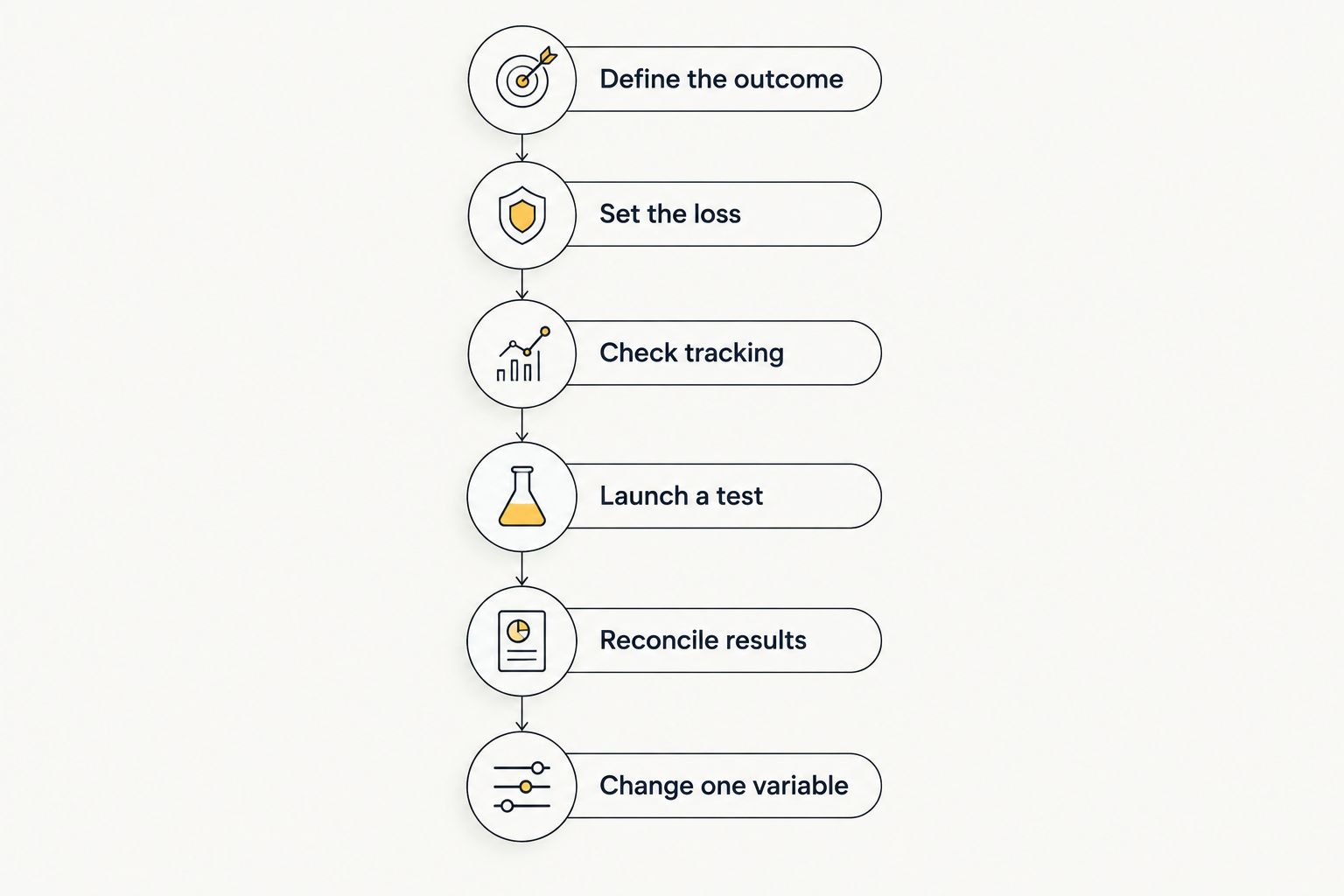
Use this sequence to keep the test interpretable:
- Define the outcome. Name the conversion event, approval status, and attribution rule that count toward success. Confirm that the offer allows the traffic you intend to buy.
- Set the loss limit. Decide how much campaign spend you accept before pausing for review. Include the expenses you need to evaluate the test honestly.
- Check tracking. Confirm the destination, campaign identifiers, conversion event, and reporting connection. A working landing page alone does not prove that attribution works.
- Launch a controlled test. Keep the offer and GEO explicit, document the creative, and avoid mixing unrelated experiments into one result.
- Reconcile results. Match spend to the same reporting period as attributed and approved conversions. Investigate discrepancies before changing bids.
- Change one variable. Adjust the bid, creative, landing page, or source selection with a stated reason. Preserve the previous result so you can compare the change.
A controlled test still carries a cost: narrower experiments answer narrower questions. The benefit is clarity. You can identify what changed instead of attributing an improvement to several simultaneous edits.
Keep a buying log
Record the campaign’s offer, GEO, billing model, bid, creative, landing page, and launch status. Add spend, billed delivery, attributed conversions, approved conversions, and the reason for each change as results arrive.
The log is not administrative decoration. It lets you separate an expensive traffic purchase from a tracking failure or an offer change. Without that record, a lower CPA after an edit does not tell you which decision produced it.
When does a cheap push click become expensive?
A cheap push click becomes expensive when too few purchased clicks produce the approved outcome you need. CPC measures the acquisition of traffic; approved-conversion CPA measures the acquisition of payable results.
Look beyond the blended click rate. Check whether the traffic reaches the intended destination, whether campaign identifiers survive the journey, and whether the offer records the expected event. Investigate ad fraud concerns separately from ordinary conversion failure; a poor result alone does not establish fraud.
For a 2026 buying review, compare sources using the same conversion status and reporting window. Do not reward one source for pending conversions while judging another only on approved results.
Is CPC or CPA better for evaluating push advertising?
CPA is the better decision metric when your objective is an acquisition, while CPC remains useful for understanding the traffic purchase. Keep both visible: a change in CPA can come from a different click cost, a different conversion rate, or both.
Use CPC to diagnose delivery economics and approved-conversion CPA to decide whether to continue buying. Neither replaces the need to reconcile tracking or account for campaign expenses outside media spend.
Should you increase your push bid to get more traffic?
Increase a push bid only within the acquisition economics you have defined. A higher bid is not a remedy for an unverified conversion path or an offer that fails to produce approved outcomes.
Before changing the bid, identify the question you want the change to answer. Then compare the new spend and approved results against the prior setup without simultaneously changing the creative and landing page.
Where EZmob fits in a push cost test
EZmob is best for affiliate marketers and media buyers who want self-serve access to push advertising. Advertisers can sign up, fund an account, and launch campaigns without a sales call. New campaigns go through creative moderation before they go live.
EZmob’s self-serve advertising access also includes pop, display, and native traffic. That is useful when you want to test another format, but each format needs its own cost and conversion evaluation. A result from pop traffic is not proof of what a push campaign will achieve.
The advantage is direct campaign access; the trade-off is that you still need to set the economics, verify tracking, and manage the test. Self-serve access does not establish a winning CPA, and creative submission does not mean a campaign is already live.
FAQ
How much does push notification advertising cost per click?
The effective cost per click is your media spend divided by billed clicks. Use the campaign’s actual billing and delivery records rather than treating an entered bid as the final rate.
What is the best way to budget for push ads in 2026?
Budget for media spend separately from tracking, creative, and landing-page expenses. Define your target acquisition cost and acceptable test loss before launching.
Is the cheapest push traffic the most profitable?
The cheapest push traffic is not necessarily the most profitable because click cost does not measure approved conversions. Compare approved-conversion CPA under the same offer and attribution rules.
Does a minimum deposit tell me the cost of a push campaign?
A minimum deposit does not tell you the cost of a push campaign because account funding is different from campaign spending. Evaluate the media actually consumed and any additional campaign expenses.
Should affiliate marketers count pending conversions when calculating CPA?
Affiliate marketers should keep pending-conversion CPA separate from approved-conversion CPA. Approved outcomes show which conversions qualify for payment under the offer’s rules.
Can I test push advertising without a sales call?
EZmob provides self-serve push advertising access without a sales call. Advertisers sign up, fund their account, and submit campaigns, which go through creative moderation before going live.
What should I check before raising a push campaign bid?
Check tracking, approved-conversion CPA, and the acquisition cost your offer can support before raising a bid. Change the bid separately from the creative or landing page so the result remains interpretable.
One last thing
Your cheapest source and your lowest-cost acquisition source are not necessarily the same. Keep the distinction visible in your reporting rather than allowing a low CPC to justify continued spend.
Before the next 2026 launch, write the target CPA, conversion status, and pause condition into the campaign brief. Decide what would make you stop before deciding what would make you scale. That recommendation applies even when the first results look encouraging.
Related guides
- Push ad networks ranked by CPC rates
- Can push notification ads work without a mobile app?
- Push notification ad networks