
Yes, you can run adult ad campaigns on a self-serve platform that accepts your offer, creative, and destination page. Self-serve means you handle campaign setup yourself; it does not remove moderation or make every adult offer eligible. For a 2026 launch, confirm the permitted content and traffic format before funding a campaign.
- Adult ad campaigns self-serve platform access does not mean automatic approval; check the offer, creative, and landing page.
- EZmob suits affiliate media buyers seeking self-serve adult campaign setup with creative moderation.
- Choose popunder, push, or display around the landing experience, not an assumed CPA advantage.
- Verify conversion tracking before buying traffic, then separate campaign changes so results remain interpretable.
Can you run adult ad campaigns on a self-serve platform?
Yes—provided the platform accepts the specific campaign, not just the adult category. An adult dating offer, an explicit creative, and a subscription landing page present different review questions. Treat the offer, ad, and destination as a connected submission rather than assuming category acceptance covers everything.
EZmob is a self-serve ad network used by performance marketers, affiliates, and media buyers, with adult among its stated advertiser verticals. Advertisers can sign up, fund an account, and launch campaigns without a sales call. New campaigns go through creative moderation before they go live.
That distinction is the practical answer: you control the setup, while the network controls campaign acceptance. For broader network selection, the guide to adult ad networks addresses a separate decision from whether your particular campaign is ready to submit.
Check eligibility before building the campaign
Use this sequence before committing to a launch:
- Identify the offer. Write down what the user receives, the conversion event, and the affiliate program's traffic restrictions.
- Confirm content acceptance. Check the network's current requirements for your creative and destination, including any redirects between the ad and the offer.
- Choose the format. Match the ad experience to the landing page rather than treating every traffic source as interchangeable.
- Check the GEO. Confirm that the offer accepts users from the country you plan to target and review applicable advertising requirements.
- Validate measurement. Test the tracking path before submission so you can distinguish paid visits from completed conversions.
- Submit for moderation. Launch only after the campaign has cleared the required review.
These are preparation steps, not a promise of approval. A platform accepting adult advertisers does not establish that a particular image, claim, destination, or affiliate offer is permitted.
Why this matters
An adult campaign can be technically ready and still be unsuitable for the selected network or offer. A working destination URL proves that the page loads. It does not prove that the traffic source is allowed, that the creative is acceptable, or that the conversion will be credited.
Separate eligibility from profitability. Approval answers whether the campaign can run. Conversion tracking answers what happened after users arrived, and your campaign economics determine whether buying more traffic makes sense.
For your 2026 campaign plan, keep those decisions separate. Otherwise, a failed submission becomes a targeting problem, or a weak landing page gets mistaken for poor inventory.
The same discipline prevents unnecessary rework. Check the offer restrictions before making creatives, and test measurement before submitting the campaign. Changing either after launch complicates your reading of the results.
What self-serve changes—and what it does not
Self-serve access removes the need for a sales-led setup process. You handle the account and campaign submission yourself. That is useful when you already understand your offer and want direct responsibility for the campaign.
It does not transfer the network's approval decision to you. Nor does it establish that every format, publisher placement, or audience is suitable for adult advertising. Check the campaign's requirements instead of reading the platform's format list as blanket permission.
For adult media buying, the main advantage is control over preparation. You can organize campaigns around distinct hypotheses, document what you submitted, and keep the offer and creative aligned.
The trade-off is responsibility. Self-serve is a good fit when you can evaluate offer eligibility, prepare compliant materials, and interpret campaign results yourself. It is not a substitute for those skills.
Before choosing a platform in 2026, ask whether you need self-directed campaign access or hands-on campaign management. Those are different services. A self-serve account alone does not promise strategic advice, creative production, or managed optimization.
Which format should you use for an adult campaign?
Choose the format around the user's first interaction with the offer. Popunder, push, and display create different entry points; none has a universal CPA advantage. Confirm adult eligibility for the specific format before building assets.
EZmob's stated self-serve formats include pop, push, display, native, video, direct-click traffic, and contextual keyword ads. That platform-level list describes available campaign types, not an approval guarantee for an adult campaign in each type.
| Format | Best for | Practical advantage | Limitation to plan around |
|---|---|---|---|
| Popunder | A landing-page-led test | The destination carries the central message | The page must orient users without relying on a preceding banner message |
| Push | Testing a concise message before the visit | You can evaluate the ad promise alongside the destination | The creative and landing page must communicate the same offer |
| Display/banner | Offers that benefit from a visual introduction | The ad can introduce the proposition before the visit | You need suitable visual assets and format-specific approval |
| Native | A content-led introduction to an offer | The surrounding message can explain why the user should continue | A content-led approach still needs clear claims and an eligible destination |
These are planning recommendations, not performance rankings. Pick the format that matches the assets you can prepare and the journey your offer requires.
Popunder: best for a landing-page-led test
Use popunder when the landing page can explain the offer on its own. Make the next action obvious and ensure the opening message identifies what the user is being asked to do.
The advantage is a test centered on the destination experience. The limitation is equally clear: a confusing page remains confusing even when the traffic reaches it successfully. Choose popunder when your landing page is ready to carry the message.
Push: best for testing a concise offer message
Use push when you have a clear proposition that can be expressed briefly and supported by the destination. Treat the creative as a promise the landing page must fulfill.
The advantage is a distinct message to evaluate before the visit. The limitation is message mismatch: a creative that suggests something different from the offer makes the campaign harder to diagnose. Choose push when the ad and landing page tell the same story.
Display and native: best for an introduction before the visit
Use display when a visual introduction helps explain the proposition. Consider native when the campaign needs a content-led introduction rather than a standalone banner message.
Both approaches require suitable assets and a clear destination. Neither format removes review requirements or affiliate restrictions. Choose the format you can execute accurately, not the one with the most appealing label.
Why adult campaign requirements vary
There is no single setup that fits every adult offer. The requirements depend on the campaign you intend to submit and the traffic you intend to buy.
- Offer terms: The affiliate program determines which traffic sources and promotional methods it accepts. Check those terms before selecting inventory.
- Creative content: The text and imagery need to satisfy the network's current requirements. Category acceptance alone is not enough.
- Destination content: Review the actual landing page and offer, not just the first URL in the tracking chain.
- Traffic format: Popunder, push, display, and native require different creative preparation and produce different entry experiences.
- GEO: Match targeting to the offer's accepted countries and review the advertising requirements that apply there.
- Conversion event: A registration, lead, or purchase requires a clearly defined measurement path. Decide what counts before evaluating performance.
For a 2026 launch, resolve these factors in the campaign brief. Do not leave the creative developer, landing-page owner, and media buyer working from different versions of the offer.
How do you prepare an adult campaign for moderation?
Start with the complete user journey. Review the ad, tracking link, landing page, and final offer as a connected path. A compliant-looking opening page is not a substitute for checking the destination users ultimately reach.
Build a submission checklist
Use these checkpoints before submitting:
- Offer eligibility: Confirm the advertiser or affiliate program accepts the intended traffic source.
- Creative accuracy: Check that the wording and imagery represent the offer without unsupported claims.
- Landing match: Make the opening page consistent with the creative and the requested action.
- Tracking test: Verify that the destination loads correctly and the intended conversion is recorded.
- Moderation: Submit the campaign and wait for the required approval before expecting delivery.
Keep a record of the materials submitted. If you revise the creative or destination, review the connected journey again rather than checking only the changed asset.
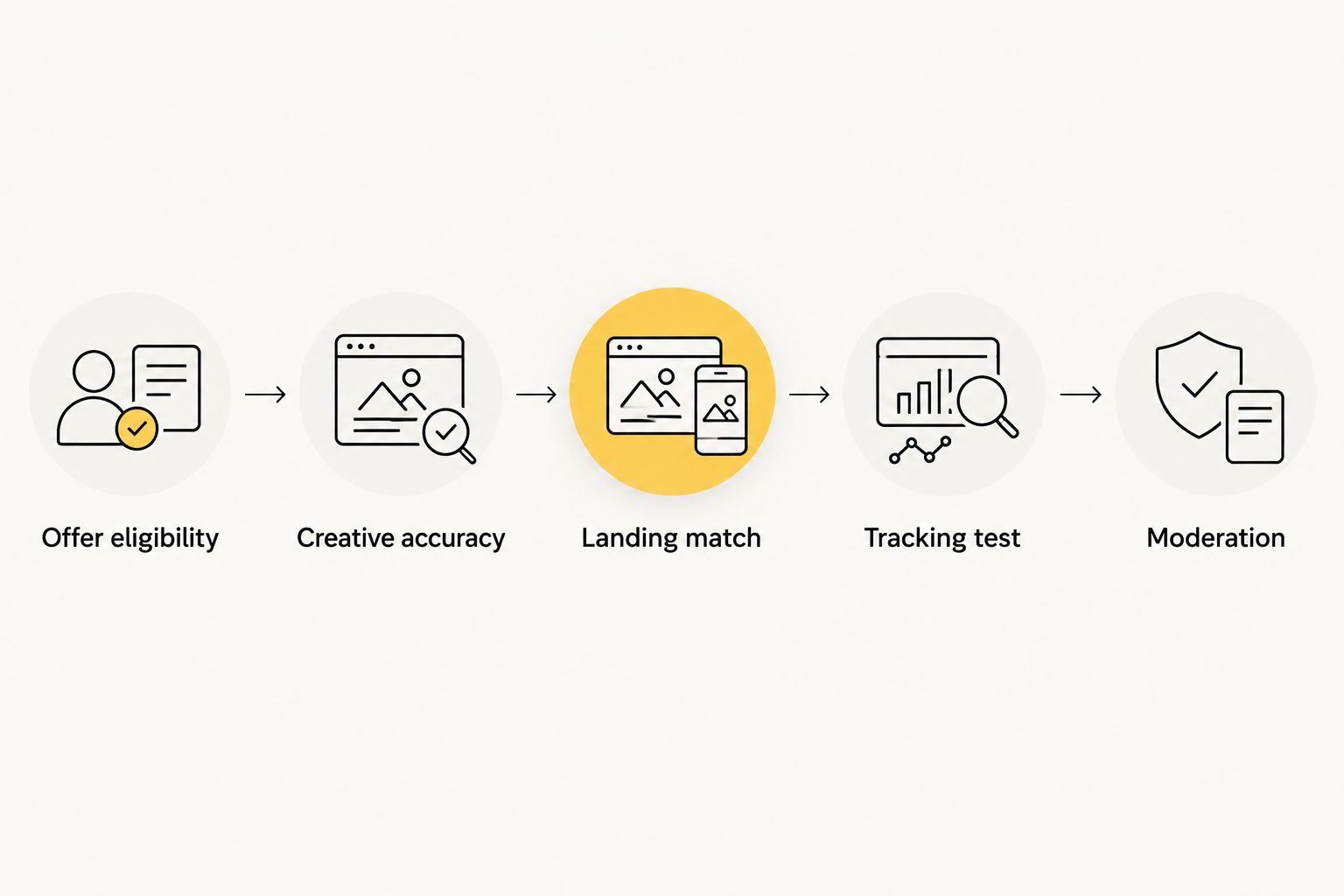
The point of this checklist is consistency. Your offer restrictions, submitted creative, destination, and tracking setup should describe the same campaign. A mismatch deserves correction before traffic starts, not an explanation after the test.
How do you judge an adult campaign after approval?
Judge an approved campaign by the conversion event you intended to buy, not by approval itself. Define that event before launch so the campaign report and affiliate report answer the same question.
First, confirm measurement. A visit in a tracker is not the same thing as a credited lead or purchase. Follow a test journey through to the destination and check that the reporting path captures the intended action.
Next, keep test conditions interpretable. Separate materially different GEOs, formats, or destinations when your goal is to understand their individual results. Combining them makes it harder to identify what deserves another test.
Finally, document changes. If you change the creative, destination, targeting, and bid together, the next result will not isolate which change mattered. Adjust around a stated hypothesis instead.
Use a campaign decision log
For each review, record the offer, format, GEO, creative, destination, and conversion event. Add the result you observed and the next decision: continue, revise, or stop.
The log does not need to be elaborate. Its value is preserving the reason for a change. Without that record, you risk repeating a rejected creative or retesting a destination without remembering why it failed.
In 2026, keep approval records separate from performance records. A moderation decision concerns campaign acceptance; a performance decision concerns whether the campaign meets your business objective.
Does self-serve mean adult ads go live immediately?
No. Self-serve describes how you create and submit the campaign, not whether review is required. New EZmob campaigns go through creative moderation before going live.
Prepare for review without assuming an approval deadline. Complete your offer, creative, destination, and tracking checks before submission, and do not build a launch plan around an unconfirmed review time.
Can you use the same adult creative across every format?
No—do not assume a creative prepared for one format is suitable for another. A landing-page-led popunder test and a push or banner campaign have different creative requirements.
Keep the offer consistent while adapting the presentation to the chosen format. Confirm the requirements for each submission rather than assuming earlier approval carries across formats.
Is self-serve access enough to make an adult campaign profitable?
No. Self-serve access gives you a way to submit and operate campaigns; it does not establish conversion performance. Profitability depends on the campaign's actual costs and credited results.
Validate measurement before making a buying decision. Then evaluate the specific offer, traffic format, GEO, creative, and destination you tested—not the category in general.
FAQ
Can I launch adult ad campaigns without a sales call?
Yes, EZmob lets advertisers sign up, fund an account, and launch campaigns through self-serve access without a sales call. New campaigns still go through creative moderation before going live.
Does accepting adult advertisers mean every adult offer is allowed?
No, category acceptance does not establish eligibility for every offer, creative, or destination. Check the network’s current requirements and the affiliate program’s traffic restrictions before submitting.
What’s the best format for an adult affiliate campaign?
The best format is the one that fits your offer and landing experience. Popunder suits a landing-page-led test, while push and display let you introduce a message before the visit; none guarantees a better CPA.
Can I skip moderation on a self-serve platform?
No, self-serve access does not remove a platform’s moderation requirements. Complete the review process before expecting your campaign to deliver.
Should I use the same landing page for push and popunder?
Use the same landing page only when it makes sense for both entry experiences. Check that the push message matches the page and that the popunder destination explains the offer without relying on that message.
What should I check before funding an adult campaign?
Check offer eligibility, creative requirements, destination content, GEO acceptance, and conversion tracking before funding the campaign. Resolve any conflict between the affiliate program’s terms and the planned traffic source first.
How do I know whether an approved adult campaign is working?
Evaluate the campaign against its defined conversion event and credited results. Approval establishes permission to run, not profitability or lead quality.
One last thing
Approval and offer eligibility are separate checks. A network's acceptance does not replace the affiliate program's restrictions. Keep both sets of requirements beside your campaign brief so the media buyer and creative owner work from the same rules.
Before launching, read the ad and destination back-to-back. If they describe different experiences, fix that mismatch before spending on traffic.
Related guides
- Best self-serve advertising platforms
- Popunder traffic for affiliate marketers
- Ad networks for dating offers