
Yes—native advertising is worth testing for affiliates in 2026 when you can match the ad to the landing page, track approved conversions, and judge results against your allowable CPA. Skip it when you cannot trace sales back to the traffic source or control the claims in your funnel. Native adds creative and landing-page work; a low click cost alone does not make that work profitable.
- Is native advertising worth it for affiliates? Yes, when approved conversions justify acquisition costs and funnel work.
- Judge native traffic by approved CPA, not CTR or cheap clicks.
- Use conversion tracking before buying traffic; separate creative problems from placement problems.
- EZmob offers self-serve native traffic alongside pop, push, and display; access does not guarantee profitable affiliate campaigns.
Why this matters
You pay for traffic before you know whether an affiliate network will approve the resulting conversions. That makes the gap between a reported lead and a payable lead central to your buying decision. A campaign that looks successful in an ad dashboard can still lose money after rejected leads, reversals, and operating costs.
Set up attribution before evaluating a format. The guide to connecting EZmob to Keitaro for postback tracking addresses that implementation task; this page focuses on whether native deserves a test.
Your decision in 2026 is whether a measurable native funnel can earn its acquisition costs—not whether native advertising works in the abstract. Start with the offer economics and tracking requirements. Choose the traffic format afterward.
Is native advertising worth it for affiliates in 2026?
Native advertising is worth testing when the offer benefits from explanation and you can keep the ad, landing page, and conversion action consistent. It is not a shortcut around weak economics. Buying more clicks cannot fix an offer that pays less than the cost of acquiring approved customers.
Use the following comparison to choose a starting format. These are funnel-fit criteria, not a ranking of network performance or a claim that one format delivers cheaper conversions.
| Format | Best for | Practical advantage | Main limitation |
|---|---|---|---|
| Native | Offers supported by an explanation, comparison, or problem-solving page | The creative can introduce the same topic the landing page develops | Requires careful headline, image, and page alignment |
| Push | Short messages with a clear next action | Lets you present a compact proposition before the visit | Leaves little room to explain qualifications or a complex offer |
| Popunder | Funnels built to orient visitors immediately | Gives the landing page the main job of introducing the offer | The page must establish relevance without relying on an ad headline |
| Display | Visually clear offers and recognizable benefits | Combines a visual message with a concise proposition | Banner engagement alone does not establish conversion quality |
The strongest reason to test native is a specific funnel hypothesis: the visitor needs context before taking action, and your page provides it honestly. The weakest reason is a claim that native traffic is universally profitable.
Before you commit, write down what would disprove your hypothesis. Examples include clicks that never reach the landing page, visitors who read but never proceed, or conversions that the affiliate network rejects. Each outcome points to a different problem.
Test native when the offer needs explanation
Use native when you can explain a real problem, identify who the offer serves, and make the next action clear. A comparison page or educational landing page must help the visitor decide, not merely delay the redirect to an affiliate offer.
Best for: affiliates who control their landing pages and can support the claims they publish. The advantage is room to explain the offer; the trade-off is the work required to create and maintain that explanation.
Check the affiliate program's rules before writing. Confirm that paid native traffic, your GEO, and the proposed promotional angle are permitted. Approval from an ad network does not replace permission from the offer owner.
Hold native when attribution is incomplete
Hold the test when a conversion cannot be connected to its originating campaign and traffic source. Aggregate sales reports tell you whether sales occurred, but they do not tell you which placements or creatives deserve further spend.
Best for: buyers prepared to fix measurement before expanding acquisition. Waiting preserves the ability to make a useful decision later; the trade-off is postponing campaign learning.
Do not treat a broken postback as a minor reporting inconvenience. Without reliable attribution, you can cut a productive source or continue funding an unproductive one for the wrong reason.
Skip native when the proposition depends on misleading curiosity
Skip an angle that needs a deceptive headline to generate clicks. A visitor expecting editorial information should not encounter an unrelated offer or unsupported claim after clicking.
Best for: buyers choosing sustainable funnel alignment over click volume. Honest framing narrows the promise; it also makes the campaign hypothesis easier to evaluate.
A high CTR cannot rescue a mismatch between the ad and the destination. If the headline attracts the wrong visitor, the problem starts before the landing page loads.
How do you test native without confusing clicks with profit?
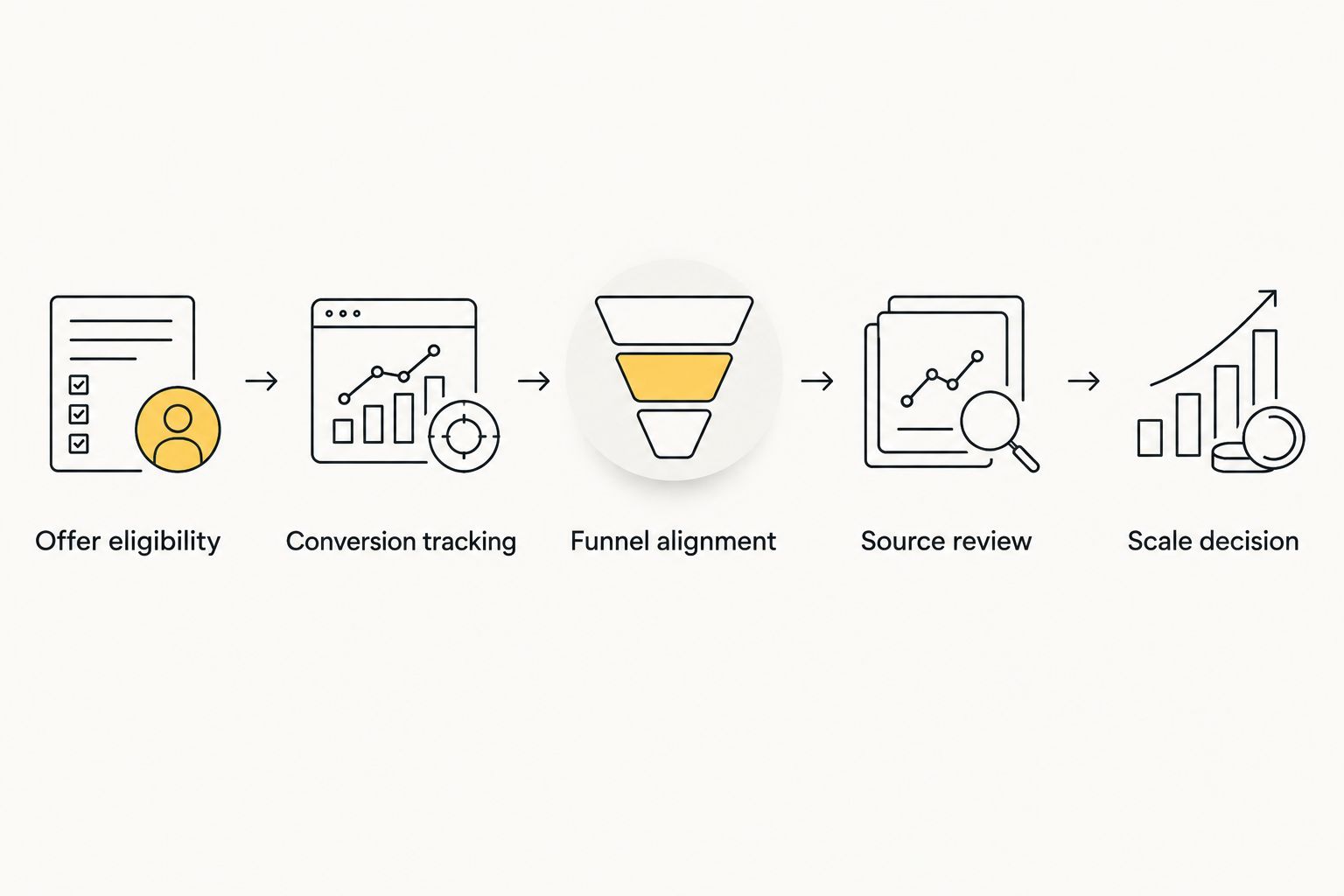
Build the test around a decision you can make from the results. In 2026, that means keeping conversion attribution, offer approval, and funnel consistency ahead of creative volume.
- Offer eligibility: Check allowed traffic sources, GEOs, device requirements, and promotional restrictions. Confirm what counts as an approved conversion and when its status becomes final.
- Conversion tracking: Validate the click identifier, landing-page events, and conversion reporting. Check that redirects preserve the information needed to attribute a conversion.
- Funnel alignment: Make the headline, image, landing-page explanation, and offer tell the same story. Remove promises that the destination cannot substantiate.
- Source review: Separate results by the traffic-source identifiers available in your campaign reporting. Review spend alongside approved outcomes rather than ranking sources by clicks alone.
- Scale decision: Expand only when the evidence supports the economics. Keep reviewing approval quality and source-level results as delivery changes.
The order matters. A creative test produces little useful evidence if the offer rejects the traffic source or the tracking loses the conversion. Fix those prerequisites before interpreting campaign performance.
Diagnose the stage that fails
If clicks do not produce landing-page visits, inspect redirects, page accessibility, and measurement. If visits do not produce onward clicks, inspect whether the page answers the promise in the ad. If reported conversions do not become approved conversions, inspect the offer's qualification rules and traffic requirements.
Keep those diagnoses separate. Rewriting a headline will not repair lost attribution, and raising a bid will not correct a misleading page.
Change the part of the funnel implicated by the evidence. Changing the bid, headline, page, and offer together leaves you unable to identify what caused the result.
Treat stopping rules as buying rules
Define what would make you stop before launching. Your rule should reflect the amount you are willing to risk, the offer's approval process, and the information needed to make a decision—not a universal spend threshold borrowed from another campaign.
Account for conversion delays before declaring a source unproductive. Equally, do not use delayed reporting as an excuse to ignore broken tracking or clearly irrelevant visits. Waiting for outcomes and checking campaign mechanics are different tasks.
Why native advertising results vary
Native affiliate results depend on the interaction between the offer, audience, creative, and destination. A successful campaign elsewhere does not establish the economics of your campaign in 2026.
- Offer economics: Approved earnings must cover acquisition and operating costs. An attractive payout does not establish how often eligible visitors will convert.
- GEO and eligibility: Language, destination availability, and offer restrictions determine whether the visitor can complete the intended action.
- Creative relevance: The headline and image shape expectations. Curiosity that attracts an unsuitable audience works against the conversion goal.
- Landing-page continuity: The page must deliver the explanation promised by the ad and make the next step understandable.
- Inventory mix: Aggregate results can conceal differences between sources. Use the source identifiers actually available to you rather than assuming every placement behaves alike.
- Measurement and approval: Missing attribution, delayed reporting, and rejected conversions change the interpretation of campaign results.
Do not turn these factors into an optimization checklist you change all at once. Identify the current failure point, make a focused adjustment, and evaluate it against the same business outcome.
What should you measure before increasing spend?
Measure approved CPA alongside the steps that explain it. CTR, landing-page engagement, and offer clicks help diagnose the funnel, but none replaces an approved conversion as the commercial outcome.
| Measure | What it tells you | What it does not prove |
|---|---|---|
| Ad CTR | Whether the creative earns clicks from its impressions | That visitors qualify for the offer |
| Landing-page arrival | Whether clicks become recorded visits | That visitors understand or want the offer |
| Offer-click rate | Whether the page sends visitors onward | That those visitors will complete an approved action |
| Reported conversions | Whether the tracking records conversion events | That every event will become payable |
| Approved CPA | Acquisition spend per approved conversion | That the result will remain unchanged after scaling |
Use consistent reporting windows and approval statuses when comparing campaign segments. Comparing finalized conversions from an older campaign with pending conversions from a newer campaign produces a distorted decision.
Include operating costs in your profitability assessment without forcing them into the ad platform's CPA column. Creative production, landing-page maintenance, and tracking are part of running the funnel even when they sit outside campaign spend.
Where does EZmob fit in a native test?
EZmob is a fit for affiliates who want self-serve access to native, pop, push, and display traffic. Advertisers can sign up, fund an account, and launch campaigns without a sales call; new campaigns undergo creative moderation before going live.
The specific advantage is access to those formats through a self-serve ad network. The limitation is equally important: platform access does not validate your offer, write a compliant landing page, or prove profitability.
For a 2026 native test, choose the format because it matches your funnel hypothesis. Do not combine results from native, push, and popunder and then attribute the total to native. Keep the format-level evidence separate so the next buying decision follows the result you actually measured.
Is native better than push for affiliate offers?
Native is the better starting hypothesis when your offer needs an explanatory page; push is the better starting hypothesis when a concise proposition can introduce the action. Neither format wins on profitability without campaign evidence.
Compare approved CPA and conversion quality for the same offer under comparable eligibility rules. A difference in click cost alone cannot settle the decision, especially when the formats introduce visitors to the funnel differently.
Can you use native traffic without a pre-lander?
You can test a direct-to-offer route when the destination explains the proposition and the offer owner permits that route. A pre-lander is useful only when it performs a necessary job, such as explaining suitability or setting accurate expectations.
Adding an extra page introduces another step to maintain and measure. Removing that page does not help if visitors then arrive without the context needed to understand the offer.
Does a high CTR mean the campaign is working?
A high CTR means the ad earns clicks relative to its impressions, not that the affiliate campaign is profitable. Judge commercial performance by approved outcomes and acquisition costs.
Keep CTR as a diagnostic measure. An engaging headline that produces unsuitable visits needs a different response from a clear headline whose landing page fails to load.
FAQ
Is native advertising worth it for affiliates in 2026?
Native advertising is worth testing in 2026 when you can track approved conversions, maintain an honest funnel, and evaluate acquisition costs against earnings. Skip expansion until those conditions are met.
What’s the best affiliate offer to test with native ads?
Start with an offer that permits native traffic and benefits from a clear explanation before the conversion action. Check GEO eligibility and promotional restrictions before choosing the angle.
Is native advertising better than popunder traffic?
Native is a better starting hypothesis when the ad’s message helps introduce an explanatory funnel. Popunder puts more of that introduction on the landing page; compare approved results rather than assuming a universal winner.
Do I need a pre-lander for native affiliate advertising?
You need a pre-lander only when it adds necessary context that the offer page does not provide. Confirm that the affiliate program permits your route and your promotional claims.
What should I track in a native affiliate campaign?
Track ad clicks, landing-page arrivals, offer clicks, reported conversions, and approved conversions. Preserve the identifiers needed to connect those outcomes to the campaign and traffic source.
Should I stop a native campaign that gets clicks but no sales?
Investigate the failed funnel stage before deciding whether to stop. Check attribution and conversion delays, then apply the stopping rule established before launch.
Can I buy native traffic through EZmob?
EZmob offers self-serve native advertising alongside pop, push, and display. New campaigns undergo creative moderation, and you remain responsible for offer eligibility and campaign economics.
One last thing
A lower CTR can still be the better outcome if the ad attracts more suitable visitors. Do not reject a clearer headline merely because it earns fewer clicks; inspect whether its visitors produce better approved outcomes.
Before your next test, compare the ad promise with the destination's actual message. Fix any mismatch before buying more traffic. That is a concrete decision you can make without waiting for a benchmark.
Related guides
- Choosing native ad networks
- Native advertising for iGaming affiliates
- Evaluating profitability when buying pop traffic