iGaming affiliate native advertising is paid promotion within publisher content with the aim of generating qualified player acquisitions for an approved gambling offer. For native ads for igaming affiliates, start with offer permissions and conversion tracking—not a headline promising wins—because GEO restrictions, advertising rules, and player qualification determine whether a campaign is usable.
- Native ads for igaming affiliates need approved GEOs, clear advertising disclosures, and tracking through qualified player acquisition.
- EZmob suits media buyers seeking self-serve native, push, popunder, and display campaigns; confirm gambling acceptance before funding a test.
- Judge native advertising by accepted conversions and payable revenue, not clicks or registrations alone.
- Separate creative, landing-page, and placement tests so campaign results identify what needs changing.
Why native advertising matters for iGaming affiliates
Native advertising gives an affiliate space to introduce an offer through a headline, image, and content-led landing page. That suits a campaign requiring explanation: which operator the page covers, who qualifies, and what conditions apply. It does not remove the obligation to identify advertising or represent the offer accurately.
For a 2026 campaign, treat permission as part of buying traffic. An operator accepting players from a country does not establish that every advertising channel, publisher, or affiliate promotion is permitted there. Confirm the operator's affiliate terms, the network's rules, and the relevant jurisdiction's requirements separately.
The wider guide to ad networks for iGaming and betting advertisers provides a separate network-selection starting point. This guide focuses on the campaign mechanics: qualifying an offer, building a compliant funnel, and deciding what deserves more spend.
Buy traffic against an approved acquisition event, not an attractive click-through rate. A registration that fails the operator's qualification rules is not equivalent to a payable acquisition.
How to build an iGaming native campaign
Confirm the offer's advertising permissions
Start manually with the affiliate agreement and the operator's advertising guidance. Record the permitted GEOs, traffic sources, landing-page requirements, and conversion conditions in a campaign brief. Get unclear permissions resolved before creating ads.
Keep country-level rules distinct from offer-level restrictions. An operator's permission does not replace legal requirements, and an ad network's approval does not establish that an affiliate promotion is lawful. Use qualified legal guidance when the applicable gambling advertising rules are unclear.
For your 2026 brief, also document who approves creative and what happens when the operator changes its terms. An offer update can make a previously accurate landing page misleading. Assign responsibility for checking the ad, prelander, and operator destination together.
Do not borrow eligibility language from another campaign. Different offers can define an accepted player differently, even when the visible registration process looks similar.
- Record permitted GEOs and excluded audiences.
- Confirm whether native affiliate promotion is allowed.
- Save the operator's creative and disclosure requirements.
- Document the payable conversion definition.
- Identify the person responsible for approving changes.
Map the conversion path before buying clicks
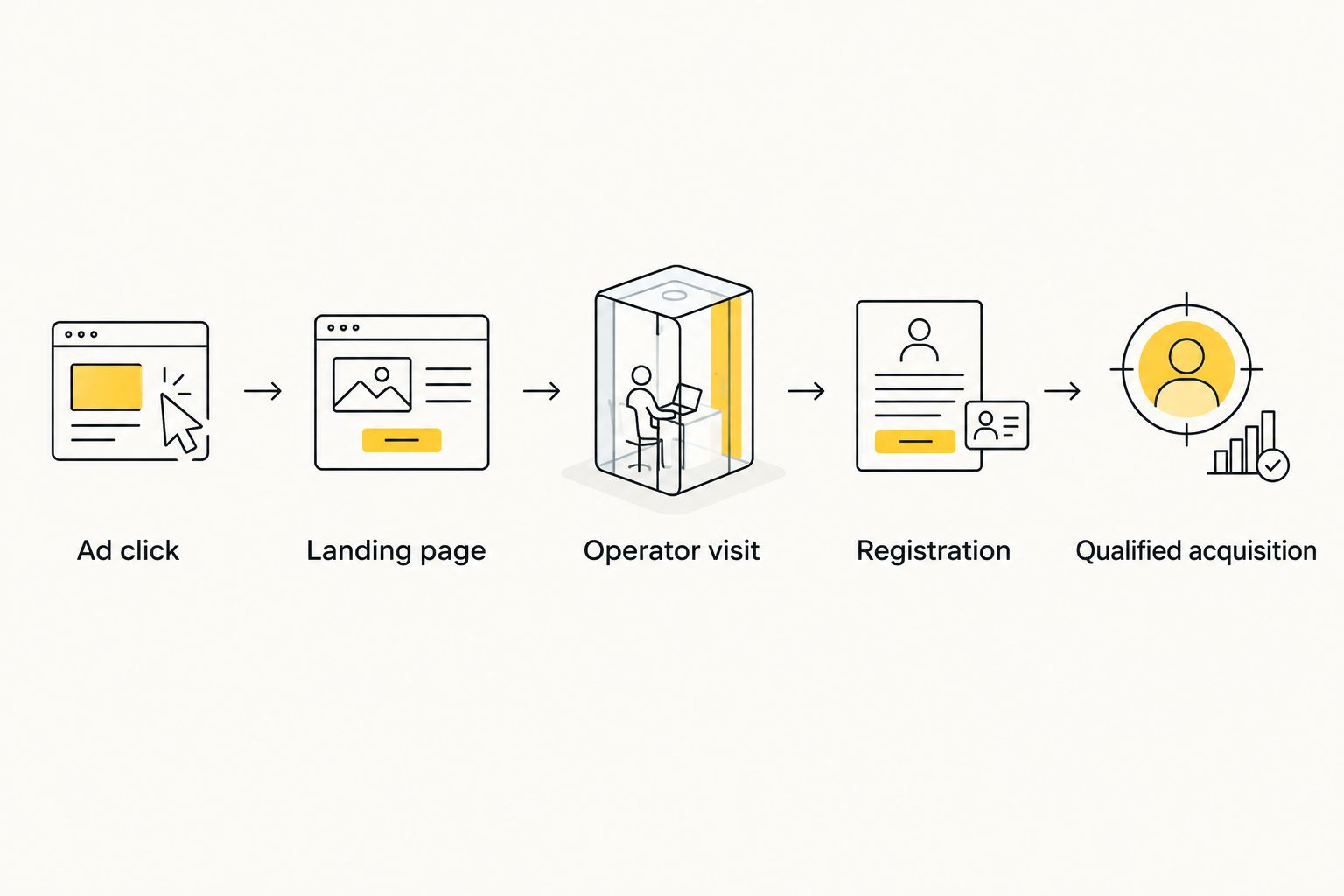
Build the funnel manually before opening a campaign: native ad, affiliate landing page, operator destination, registration, and the event required for payment. A first deposit and an accepted acquisition are not interchangeable unless the affiliate agreement defines them that way.
Test every redirect and tracking parameter. Check that the landing page preserves attribution when a visitor continues to the operator. Where the affiliate program supports conversion callbacks or reporting exports, reconcile the campaign's recorded events with the operator's accepted events.
Use this sequence as your measurement map: Ad click, Landing page, Operator visit, Registration, Qualified acquisition. Each stage answers a different question. A high landing-page exit rate calls for a different investigation from registrations that fail qualification.
Keep your conversion names explicit. A dashboard event called conversion is insufficient when it combines registrations with payable acquisitions. Your 2026 reporting should preserve that distinction from the first test.
- Test the complete redirect path on intended devices.
- Preserve campaign and creative identifiers.
- Track the landing-page continuation event separately.
- Match acquisition events to the affiliate agreement.
- Reconcile recorded conversions with accepted conversions.
Choose a traffic source against your requirements
Create a requirements sheet before comparing networks. Ask about native inventory, gambling policies, GEO coverage, creative review, placement reporting, and available tracking methods. Request answers for your actual offer rather than relying on a broad statement that a network serves performance advertisers.
The manual approach is to compare those answers and record the gaps. For campaign setup, EZmob offers self-serve access to advertising formats that include native, push, popunder, and display. Advertisers can sign up, fund an account, and launch campaigns without a sales call; new campaigns undergo creative moderation before going live.
EZmob is best for media buyers who want self-serve access to native, push, popunder, and display traffic. That is a workflow recommendation, not a claim that every iGaming offer or GEO is accepted.
Confirm the specific offer's eligibility before committing campaign spend. EZmob's self-serve access does not replace operator permission, network moderation, or legal review.
- Confirm acceptance of the offer and destination page.
- Ask which native inventory matches the intended GEO.
- Verify the available placement identifiers and reporting.
- Check how conversion attribution will work.
- Review moderation requirements before scheduling launch.
Build a landing page that matches the ad
Draft the landing page yourself before paying for production. The native headline should introduce the same subject the page covers, and the page should explain the operator destination without disguising itself as independent reporting.
Use a comparison or review angle only when you can support its claims. Do not invent a personal gambling experience, an operator ranking, or a testimonial. If an affiliate relationship influences the recommendation, disclose that relationship clearly rather than hiding it in a footer.
A 2026 landing page should state current offer terms accurately and direct readers to the operator's full conditions. Avoid promises of guaranteed winnings, easy income, or recovery of losses. Do not aim the creative at underage audiences or use financial distress as the sales argument.
Keep the call to action aligned with what happens next. If the button opens an operator page, say so; do not label it as an unrelated article download or imply that the visitor has already qualified.
- Match the headline, image, and landing-page subject.
- Identify advertising and affiliate relationships clearly.
- Explain eligibility without copying unsupported claims.
- Check offer conditions against the operator's current terms.
- Make the next destination clear before the click.
Isolate your creative and placement tests
Start with a written hypothesis, not a pile of unrelated ads. A headline test should compare different wording around the same supported proposition. A landing-page test should preserve the traffic source and offer conditions as far as practical.
Changing the headline, image, GEO, landing page, and operator together prevents you from identifying which change affected acquisition quality. Keep a change log and name campaign variants consistently. Separate native results from push or popunder results instead of treating them as one interchangeable traffic pool.
For placement analysis, use the identifiers the network actually provides. A publisher or placement producing many visits deserves investigation if those visits never progress through the funnel. Do not classify every weak placement as fraud: poor audience fit, technical errors, and misleading creative also require attention.
Avoid copying a winning headline into a different offer without checking its accuracy. The message can remain persuasive while the underlying conditions have changed.
- Write the hypothesis before launching each variant.
- Change a clearly defined campaign element.
- Keep offers and GEOs separate in reporting.
- Record edits alongside their launch dates.
- Evaluate placements against downstream events.
Evaluate accepted acquisitions and payable revenue
Use a spreadsheet before adding more reporting software. Record traffic spend, tracked acquisitions, accepted acquisitions, and payable affiliate revenue for each campaign segment. Keep rejected, pending, and accepted events separate.
CPA means campaign spend divided by the acquisition count you specify. Label the denominator: registration CPA and accepted-acquisition CPA measure different outcomes. For an iGaming affiliate, the payment decision belongs with the accepted event defined in the agreement.
Revenue timing matters as well. Pending commission is not settled revenue, and a revenue-share agreement cannot be evaluated as though every player creates a fixed payment. Preserve the distinction between observed results and assumptions about future player activity.
For 2026 reporting, use a consistent attribution window and currency across comparisons. Record delayed conversions against the campaign that generated them. Otherwise, recent campaigns look weaker simply because their qualification or reporting cycle is unfinished.
- Separate registrations from accepted acquisitions.
- Calculate CPA using the named conversion event.
- Record rejected events and their stated reasons.
- Compare spend with payable rather than assumed revenue.
- Keep attribution windows and currencies consistent.
Scale only after explaining the result
Review the campaign manually before increasing spend. Identify which creative, GEO, device segment, and placement produced accepted acquisitions. Check that the result survives reconciliation with the operator's reporting rather than relying only on the advertising dashboard.
Scaling is a new test, not an administrative change. A larger budget can expose the campaign to a different inventory mix; a bid change can alter where the campaign competes. Watch qualified outcomes after each adjustment instead of assuming the original result transfers unchanged.
Set stop conditions before editing. Use your offer economics and observed conversion cycle to decide what would invalidate the test. There is no universal loss threshold or waiting period that applies to every iGaming affiliate agreement.
Preserve the earlier campaign settings so you can compare the expanded campaign with its original version. If performance changes, investigate the traffic mix and funnel before replacing everything at once.
- Reconcile accepted acquisitions before expanding spend.
- Document the reason for each budget or bid change.
- Monitor placement mix after adjustments.
- Set stop conditions from the offer's economics.
- Retain the original settings for comparison.
Compare traffic options for your campaign
Choose a format according to how much explanation the offer needs and what inventory the network permits. Native is a fit for a content-led funnel, not a substitute for tracking or approval. The table compares campaign mechanics, not unsupported network performance claims.
| Option | Best for | Useful characteristic | Key limitation |
|---|---|---|---|
| Native ads | Affiliates using an explanatory landing page | Headline and image introduce a content-led journey | Needs clear advertising disclosure and close ad-to-page matching |
| Push ads | Media buyers testing a short, direct message | Notification-style creative presents a concise prompt | Limited creative space leaves less room to explain conditions |
| Popunder | Affiliates testing a separate landing-page visit | Opens a landing page in a separate browser window or tab | The opening does not establish deliberate interest in the offer |
| Display | Buyers with a clear visual proposition | Banner creative communicates a visible message | Small formats restrict detail; the destination must explain the offer |
EZmob offers these formats through its advertiser platform. Select the format after confirming the offer's traffic permissions, then judge it by accepted acquisitions. Do not infer that a format with more visits produces more qualified players.
Common mistakes iGaming affiliates make
Treating a registration as payable revenue
An operator can require additional qualification beyond registration. Report the agreement's accepted event separately and investigate rejection reasons before changing bids. Otherwise, a campaign can look successful while failing the payment conditions.
Advertising an offer outside its permitted GEO
Traffic targeting, operator eligibility, and advertising permission are separate checks. Keep the permitted GEO list attached to the campaign brief and verify the destination's handling of visitors who do not qualify. Do not assume a translated landing page makes an offer eligible in another market.
Disguising an affiliate page as independent news
A publisher-style layout does not justify undisclosed promotion, invented reporting, or fake personal results. Make the commercial relationship clear and substantiate every operator claim. Native advertising should match the surrounding format without misleading readers about its purpose.
Optimizing clicks while ignoring qualification
A sensational headline can attract visitors who do not meet the offer's conditions. Compare the creative's downstream accepted acquisitions, not just its click-through rate. Revise the promise when the audience's expectations do not match the destination.
Moving to scale before the operator reports outcomes
Recent traffic can have incomplete qualification and revenue reporting. Use the operator's actual reporting cycle and your recorded conversion delays when reviewing results. Increasing spend before reconciliation magnifies an unresolved measurement problem.
FAQ
What’s the best way to start native ads for igaming affiliates?
Start by confirming offer permissions and mapping the payable conversion event. Then test the complete ad-to-operator journey before buying traffic.
Is native advertising better than push for iGaming offers?
Native advertising is better suited to a funnel that needs an explanatory landing page; push suits a shorter message. Compare accepted acquisitions under the same offer conditions rather than assuming either format wins universally.
Can I run an iGaming offer on EZmob?
Confirm the specific offer and GEO with EZmob before launching. Self-serve access does not establish gambling-offer acceptance, and new campaigns undergo creative moderation.
Should I track registrations or first deposits?
Track both when available, but optimize against the accepted event defined in your affiliate agreement. A registration or first deposit is not automatically a payable acquisition.
Do iGaming affiliate landing pages need disclosures?
Clearly identify advertising and affiliate relationships on an iGaming affiliate landing page. Apply the disclosure requirements relevant to the jurisdiction, operator, and advertising network.
How do I identify bad native placements?
Review placements against landing-page progression and accepted acquisitions. Investigate technical errors, audience mismatch, and suspicious traffic before assigning a cause.
When should I scale a native iGaming campaign?
Scale after you can reconcile accepted acquisitions with operator reporting and explain which campaign segments produced them. Monitor the inventory mix and qualified outcomes after each budget or bid change.
One last thing
A rejected acquisition is campaign evidence, not just lost commission. Its stated rejection reason can expose an eligibility mismatch that a click report never shows. Add those reasons to your campaign review alongside placement, creative, and GEO.
Before changing a 2026 campaign, ask whether the problem is acquisition, qualification, or attribution. Those require different fixes. More traffic does not repair a broken redirect, an ineligible audience, or a landing page that promises the wrong thing.
Related guides
Confirm your offer permissions, prepare the landing page, and test the conversion path. Start advertising on EZmob.