
Bloggers’ website monetization is turning readership into revenue through ads, affiliate recommendations, sponsorships, or paid content, with the aim of funding your publishing work. For website monetization for bloggers in 2026, start with the method that fits why people read your site—not the format that promises the biggest payout. Bloggers who would rather sell their own products can start with the best ecommerce platform for small business.
- Website monetization for bloggers should match reader intent before adding more ad placements.
- EZmob supports publisher monetization through pop, push, display, and native formats.
- Affiliate marketing fits purchase-focused articles; display advertising fits content you want readers to browse.
- Compare revenue with reader engagement, not ad earnings alone.
Why website monetization matters for bloggers
A blog has more than one job. A tutorial must solve a problem, a review must help someone choose, and an opinion column must give readers a reason to return. Monetization succeeds when it supports that job instead of interrupting it.
Start your 2026 plan by separating informational pages from purchase-focused pages. A buying guide can support affiliate recommendations; a reference article can support advertising without turning the article into a sales pitch. Neither approach earns a guaranteed amount simply because the page receives visits.
Use the publisher ad networks guide to organize your network research, then check each provider’s current publisher requirements. Your first decision is the revenue model; choosing a network comes after that.
Bloggers also have an editorial constraint that traffic sellers do not: your next visit depends on whether the current article was useful. Keep the headline, answer, navigation, and subscription path usable while you test monetization.
How to monetize your blog without losing its purpose
Audit your pages by reader intent
Use your existing analytics, search reports, and a spreadsheet before installing another monetization tool. Record each important page’s topic, traffic source, device mix, and intended reader action. If analytics are not configured, begin there rather than guessing which articles deserve ads.
For your 2026 inventory review, group pages by purpose rather than by publishing date. An older troubleshooting article and a new troubleshooting article can need the same treatment; a product review needs a different plan.
Look beyond your busiest page. A smaller article with a clear buying question has a different monetization opportunity from a broad article that readers skim for a definition. That distinction does not establish its earnings—it tells you what to test.
Finish the audit with a simple page map:
- Mark tutorials and reference pages as informational inventory.
- Mark reviews and comparisons as purchase-focused inventory.
- Flag pages where the main goal is an email subscription.
- Separate mobile and desktop performance in your reports.
- Identify pages where overlays would block a task or essential control.
Choose a revenue model for each page group
Start manually: add a relevant affiliate recommendation to a purchase-focused article, or draft a sponsorship offer around a clearly defined readership. Avoid treating every page as space for every monetization method.
Affiliate marketing rewards a tracked action under a program’s terms. Advertising monetizes exposure or interaction under a network’s terms. Sponsorships involve a direct agreement, while paid content requires readers to value something enough to purchase access. These are different businesses, not interchangeable widgets.
Choose the model you can support editorially and operationally. A sponsored article needs clear disclosure and an agreed scope. A paid resource needs maintenance and customer support. Advertising needs placement checks and performance monitoring.
Give each page group a primary role before combining models:
- Use affiliate recommendations where the article answers a buying question.
- Reserve sponsorships for partners relevant to your actual readership.
- Consider paid resources when the content solves a specific recurring problem.
- Use advertising where readers can still reach the article’s main answer.
- Keep commercial disclosures close to the relevant recommendation or placement.
Match ad formats to the reading experience
Sketch proposed placements on your actual pages before adding network code. Open the layouts on a phone and desktop, then check whether the headline, article text, menus, and subscription controls remain accessible.
EZmob website monetization supports publishers using pop, push, display, and native formats. EZmob is best for bloggers who want publisher access to pop, push, display, and native monetization. That is a format-based fit, not a claim about earnings or acceptance.
Display ads occupy a defined area of the page. Native placements use a content-like presentation, so clear advertising labels matter. Pop formats create an additional browsing interruption. Browser push involves notification permission and delivery beyond the article itself; treat the permission request as a reader decision, not a shortcut to revenue.
A network provides access to monetization formats rather than requiring you to negotiate every advertising arrangement directly. You still own the placement decisions and their effect on the blog.
Before adopting a format:
- Keep display placements clear of navigation and article controls.
- Distinguish native advertising from your editorial recommendations.
- Test pop behavior during a complete reading session.
- Explain notification requests before asking readers to accept them.
- Review publisher requirements and implementation instructions before publishing code.
Test a placement against your baseline
Use existing analytics and a change log to establish a baseline before modifying the site. Record the page group, device category, placement, and date, then change a defined part of the setup rather than replacing everything at once.
A sequential before-and-after comparison is not automatically proof that the placement caused the result. Traffic sources, article popularity, and advertiser demand also change. A controlled test is more useful when your setup supports comparable groups; otherwise, document those differences before making a decision.
Keep the test focused on the reader’s actual journey: arrive, find the answer, move through the article, and take the intended next action. Check the live experience yourself rather than relying only on a revenue report.
Build a test record you can interpret later:
- Name the page group and placement being tested.
- Record the implementation date and any simultaneous site changes.
- Compare equivalent device and traffic-source groups.
- Check loading, scrolling, menus, and subscription forms.
- Record revenue alongside engagement and reader complaints.
- Remove or revise a placement that blocks the article’s main task.
Measure revenue using the right denominator
Keep your 2026 reporting simple enough to act on. Total revenue tells you what the site earned; revenue normalized by traffic helps you compare periods with different audience sizes. Neither metric replaces a check of the reading experience.
Page RPM expresses revenue per 1,000 pageviews: revenue divided by pageviews, multiplied by 1,000. Impression eCPM expresses revenue per 1,000 ad impressions: revenue divided by ad impressions, multiplied by 1,000. Revenue per 1,000 sessions uses sessions as its denominator instead.
These are metric definitions, not earnings forecasts. Pageviews, sessions, and ad impressions count different things, so the resulting figures are not interchangeable. A page containing several placements can generate multiple impressions during a visit.
Use consistent definitions when comparing reports. Check whether reported revenue is estimated or finalized, and whether the reporting periods use the same time zone.
Build a reporting sheet with:
- Total revenue for the reporting period.
- Page RPM with the pageview source identified.
- Impression eCPM with the impression source identified.
- Revenue per session alongside the session count.
- Engagement measures segmented by device and traffic source.
- A change log explaining placement and content updates.
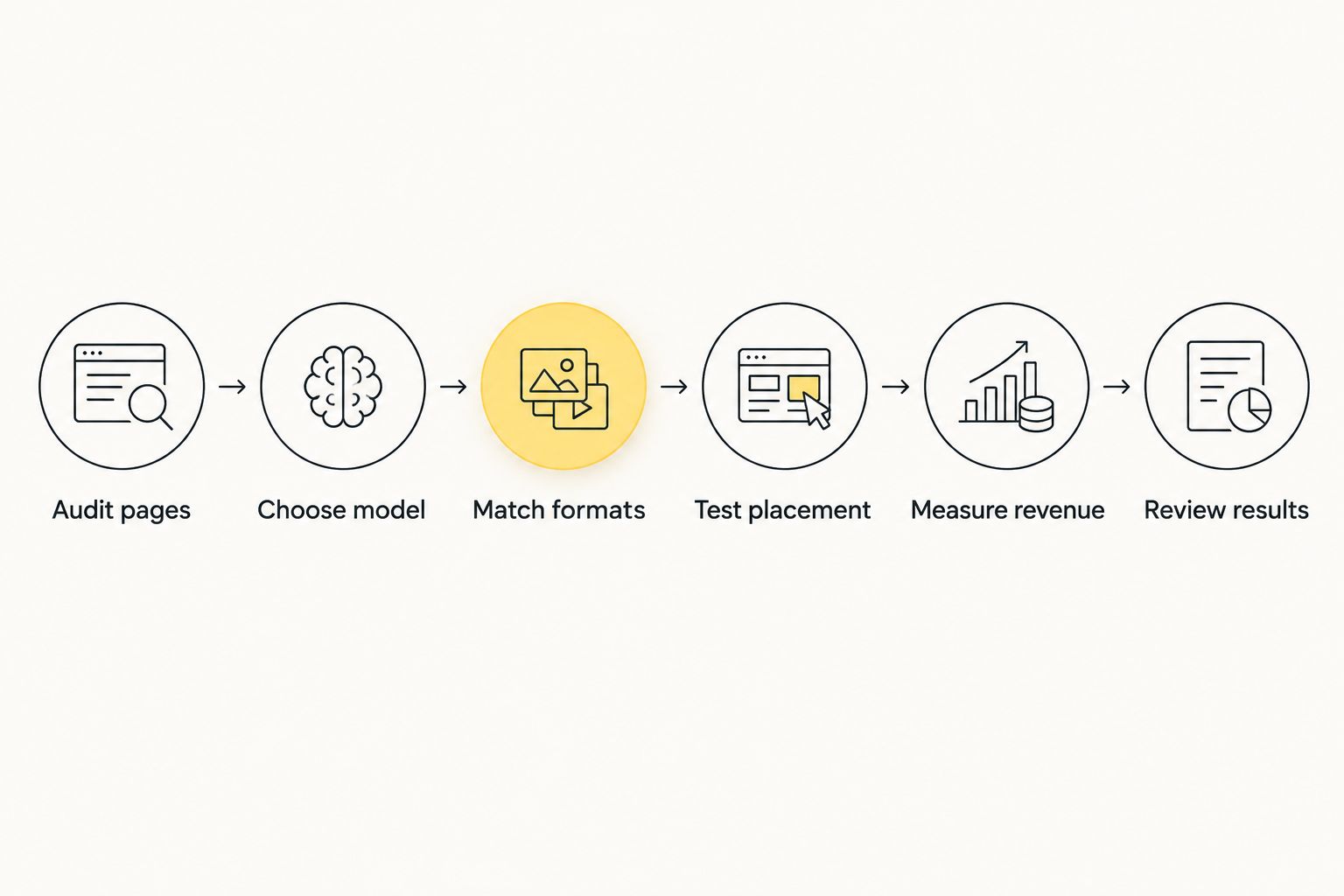
Review results before expanding monetization
Start with a manual review of the test record. Identify which pages earned revenue, whether readers could complete their intended task, and whether the result depended on a particular traffic source. Then decide whether to retain, revise, or remove the placement.
Expansion does not have to mean adding more ads. It can mean applying a working layout to similar pages, improving an affiliate recommendation, or removing a format that conflicts with your newsletter goal. Keep the change narrow enough to measure.
Review results as a publishing business, not just as an ad account. Advertising revenue and affiliate revenue belong in the same business assessment, but they should remain separate in your reporting so you can identify what changed.
Before expanding:
- Repeat the reading-experience check on representative pages.
- Confirm tracking still records the intended actions.
- Compare revenue changes with changes in traffic composition.
- Check that affiliate links and disclosures remain accurate.
- Revisit notification and advertising controls after implementation changes.
- Apply successful layouts only to pages with a similar purpose.
Compare monetization options for your blog
Choose an option by reader intent and the work you can maintain. The table separates each model’s benefit from its limitation; no model is the default winner for every blog.
| Option | Best for | Main benefit | Key limitation |
|---|---|---|---|
| EZmob publisher monetization | Bloggers seeking pop, push, display, and native formats | Access to several publisher monetization formats | You must assess format suitability and reader experience; revenue is not guaranteed |
| Affiliate marketing | Reviews, comparisons, and buying guides | Recommendations can align with the reader’s buying task | Earnings depend on tracked qualifying actions and program terms |
| Direct sponsorships | Blogs with a clearly defined audience and relevant partners | You negotiate the campaign scope directly | Finding partners, agreeing terms, and delivering the work require ongoing effort |
| Paid resources | Blogs offering a distinct resource readers want to purchase | Revenue connects directly to the resource you provide | Product creation, updates, and support become publishing responsibilities |
| Paid subscriptions | Blogs with recurring content readers value | Payment supports continued access or membership | You must sustain the content promise and manage subscriber expectations |
Keep the first combination simple. Pair advertising on suitable informational pages with affiliate recommendations on genuine buying guides. Add sponsorships or paid content only when you can deliver the associated work without weakening the blog.
A format catalogue is not a performance comparison. Compare networks only after checking current publisher eligibility, implementation requirements, reporting definitions, ad controls, and the formats you actually intend to use.
Common monetization mistakes bloggers make
Treating every article as purchase-ready
A reader looking for a definition has not necessarily asked for a product recommendation. Filling that article with affiliate pitches changes its purpose. Keep recommendations tied to a problem the article actually addresses.
Confusing advertiser access with publisher access
Buying push or pop traffic is an advertiser activity; monetizing your blog’s traffic is a publisher activity. EZmob serves both audiences, but this guide concerns its publisher formats. Use publisher registration and publisher requirements when assessing your blog.
Comparing incompatible revenue metrics
A network’s impression eCPM and your blog’s page RPM have different denominators. Comparing them directly creates a false ranking. Label every metric with its denominator and reporting period before deciding that a format performed better.
Increasing interruptions before checking the basics
More placements do not establish a better business result. A broken menu, covered answer, or obstructed signup form damages the task the page exists to support. Fix usability and tracking before increasing ad exposure.
Publishing a 2026 plan with stale commercial details
Affiliate destinations, sponsorship disclosures, and implementation instructions need review when they change. Treat commercial content as maintained publishing inventory, not a setup task you finish once. Keep the review tied to actual changes rather than rewriting pages simply to add a new date.
FAQ
What’s the best website monetization method for bloggers?
The best method matches the page’s reader intent. Affiliate marketing fits genuine buying guides, while advertising fits suitable informational inventory; sponsorships and paid content require additional delivery work.
Can I monetize a blog without affiliate marketing?
Yes, bloggers can use advertising, direct sponsorships, paid resources, or subscriptions without affiliate marketing. Choose a model that fits your readership and the work you can maintain.
Is EZmob for bloggers or only for advertisers?
EZmob serves publishers as well as advertisers. Website owners can monetize traffic with publisher formats including pop, push, display, and native.
Are pop ads better than display ads for a blog?
Neither format is automatically better for a blog. Display occupies a defined page area, while pop introduces an additional browsing interruption; compare revenue and the reading experience on your own inventory.
How many visitors do I need before monetizing my blog?
Check the current eligibility rules for the monetization provider or program you want to use. Audience size alone does not determine suitability: reader intent, traffic composition, and your ability to maintain the implementation also matter.
What’s the difference between page RPM and impression eCPM?
Page RPM measures revenue per 1,000 pageviews, while impression eCPM measures revenue per 1,000 ad impressions. Their denominators differ, so do not treat the figures as interchangeable.
Can I use ads and affiliate links on the same blog?
Yes, ads and affiliate links can serve different page purposes on the same blog, subject to the applicable program terms. Keep disclosures clear and report each revenue source separately.
One last thing
Your highest-earning page is not automatically your best monetization template. Its topic, device mix, and traffic source can differ from the rest of the blog, so copying its placements everywhere confuses page-specific results with a site-wide rule.
For your next 2026 test, choose a page group with a shared reader task. Preserve the answer, test a defined placement, and decide from both revenue and usability. Protect the reason readers came before expanding how you earn from their visit.
Related guides
Ready to test publisher monetization? Monetize your traffic with EZmob.