Choose EZmob if you want self-serve access to pop, push, display, and native advertising; choose PlugRush if your existing campaigns there already meet your CPA target and your priority is keeping that buying workflow. For this 2026 comparison, the decision is format access versus proven campaign continuity—not an unsupported claim that one network always converts better.
- EZmob vs PlugRush: choose EZmob for self-serve pop, push, display, and native advertising.
- Keep profitable PlugRush campaigns running when their approved conversions meet your CPA target.
- Compare traffic sources using the same offer, GEO, attribution rules, and conversion definition.
- Separate format selection from performance: access to inventory does not establish campaign profitability.
Why this comparison matters
An ad network gives you access to traffic. Your offer, landing page, tracking, and buying decisions determine whether that traffic produces an acceptable acquisition cost. A platform comparison should help you choose a starting point without pretending to predict your campaign results.
EZmob is a self-serve advertising network: advertisers register, fund an account, and launch campaigns without a sales call. New campaigns go through creative moderation before going live. That makes it a clear option for buyers who want to manage campaigns themselves across the stated formats.
For an advertiser already buying through PlugRush, switching requires a different argument. A familiar account with profitable campaigns is an operating asset. Keep it until a controlled comparison gives you a reason to move budget.
Choose a network for the campaign you need to run, then judge that campaign by approved conversions.
At a glance: campaign access versus campaign continuity
| Dimension | EZmob | PlugRush |
|---|---|---|
| Best for | Media buyers seeking self-serve pop, push, display, and native campaigns | Existing buyers whose campaigns already meet their acquisition targets |
| Standout feature | Stated access to several advertising formats within a self-serve platform | For an established buyer, continuity with an already measured campaign |
| Launch workflow | Register, fund the account, submit a campaign for creative moderation | Keep your established workflow when it already supports the campaign |
| Existing performance baseline | Evaluate a new campaign against your current acquisition target | Retain an existing baseline when approved conversions justify it |
| Pricing model | Account funding precedes campaign launch; evaluate the applicable buying terms | Check the funding and billing terms applicable to your account |
| Performance decision | Judge results by approved conversions and acquisition cost | Apply the same conversion definition and acquisition target |
| Offer suitability | Confirm the offer and creative meet the platform's requirements | Confirm the offer and creative meet the platform's requirements |
| Budget expansion | Test an additional format without treating access as proof of profitability | Expand an established campaign only while its economics remain acceptable |
The PlugRush recommendations above apply to buyers with existing campaign evidence. They are not claims about its relative traffic quality, format coverage, or platform features. Use the table to identify your decision, then check the details that affect your particular offer.
EZmob is the clearer choice for stated format access
EZmob is a self-serve advertising network for media buyers who want pop, push, display, and native campaign access. Its stated advertiser offering also includes video and direct-click/redirect traffic. You can choose a format around the offer rather than starting with a generic request for more visitors.
That distinction matters because formats require different campaign assets. Push and display advertising involve an ad message before the visit. Popunder traffic requires particular attention to the landing experience because the destination page must establish relevance quickly.
Do not treat these formats as interchangeable placements. An ad message that works in a banner does not automatically become a useful push creative, and a landing page built for a deliberate ad click still needs evaluation for pop traffic.
The advantage is access. The limitation is that access does not establish which format will produce your target CPA. In 2026, build separate campaign hypotheses for each format instead of combining their results into a single network-wide verdict.
- Best for: An affiliate or media buyer selecting traffic formats for a new offer.
- Pro: The stated format range supports testing different acquisition approaches.
- Con: Each approach still needs suitable creative, tracking, and a conversion-based evaluation.
EZmob is the clearer choice for an explicitly self-serve launch
The advertiser workflow is direct: sign up, fund the account, and launch campaigns yourself, with creative moderation before a new campaign goes live. You do not need a sales call to begin that process.
This suits a buyer who wants hands-on campaign management. It does not mean a submitted campaign is immediately approved, nor does it establish a moderation turnaround time. Build your launch plan around approval rather than assuming that submission and delivery are the same event.
Prepare the offer destination before submitting the campaign. Check that the creative describes the destination accurately, that the landing page works on the intended device, and that your tracker records the action you will use to evaluate performance.
Self-serve access also leaves buying decisions with you. Set your own evaluation criteria before traffic starts; otherwise, an active campaign can become an exercise in watching clicks rather than measuring acquisitions.
- Best for: A buyer who wants to start and manage campaigns without a sales-led onboarding process.
- Pro: The launch sequence and moderation requirement are stated.
- Con: Self-serve access does not remove the need for campaign preparation or approval.
PlugRush wins on continuity when your campaigns already work
PlugRush is the better continuity choice when your existing campaigns there already produce approved conversions at an acceptable CPA. That is a conditional recommendation based on your campaign, not a claim that the network outperforms every alternative.
An established campaign gives you a baseline: the offer, landing page, traffic settings, attribution rules, and conversion quality have already interacted in a live buying environment. Preserve that baseline while evaluating another source.
Do not stop a profitable campaign simply to make a platform switch look decisive. Keep the working campaign separate from the new test so you can distinguish expansion from replacement. A new source earns additional budget through results, not through a longer feature list.
Continuity has a limitation, too. Staying with a familiar account does not answer whether another format or source would improve your acquisition mix. Use your existing result as the comparison standard rather than as a reason never to test.
- Best for: An affiliate with a working PlugRush campaign and a documented acquisition target.
- Pro: Retaining the campaign preserves a measured operating baseline.
- Con: That baseline does not establish the performance of untested sources or formats.
PlugRush wins on workflow familiarity for established buyers
Keep PlugRush as your primary workflow when your team already knows how to manage the campaigns it runs there and those campaigns meet your business requirements. Familiarity is useful when it supports accurate decisions, not when it substitutes for checking results.
Before moving an established workflow, list the tasks you would need to reproduce: campaign setup, creative submission, tracking checks, reporting review, and budget decisions. This is a migration checklist, not an assertion that either platform handles those tasks better.
A new account introduces a new operating context. Check the settings and reporting definitions instead of assuming they match the account you already use. Similar labels can still require careful interpretation when you reconcile traffic with your tracker.
The limitation of familiarity is inertia. If your current workflow cannot support the campaign you need, preserving it stops being an advantage. For your 2026 buying plan, separate “easy for the team” from “right for the offer.”
- Best for: A team whose existing buying process is effective and documented.
- Pro: Keeping a working process avoids an unnecessary migration.
- Con: Familiarity alone does not justify keeping an underperforming campaign.
Neither network wins CPA before your campaign runs
The defensible performance comparison uses your own approved conversions. A click, visit, registration, and accepted lead are different events; do not let different reporting definitions decide the winner.
Hold the offer, GEO, conversion definition, and attribution rules consistent when comparing sources. If you change the landing page and traffic source together, you lose a clean explanation for the result.
Use a practical evaluation sequence:
- Offer fit: Confirm that the campaign destination and creative match the offer.
- Tracking check: Verify that the intended conversion reaches your tracker.
- Source test: Evaluate each traffic source against the same campaign objective.
- Conversion review: Separate approved outcomes from rejected or invalid actions.
- Budget decision: Allocate spend according to the resulting acquisition economics.
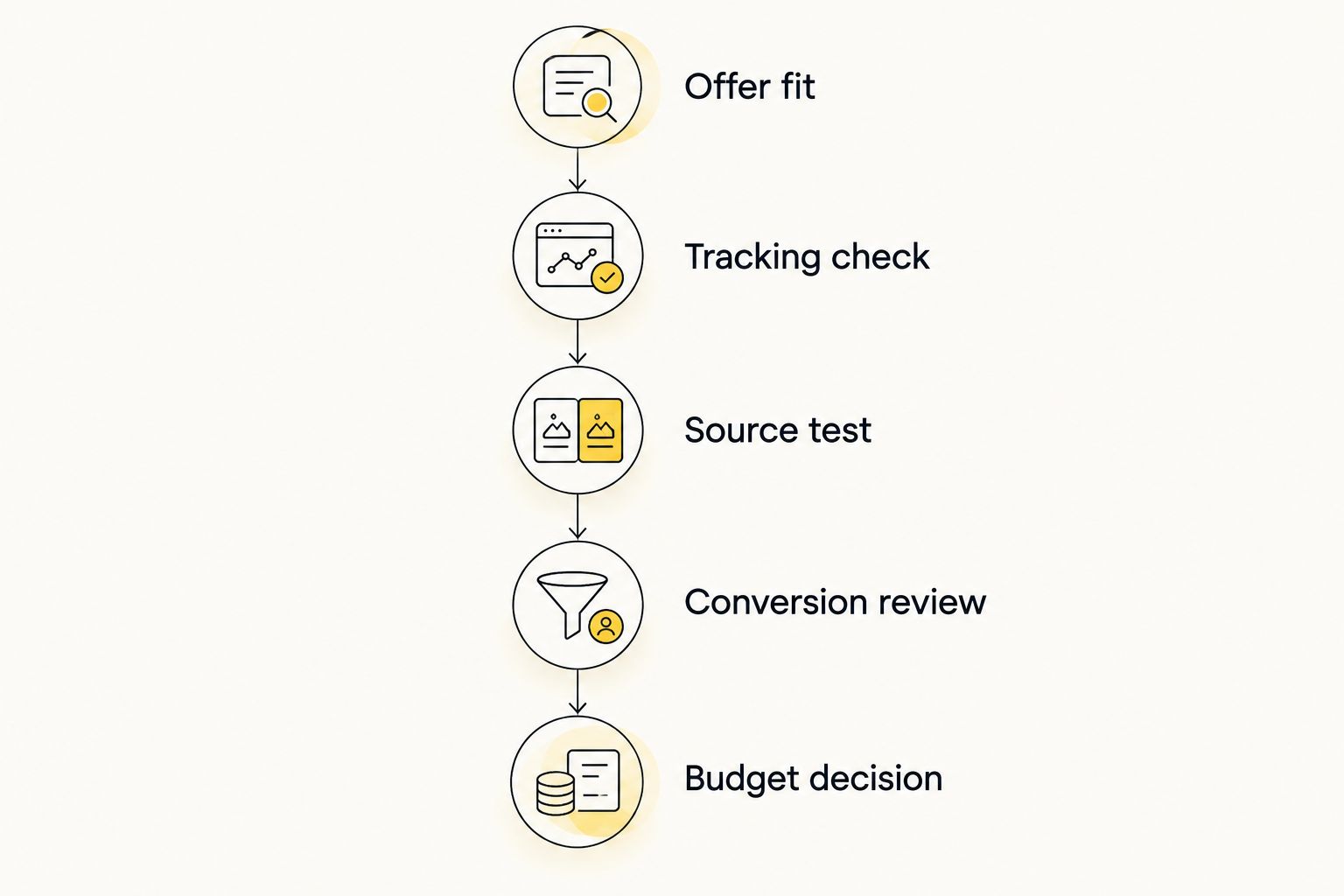
The outcome can be a split rather than a single winner. Keep an established source for the campaign it serves well and use another source for a separately evaluated opportunity.
Both choices require offer and creative checks
A network comparison is not permission to run every offer. Check the current campaign requirements for the offer, GEO, creative, and destination before committing to a launch.
The client's stated advertiser audience includes affiliates and media buyers working across e-commerce, nutra, sweepstakes, crypto, software/SaaS, lead generation, and adult campaigns. That audience description is not a blanket approval policy for every offer within those categories.
Apply the same discipline to PlugRush. Confirm the actual campaign requirements rather than treating a network's reputation or an older campaign approval as permission for a new submission.
This is a procedural tie, not a claim that the platforms have identical policies. In 2026, make offer acceptance a prerequisite and performance the next decision—not the other way around.
Pricing: compare buying terms, not isolated rates
Account funding precedes campaign launch on the client's self-serve platform. For PlugRush, review the funding and billing terms that apply to the account you intend to use. Do not assume that the same payment conditions or charging basis apply across platforms or formats.
Separate how you pay from how you evaluate performance. A campaign's charging basis determines what consumes budget; approved acquisition cost determines whether that spending meets your objective.
For budget control, write down the campaign's evaluation conditions before launch. Identify the conversion you accept, how you will reconcile it with your tracker, and what evidence will support continuing or stopping the campaign. This creates a consistent buying process without pretending that a platform's payment model guarantees predictable results.
If you are considering more than these two options, the PlugRush alternatives guide gives you a separate comparison starting point. Keep the same evaluation criteria across your shortlist.
Final verdict: pick for your current buying situation
Choose EZmob if you are launching across formats
Winner for the new cross-format buyer: EZmob. Choose it when your immediate requirement is self-serve access to pop, push, display, and native advertising, and you are prepared to evaluate each campaign on its own conversion results.
Your next move is to select the format that matches your offer, prepare the creative and destination, check tracking, and submit the campaign for moderation. Format breadth is the reason to start—not proof that every available format belongs in your campaign plan.
Choose PlugRush if you are preserving proven campaigns
Winner for the established PlugRush buyer: PlugRush, when the existing campaign still meets the acquisition target. Keep the working campaign and evaluate additional sources separately.
Your next move is to document the current baseline before testing elsewhere. Retaining a profitable campaign and expanding your traffic mix are compatible decisions.
| Decision dimension | Winner |
|---|---|
| Stated self-serve format access | EZmob |
| Explicit launch workflow | EZmob |
| Continuity of a profitable existing PlugRush campaign | PlugRush |
| Familiarity with an effective existing PlugRush workflow | PlugRush |
| CPA before campaign evidence | No automatic winner |
| Offer and creative checks | Both require verification |
| Pricing and funding decision | Campaign-specific terms decide |
| Budget expansion | Approved acquisition results decide |
FAQ
Is EZmob better than PlugRush in 2026?
EZmob is the clearer choice for buyers seeking its stated self-serve pop, push, display, and native campaign access. PlugRush is the continuity choice when your existing campaigns there already meet your acquisition target.
Which platform should I choose for a new affiliate campaign?
Choose EZmob when you want its stated self-serve format range for a new affiliate campaign. Select a format around the offer and verify tracking before judging traffic performance.
Should I move a profitable PlugRush campaign?
Keep a profitable PlugRush campaign running while you evaluate another source separately. A new source should earn budget through approved conversions rather than replace a working campaign without evidence.
Does self-serve advertising mean a campaign launches immediately?
Self-serve access does not mean immediate approval. EZmob sends new campaigns through creative moderation before they go live.
How should I compare campaign costs between the networks?
Compare acquisition cost using the same approved conversion definition and attribution rules. Review each account’s applicable funding and billing terms separately from campaign performance.
Which network has better traffic quality?
Choose the source that produces acceptable approved conversions for your campaign. Evaluate rejected actions and acquisition outcomes rather than treating click volume as proof of traffic quality.
Can I use both advertising networks?
You can evaluate a new source while retaining an established campaign. Keep campaign results separate so that each budget decision follows its own conversion evidence.
One last thing
Before your next 2026 traffic test, check the conversion path from the landing page through to the approved action in your tracker. A reporting mismatch can produce a convincing comparison that answers the wrong question.
Keep the working campaign, test the new opportunity, and move budget only when the acquisition evidence supports it.
Related guides
- Is buying pop traffic profitable for affiliate marketers?
- Self-serve advertising platforms
- Adsterra alternatives for push ad campaigns
Start your next advertising campaign
Explore self-serve pop, push, display, and native advertising before preparing your campaign.