
Popunder ads for enterprise advertisers are ads that open a landing page behind the active browser window, with the aim of generating measurable acquisition outcomes. For your 2026 plan, treat popunder as a controlled performance test: approve the inventory, verify conversion tracking, and judge traffic by accepted sales or leads rather than visits.
- Popunder ads for enterprise advertisers need approved inventory, reliable attribution, and conversion-quality checks before scaling.
- EZmob is best for media buyers who want self-serve pop, push, display, and native campaigns.
- Evaluate popunder traffic on accepted conversions and CPA, not landing-page visits alone.
- Keep GEO, landing page, and source results separate so poor inventory cannot hide inside campaign averages.
Why popunder advertising matters for enterprise advertisers
Popunder gives you an acquisition format to evaluate alongside push, display, and native advertising. Its defining difference is the arrival mechanism: a visitor encounters a newly opened page rather than choosing your offer from a conventional banner. Your landing page must establish relevance without assuming deliberate interest.
Enterprise media buyers also need an approval trail that connects acquisition decisions to finance, legal, analytics, and brand requirements. A campaign that produces leads but fails those requirements is not a usable acquisition channel. Build the approval process into your 2026 test plan, not into the cleanup afterward.
EZmob provides self-serve advertising access, including popunder, push, display, and native formats. Advertisers can register, fund an account, and launch campaigns without a sales call; new campaigns undergo creative moderation before going live. That access supports hands-on buying, but it does not replace your own inventory approval or commercial checks.
EZmob is best for media buyers who want self-serve pop, push, display, and native campaigns. For an enterprise team, the decision is whether that buying model fits the approval and measurement process around the campaign.
Build an enterprise popunder campaign
Use this sequence to separate commercial eligibility from campaign execution: define outcomes, approve inventory, verify tracking, prepare pages, launch campaigns, audit traffic, and scale sources. Each stage has a different owner and a different reason to stop the test.
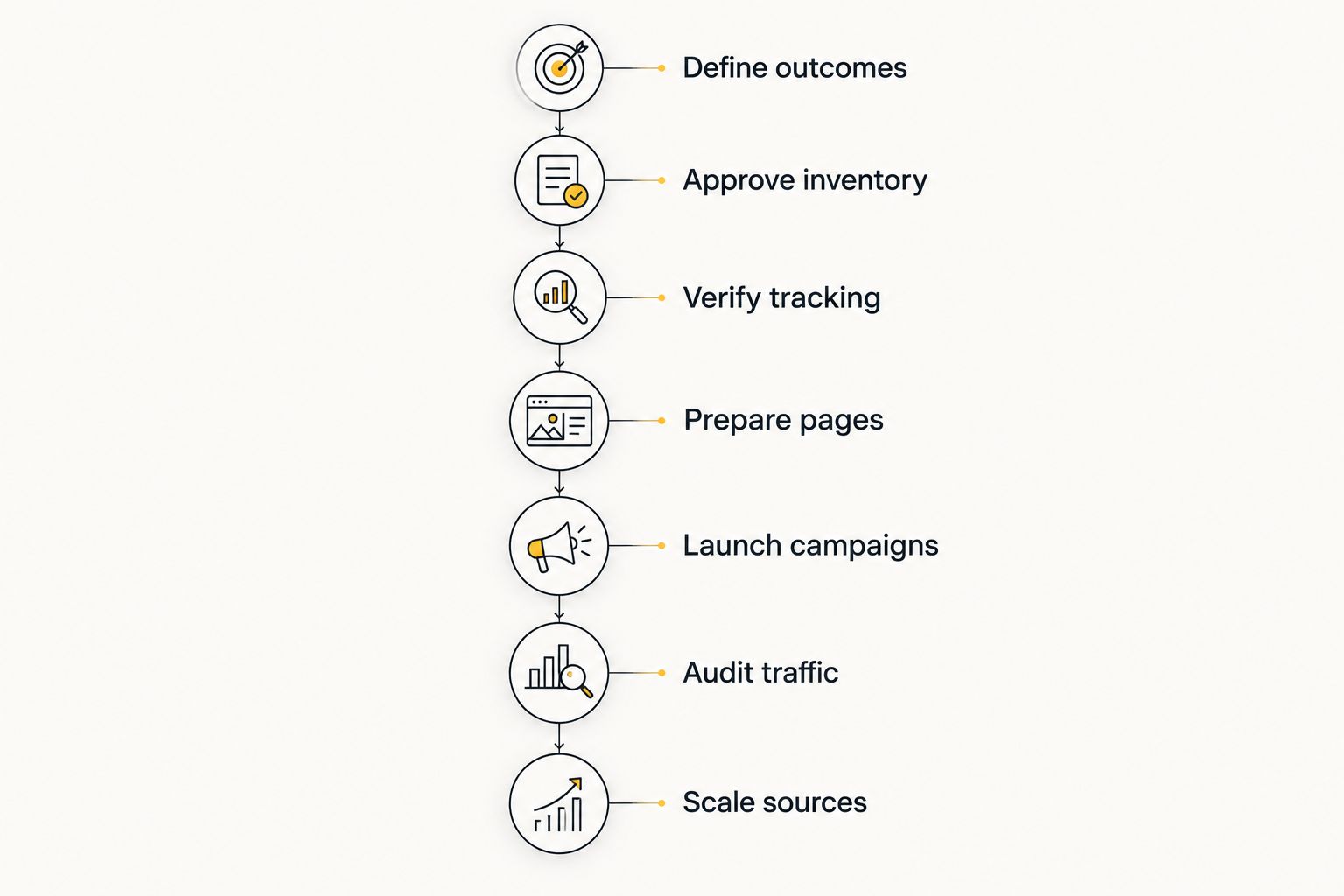
Define outcomes before choosing traffic
Start with a shared document that defines the business outcome and the evidence required to count it. A lead submission, accepted lead, completed sale, and retained customer are different events. Choose the event that matches how your business earns revenue, then decide which earlier events help diagnose the funnel.
For enterprise advertisers, this distinction keeps media buying aligned with downstream teams. Sales should not reject the leads that acquisition reports as successful, and finance should not discover that campaign revenue includes canceled orders. Write the acceptance rule before the first visit arrives.
Use your own historical conversion records to set an allowable CPA. Do not copy another advertiser's target: margins, qualification rules, and attribution methods differ.
- Name the primary conversion and its acceptance criteria.
- Assign an owner for lead or order validation.
- Document which cancellations and duplicates are excluded.
- Set a spending ceiling using approved internal economics.
- Record the decision rule for pausing or continuing.
Approve inventory before committing spend
Build an inventory review checklist manually with your legal, brand, and acquisition owners. The review should distinguish permitted GEOs, eligible offers, acceptable publisher contexts, and prohibited experiences. An offer's commercial appeal does not establish its eligibility for every source.
For a 2026 enterprise campaign, ask the prospective network what information it exposes about sources and which controls are available. Verify those answers against the actual account and current terms. Do not assume that every popunder provider offers identical exclusions, source reporting, or targeting.
Document unresolved requirements as launch blockers. If your internal policy requires placement-level approval, source-level reporting alone does not satisfy that policy. This is a procurement decision, not a bid adjustment.
- List permitted GEOs and offer categories.
- Define unacceptable publisher contexts.
- Confirm available targeting and exclusion controls.
- Check the landing-page and creative requirements.
- Record approval ownership and unresolved blockers.
Verify tracking before buying visits
Map the conversion path in a spreadsheet before connecting any campaign. Record how a visit becomes a lead or sale, which identifiers connect those events, and where reporting can lose that connection. Test the full path with an approved test transaction or test lead.
Then prepare the same measurement plan for EZmob popunder campaigns. Self-serve access lets the media buyer manage launch directly; it does not prove that your tracker, analytics, CRM, and reporting systems agree. Confirm supported tracking methods before choosing an implementation.
Measure accepted conversions against spend from the same campaign scope. Mixing revenue from one attribution view with spend from another produces a CPA figure that cannot support a buying decision. Keep pending outcomes separate from accepted outcomes until the business validates them.
- Check campaign parameters through every redirect.
- Verify that the intended conversion event fires.
- Confirm that duplicate events do not count twice.
- Reconcile tracker records with CRM or order records.
- Document attribution rules and reporting time zones.
Prepare pages for an unexpected arrival
Review the landing page yourself before involving a design or optimization service. Open it on the devices you intend to target, follow every important interaction, and confirm that the offer matches the audience. Popunder visitors need an immediate explanation of what the page offers and why they should continue.
Keep the first action consistent with the conversion goal. A lead-generation page should explain the next step and the information requested; an e-commerce page should make the product and purchase path clear. Avoid misleading system messages or language that implies the visitor has already agreed to something.
For enterprise advertisers, the landing page also carries the responsibility for approved claims and appropriate data collection. Network moderation is a separate check, not a substitute for your review.
- State the offer clearly near the page opening.
- Match language and eligibility to the selected GEO.
- Check mobile layouts, forms, and checkout behavior.
- Remove unnecessary redirects and broken interactions.
- Obtain approval for claims and data collection.
Launch campaigns with separate test cells
Draft the campaign structure manually before entering settings into an account. Separate the variables whose performance you need to understand, without fragmenting the budget so far that every result becomes inconclusive. GEO, device, offer, and landing page are useful distinctions when they change the business question.
EZmob popunder advertising gives media buyers a self-serve route to campaign launch, alongside access to other formats. Keep popunder separate from push or display when evaluating format performance. Combining their results would conceal the different arrival experiences and conversion paths.
Your 2026 launch record should identify the approved settings, landing-page version, measurement rules, and campaign owner. Account for creative moderation before setting launch expectations internally. Launch the approved test, not an expanded version of it.
- Name campaigns consistently by offer and test scope.
- Keep materially different GEOs separate.
- Change a defined variable rather than several simultaneously.
- Save the approved settings and landing-page version.
- Assign an owner who can pause the campaign.
Audit traffic against accepted outcomes
Start with a manual reconciliation of network spend, tracker events, and accepted conversions. Campaign visits show that traffic arrived; they do not establish that the traffic was commercially useful. Inspect source-level results wherever the available reporting supports that view.
Check suspicious patterns without treating a single symptom as proof of ad fraud. Repeated identifiers, unexpected GEOs, duplicate leads, and differences between tracking systems need investigation. A legitimate visit can still be irrelevant, and an implementation error can resemble a traffic-quality problem.
The e-commerce popunder case study is a related resource for campaign examples. Keep your own acceptance criteria in place when reviewing another campaign: an example is not a forecast for your offer.
- Compare billed traffic with recorded landing-page visits.
- Review accepted and rejected conversions separately.
- Investigate duplicate submissions and repeated identifiers.
- Check GEO alignment against the approved campaign scope.
- Record source exclusions with the reason for each decision.
Scale sources only after validation
Prepare a source-level decision sheet before increasing spend. Distinguish sources that meet your acceptance criteria from sources that only generate attractive early indicators. A low apparent CPA is not useful if the underlying leads fail qualification or the orders are canceled.
For 2026 expansion, keep the approved offer, landing page, and conversion definition stable while evaluating the effect of a spending change. Otherwise, you cannot tell whether performance changed because of traffic composition, page changes, or reporting changes.
Scaling also requires operational capacity. Confirm that sales can process the leads, fulfillment can handle the orders, and the campaign owner can monitor exceptions. Increase spending on validated sources, not on the strength of a blended campaign average.
- Reconcile accepted outcomes before changing spend.
- Separate qualifying sources from unresolved sources.
- Keep the measurement definition unchanged.
- Record each expansion and its approval.
- Pause expansion when downstream quality deteriorates.
Compare acquisition options for enterprise teams
Choose the format according to the question you need answered. Popunder tests a landing page reached through a newly opened window; push and display introduce an advertising message before the destination visit. Native places a promotional unit within a surrounding content experience.
None of these formats removes the need to verify inventory, claims, and conversion quality. EZmob offers self-serve access to all the formats below, so the useful comparison is their role in your test—not an unsupported claim that one always wins.
| Option | Best for | Practical advantage | Key limitation |
|---|---|---|---|
| Popunder | Testing direct-response landing pages | The destination page presents the offer directly | Arrival does not establish deliberate interest in the offer |
| Push | Testing concise messages before a destination visit | The notification introduces the proposition | Message response still needs downstream conversion validation |
| Display/banner | Testing visual offers in publisher placements | The banner presents a message before the visit | Creative response and landing-page performance require separate diagnosis |
| Native | Testing offers within content-led placements | The unit introduces a proposition within surrounding content | The destination must deliver on the promotional message |
Use separate reporting for each format. If popunder produces visits while push produces qualified leads, the decision depends on accepted outcomes and your business economics, not which campaign appears busier.
Common mistakes enterprise advertisers make
Treating network moderation as corporate approval
New EZmob campaigns undergo creative moderation, but your internal approval responsibilities remain. Legal eligibility, claim substantiation, data collection, and brand requirements need their own sign-off. Keep the network review and enterprise review as separate records.
Reporting submissions as qualified leads
A form completion is not automatically a sales-ready lead. Define the qualification event with the team that accepts leads, then report submissions and accepted leads separately. Otherwise, acquisition and sales can describe the same campaign as both successful and unusable.
Combining incompatible results
A campaign average can conceal differences between GEOs, devices, sources, and offers. Preserve the dimensions that affect eligibility or commercial value. Do not combine results simply to make the reporting dashboard shorter.
Scaling before the reporting window closes
Pending conversions are not accepted revenue. Wait for the outcome validation required by your business before approving expansion, and compare sources under the same attribution rules. A faster report is not a more complete report.
Assuming self-serve means enterprise-ready by default
Self-serve describes how you buy traffic, not how your organization governs it. Verify account ownership, approval responsibilities, reporting access, and contractual requirements before launch. Do not infer features or commitments from the buying model alone.
FAQ
What are popunder ads for enterprise advertisers?
Popunder ads for enterprise advertisers open a destination page behind the active browser window to support an acquisition campaign. Enterprise teams should evaluate them using approved inventory, accepted conversions, and documented attribution rules.
Is EZmob suitable for enterprise popunder campaigns?
EZmob is suitable for media buyers seeking self-serve popunder campaign access. Enterprise teams still need to verify that the available controls, reporting, and terms satisfy their internal requirements.
Are popunder ads better than push ads?
Neither format is universally better; compare accepted outcomes under consistent measurement rules. Popunder presents the destination through a newly opened window, while push introduces a notification message before the destination visit.
What should an enterprise team measure first?
An enterprise team should first verify that an accepted conversion connects reliably to its campaign. Then evaluate spend, accepted CPA, rejection reasons, and source-level results where reporting supports them.
How do I check popunder traffic quality?
Check popunder traffic quality by reconciling spend, recorded visits, and accepted conversions. Investigate duplicate submissions, unexpected GEOs, and tracking discrepancies without treating any single symptom as proof of fraud.
Can I launch an EZmob campaign without a sales call?
Yes, EZmob lets advertisers register, fund an account, and launch campaigns through its self-serve platform without a sales call. New campaigns undergo creative moderation before going live.
When should enterprise advertisers scale popunder campaigns?
Enterprise advertisers should scale after the relevant conversions have passed their business acceptance checks. Keep attribution rules stable and increase spend on validated sources rather than relying on blended campaign averages.
One last thing
The most useful popunder test can be one that exposes a broken conversion definition before you expand acquisition spending. If your tracker reports success while sales rejects the outcome, fix that disagreement first. For your 2026 campaign, make accepted outcomes the shared language between media buying, finance, and sales.
Related guides
- Popunder traffic for affiliate marketers
- Is buying pop traffic profitable?
- Self-serve advertising platforms
Start advertising on EZmob
Prepare your approved offer, landing page, and conversion tracking before launching a self-serve campaign.