
Publishers earn from pop ads according to the ad impressions their traffic generates and the net revenue those impressions produce—not a fixed amount per visitor. For your 2026 forecast, calculate earnings from your own reported publisher revenue and impressions, then check revenue per session to account for traffic that never produces a paid pop impression.
- How much do publishers earn from pop ads? Actual earnings depend on monetized impressions and realized publisher eCPM.
- Calculate publisher eCPM using net revenue per 1,000 ad impressions, not advertiser bids.
- Compare revenue per session alongside eCPM so unmonetized visits stay visible.
- EZmob supports pop monetization for publishers; judge the fit using your own traffic results.
Why this matters
A high pop eCPM does not automatically mean high website earnings. An impression-based rate describes the ads that were counted, not every visitor who reached your site. Your analytics sessions and your ad-network impressions measure different events.
That distinction matters when you compare networks, change frequency settings, or forecast income from traffic growth. Start with the measurement framework below; use the guide to website monetization for bloggers for the broader monetization plan.
Keep advertiser economics separate, too. A media buyer's bid or CPA target is not your publisher payout. Build your forecast from the revenue credited to your publisher account, using the reporting basis that applies to that revenue.
How much do publishers earn from pop ads?
Your pop earnings equal monetized ad impressions multiplied by realized publisher eCPM, divided by 1,000. The denominator reflects what eCPM means: earnings per 1,000 ad impressions.
Estimated pop revenue = monetized impressions × publisher eCPM ÷ 1,000.
Use the same reporting period and currency for every part of the calculation. For historical performance, calculate eCPM from recorded revenue rather than treating a promotional rate or advertiser bid as a publisher earnings figure.
| Measurement | Calculation | Best for | Limitation |
|---|---|---|---|
| Publisher eCPM | Publisher revenue ÷ ad impressions × 1,000 | Comparing revenue per ad impression | Excludes visits that produced no counted impression |
| Session RPM | Publisher revenue ÷ sessions × 1,000 | Comparing monetization across website visits | Changes when your traffic mix changes |
| Page RPM | Publisher revenue ÷ pageviews × 1,000 | Comparing revenue against content consumption | Pageviews are not pop impressions |
| Total publisher revenue | Revenue recorded for the selected period | Tracking the income produced | Does not explain why performance changed |
Session RPM expresses earnings per 1,000 sessions. Page RPM expresses earnings per 1,000 pageviews. Neither should be relabeled as pop eCPM, even when all the revenue comes from pop ads.
For a useful 2026 baseline, record all these measurements together. Total revenue answers how much you earned; eCPM and session RPM help explain the result.
Calculate your pop earnings from actual traffic
Build your estimate from a reporting period you can reconcile across your website analytics and publisher reporting. A forecast is only useful when its inputs describe the same traffic.
- Match reporting. Select the same dates, currency, and reporting time zone wherever those settings are available. Avoid comparing a completed reporting period with an unfinished one.
- Count impressions. Use the impressions reported for your pop placement. Do not substitute total pageviews or assume every session produced a pop.
- Record revenue. Use the publisher revenue attached to those impressions. Keep estimated and finalized figures clearly separated if your reporting distinguishes them.
- Calculate yield. Calculate eCPM and session RPM from the matched data. Keep the formulas unchanged between tests.
- Check engagement. Review returning visits, engagement, and other monetization alongside the pop result. A format change should be judged against the website's overall performance.
The sequence matters: reconcile the data before you interpret the rate. Otherwise, a reporting mismatch can look like a monetization problem.
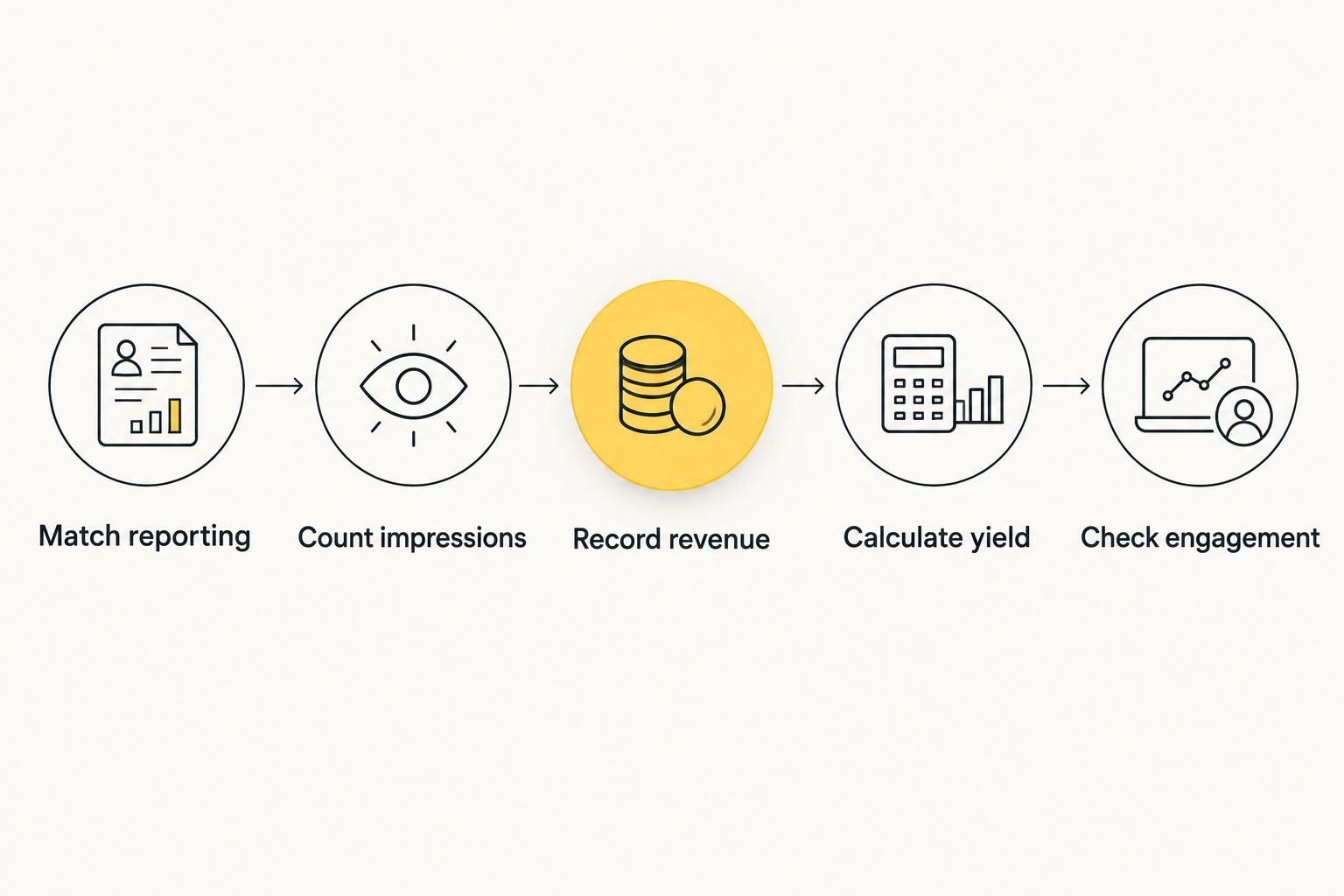
For your 2026 worksheet, retain the raw inputs beside the calculated rates. If a result looks unusual, you can trace it back to impressions, sessions, or revenue instead of guessing which variable moved.
Do not project from your strongest traffic segment across the whole website. Calculate each meaningful segment separately, then add its estimated revenue to the total.
Why pop ad earnings vary
Pop earnings reflect both the traffic you supply and how that traffic turns into monetized impressions. These factors belong in your analysis because they change the inventory advertisers can buy or the revenue you receive from it.
- GEO mix. Keep countries separate when comparing results. Advertisers target GEOs, so a change in country mix changes the inventory being offered.
- Device and browser mix. Segment devices and browsers when your reports support it. Browser behavior and pop delivery are relevant to whether a visit produces an impression.
- Advertiser demand. Buyers choose targeting and bids for their campaigns. Do not assume the same traffic will produce an unchanged rate across reporting periods.
- Traffic quality. Separate genuine audience activity from invalid traffic. Raw traffic counts are not a substitute for valid, monetizable inventory.
- Frequency settings. A cap affects how often visitors are eligible to see a pop. Evaluate the resulting revenue alongside the effect on the visit.
- Placement implementation. Check that the placement works as intended on the pages and devices you are measuring. A delivery problem is different from weak advertiser demand.
Change one controllable variable at a time. If you change frequency, placement, and traffic acquisition together, the revenue result will not tell you which change helped.
Keep a short change log with each test. Record what changed and when, then annotate the corresponding reporting period rather than relying on memory.
What should you compare before choosing a pop network?
Compare the same traffic, not headline rates. A network's rate for a different GEO, device, or audience does not answer what your website will earn.
Use a written evaluation sheet with the same questions for every candidate:
- Which traffic segment does the result describe?
- Does the figure represent publisher revenue or advertiser spending?
- Is the denominator impressions, sessions, or pageviews?
- Were frequency and placement settings comparable?
- Are the reporting periods complete and aligned?
- What happened to total revenue and visitor engagement?
A matched test still needs interpretation. If the audience mix changes between periods, segment the results before declaring a winner. A higher aggregate eCPM can reflect a different mix rather than better monetization of the same traffic.
For a 2026 network decision, choose on observed publisher revenue and site-level results, not the largest advertised rate. Review payment terms and reporting definitions directly before committing; neither a rate screenshot nor an earnings projection establishes those terms.
Where EZmob fits
EZmob pop monetization fits website owners who want to monetize their traffic through pop ads. Its publisher offering also includes push, display, and native formats, but access to multiple formats does not establish which will earn most on your site.
| Publisher format | Best for | Practical benefit | Trade-off to evaluate |
|---|---|---|---|
| Pop | Publishers evaluating a separate-window ad experience | Does not depend on an in-content banner slot | Browser behavior and interruption require attention |
| Push | Publishers evaluating notification-based monetization | Provides a different delivery mechanism from page ads | Permission and delivery requirements differ from pop |
| Display | Publishers with space for banner placements | Keeps the ad within a defined page placement | Placement occupies page space |
| Native | Publishers evaluating content-style ad placements | Supports an in-page advertising presentation | Placement and clear ad identification need attention |
Treat the formats as separate tests, not interchangeable revenue streams. The advantage is the choice of monetization formats; the limitation is that format access alone does not predict earnings.
Will increasing pop frequency increase my earnings?
Increasing pop frequency creates more opportunities to serve ads, but it does not establish that total website earnings will improve. Evaluate the change using publisher revenue, session RPM, and visitor behavior together.
A frequency test needs a clear comparison. Keep the placement and traffic segment stable, record the setting change, and compare complete reporting periods. If the traffic mix changes, review the relevant segments separately.
Watch the denominator as well as the payout. More impressions with lower revenue per impression can produce a different result from fewer impressions with stronger yield. Neither pattern is a verdict until you calculate total revenue.
Avoid treating the most aggressive setting as the default winner. Your goal is monetization that supports the website, not the largest possible impression count.
Can a smaller website earn more per visitor?
A smaller website can have higher revenue per visitor without earning more total revenue. Traffic volume and monetization yield answer different questions.
Use session RPM to compare earnings per 1,000 sessions, then use total revenue to compare income. Keep GEO, device, and reporting period visible so the comparison does not hide a change in audience composition.
Do not scale a forecast solely by multiplying your current sessions. First check whether the additional traffic would resemble the audience that produced your measured yield. A different traffic source needs its own evidence.
How do I know whether pop ads are worth keeping?
Keep pop ads when the measured contribution supports your website's revenue and audience goals. Judge the whole outcome, including other monetization, rather than isolating the pop dashboard.
Write down the decision criteria before testing. Include the revenue measure you want to improve, the visitor-experience signals you will monitor, and the implementation conditions you will keep unchanged.
Your 2026 review should distinguish a technical failure from a commercial result. If impressions stop recording, investigate delivery first; if delivery remains consistent but yield changes, examine the traffic segments and revenue data.
A documented decision is easier to repeat. Retain the result even when you remove the placement, so the next test starts from evidence rather than another headline earnings claim.
FAQ
How much do publishers earn from pop ads per 1,000 views?
Publisher eCPM measures pop earnings per 1,000 ad impressions, not per 1,000 website views. Calculate it by dividing publisher revenue by counted ad impressions and multiplying by 1,000.
Can I estimate pop earnings from my monthly visitors?
Visitor counts alone are not enough to estimate pop earnings. You also need evidence of how your visits translate into monetized impressions and what those impressions earn.
Is an advertiser’s CPM the same as my publisher payout?
An advertiser’s CPM is not your publisher payout. Use the revenue reported to your publisher account rather than substituting a buyer’s bid or campaign spending figure.
Are popunder ads guaranteed to earn more than banners?
Popunder ads are not guaranteed to earn more than banners. Compare the formats on your own traffic using total publisher revenue, session RPM, and visitor-experience measures.
Does EZmob let website owners monetize with pop ads?
EZmob lets website owners monetize traffic with pop ads. Its publisher formats also include push, display, and native; actual earnings need to be evaluated using your publisher results.
Should I increase pop frequency if my revenue is low?
Do not increase frequency solely because revenue is low. Check placement delivery, traffic composition, and revenue per session first, then test the frequency change separately.
Which metric should I use to compare pop monetization tests?
Use session RPM alongside publisher eCPM and total revenue. Session RPM includes visits that produced no pop impression, while eCPM describes revenue from counted ad impressions.
One last thing
A rising eCPM can accompany falling total revenue. The rate describes earnings per impression; it does not tell you how many impressions your traffic produced. Always read the rate beside its denominator.
Before your next placement change, save a baseline containing sessions, pop impressions, publisher revenue, and frequency settings. That small record makes the next earnings comparison useful.
Related guides
- How much traffic do you need to monetize a website?
- How long does publisher approval take on an ad network?
- Ad monetization for streaming website owners
Monetize your traffic with EZmob.